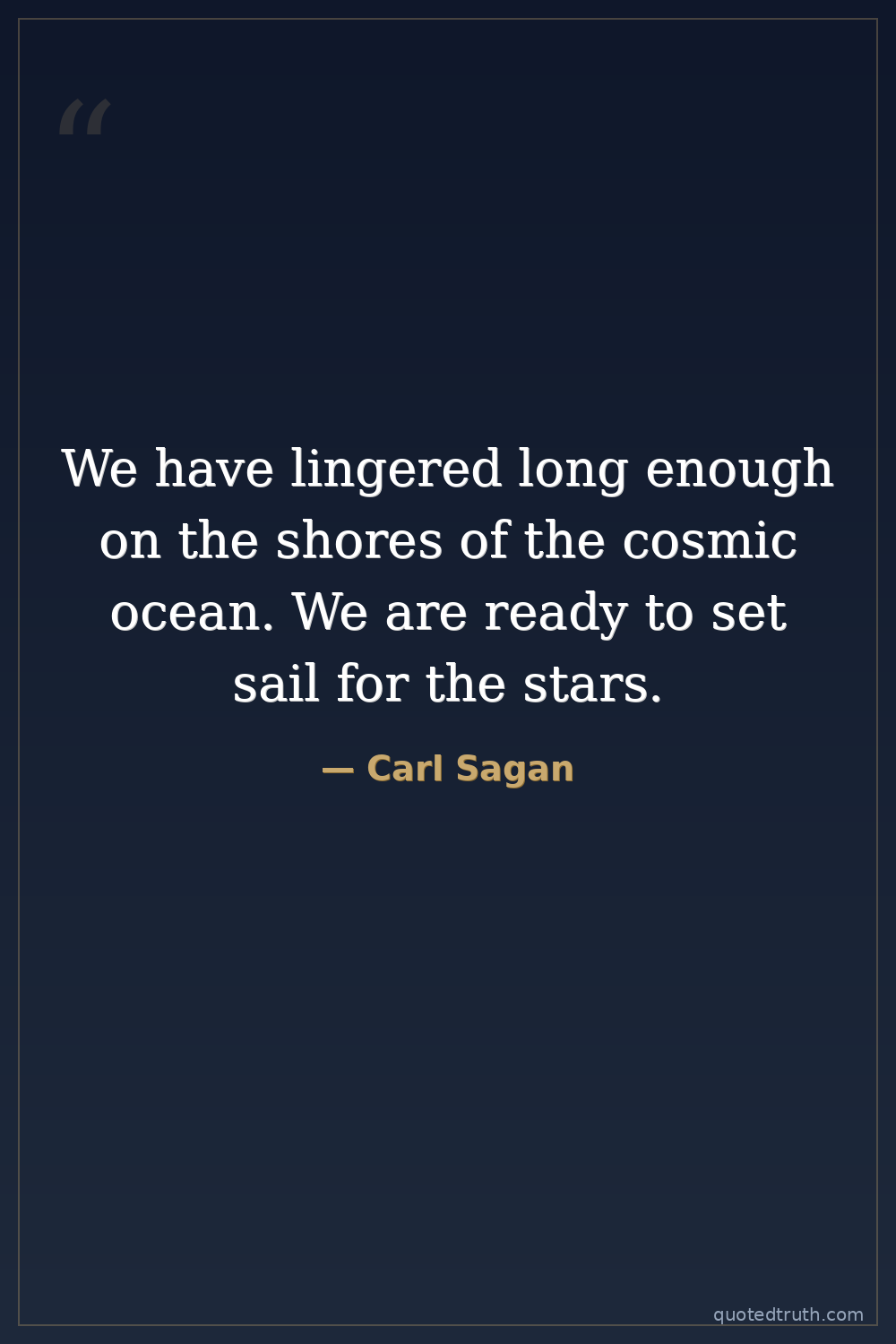
Carl Sagan — "We have lingered long enough on the shores of the cosmic ocean. We are ready to …"
We have lingered long enough on the shores of the cosmic ocean. We are ready to set sail for the stars.
We have lingered long enough on the shores of the cosmic ocean. We are ready to set sail for the stars.
Click any product to generate a realistic preview. Up to 3 at a time.
* Initial load can take up to 90 seconds — revising the preview in another color is nearly instant.
"...that it is better to understand the universe as it is than to pretend that it is something it is not."
"The brain is a very big place in a very small space."
"If we are to survive, we must look to the stars."
"The cosmos is all that is or ever was or ever will be. Our feeblest contemplations of the Cosmos stir up a tingling sensation, a slight challenge for the nerves, a faint foreboding, as if we were appr…"
"We are the local embodiment of a cosmos grown to self-awareness."
Found in 1 providers: grok
1 source checked
Humanity has spent millennia simply watching the cosmos from Earth, accumulating knowledge without venturing into it. Now the technology, understanding, and will exist to move from observation to action — to physically travel beyond our planet into the wider universe. The ocean-voyage metaphor invokes the great age of exploration, framing space travel as humanity's next defining chapter of discovery and expansion rather than distant dreaming.
Sagan spent his career bridging astronomy and public imagination — hosting Cosmos (1980), advising NASA on Voyager's Golden Record, and championing SETI. He believed interstellar exploration was humanity's evolutionary imperative. The ocean metaphor recurs throughout his writing; he saw Earth as a fragile pale blue dot, a mere shore. This quote encapsulates his conviction that curiosity defines us and that remaining earthbound indefinitely risked both stagnation and extinction.
The quote appeared in Cosmos (1980), as NASA faced a pivotal transition. The Apollo moon landings had ended in 1972; the Space Shuttle was just launching. Voyager 1 and 2 had recently completed breathtaking flybys of Jupiter and Saturn. Cold War rivalry still shadowed space policy, while public enthusiasm had cooled post-Apollo. Sagan used Cosmos to reignite that enthusiasm and argue for bolder, sustained investment in exploration.
AI-generated insights based on extensive research and information for context. Factual errors? Email [email protected].
Your cart is empty