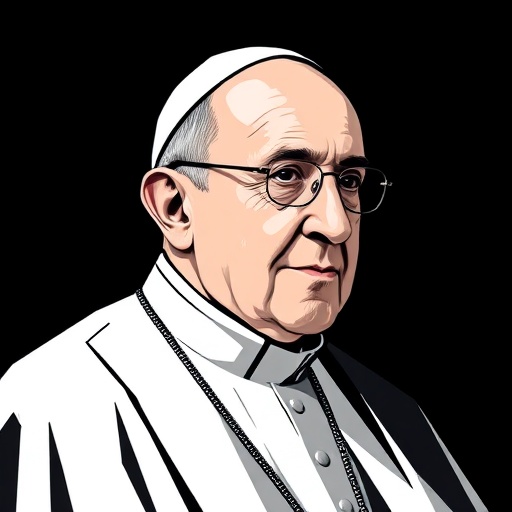
Pope Francis — "We have to state, without mincing words, that there is an inseparable bond betwe…"
We have to state, without mincing words, that there is an inseparable bond between our faith and the poor.
We have to state, without mincing words, that there is an inseparable bond between our faith and the poor.
Click any product to generate a realistic preview. Up to 3 at a time.
* Initial load can take up to 90 seconds — revising the preview in another color is nearly instant.
"A world without women would be a sterile world."
"Rigidity is not of God."
"The powerful of the earth, when they do not want to see problems, they cover them up. They hide them."
"The true power is service."
"Women must be valued, not exploited."
First Latin American and Jesuit pope (2013-), who has steered the Catholic Church toward pastoral inclusion on LGBTQ pastoral care, divorced Catholics, and climate. Closely associated with Pope John XXIII (the Vatican II reformer pope) and Cardinal Walter Kasper (his theological ally on pastoral reform). For an intellectual contrast, see Cardinal Raymond Burke, American traditionalist cardinal, former head of the Vatican Apostolic Signatura — Burke is the public face of Catholic traditionalism that views Francis's pastoral approach as doctrinally dangerous — he has formally challenged Amoris Laetitia and other Francis reforms.
Found in 1 providers: deepseek
1 source checked
Genuine Christian faith cannot be separated from concern for the poor — it is non-negotiable, not optional charity. The blunt phrasing signals this is beyond debate. If your faith doesn't move you toward the marginalized, something is wrong with your faith. Poverty and spirituality are intertwined, not parallel tracks. Caring for the impoverished isn't a social program attached to religion; it is what religion, at its core, demands.
Jorge Mario Bergoglio grew up in working-class Buenos Aires and, as Archbishop, rode public buses and cooked his own meals rather than use the palace. He chose the name Francis after the saint of poverty. His landmark document Evangelii Gaudium (2013) placed the poor at the Gospel's center. He washed prisoners' feet, visited refugee camps, and publicly criticized trickle-down economics — consistent, personal actions that back this precise conviction.
Francis became pope in 2013 amid surging post-2008 global inequality, European austerity cuts, and a growing refugee crisis. Liberation theology — which centers the poor in Christian teaching — had been suppressed under predecessors John Paul II and Benedict XVI. His papacy revived that tradition as wealth gaps widened dramatically, capitalism's moral limits were debated openly, and millions of displaced people tested wealthy nations' political will.
AI-generated insights based on extensive research and information for context. Factual errors? Email [email protected].
Your cart is empty