Robert Oppenheimer — "We may be likened to two scorpions in a bottle, each capable of killing the othe…"
We may be likened to two scorpions in a bottle, each capable of killing the other, but only at the risk of his own life.
We may be likened to two scorpions in a bottle, each capable of killing the other, but only at the risk of his own life.
Click any product to generate a realistic preview. Up to 3 at a time.
* Initial load can take up to 90 seconds — revising the preview in another color is nearly instant.
"I believe that in the long run, the only way we can survive is to make the world safe for peace."
"We have made a thing, a most terrible weapon, that has altered the nature of the world and of man."
"It is a profound and necessary truth that the deep things in science are not found because they are useful; they are found because it was possible to find them."
"Both the man of science and the man of action live always at the edge of mystery, surrounded by it."
"I think that we have made a very dangerous discovery, and that we have a very great responsibility."
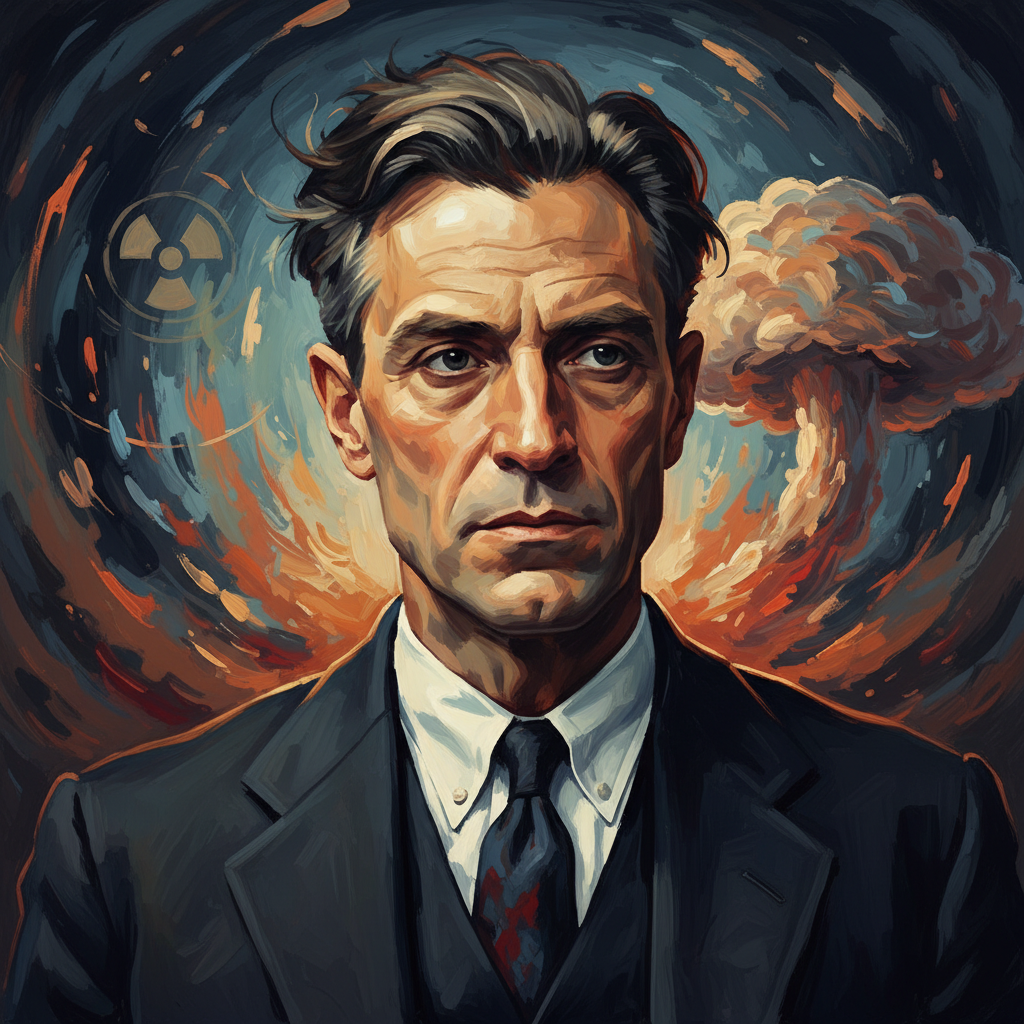
American theoretical physicist who directed the Manhattan Project's Los Alamos Laboratory and oversaw the atomic bombs; lost his security clearance in 1954. Closely associated with Niels Bohr (Manhattan Project consultant and atomic-policy advisor) and Hans Bethe (Los Alamos theoretical-division chief). For an intellectual contrast, see Edward Teller, Hungarian-American physicist and 'father of the H-bomb' — Teller pushed the H-bomb against Oppenheimer's objections and testified against him at his 1954 security hearing — the precise moment that ended Oppenheimer's career. The canonical 'physicist-of-conscience vs physicist-of-state' pairing in nuclear-age ethics; Christopher Nolan's Oppenheimer (2023) dramatized this rivalry for a mass audience.
Found in 1 providers: gemini
1 source checked
Two parties each hold the power to destroy the other, but using that power guarantees their own destruction. It captures the paradox of nuclear deterrence—power so absolute it becomes self-defeating. True security rests not on military strength alone, but on the mutual certainty that aggression leads to shared annihilation. Neither side can strike first and survive intact, making the weapons themselves a grim guarantor of uneasy peace.
Oppenheimer led the Manhattan Project, creating the atomic bombs dropped on Hiroshima and Nagasaki. He later became a vocal advocate for international arms control, haunted by what he'd helped unleash. This 1953 quote reflects his role as both architect and critic of the nuclear age. His opposition to the hydrogen bomb and push for Soviet transparency ultimately cost him his security clearance in 1954, confirming his genuine moral conflict.
By 1953, both the US and Soviet Union had tested hydrogen bombs, escalating Cold War tensions to existential stakes. Mutually assured destruction wasn't yet official doctrine, but the terrifying logic was crystallizing. Stalin had just died, the Korean War was ending, and both superpowers raced to expand nuclear arsenals. Oppenheimer's scorpion metaphor gave the public a visceral framework for understanding why more weapons no longer meant more safety.
AI-generated insights based on extensive research and information for context. Factual errors? Email [email protected].
Your cart is empty