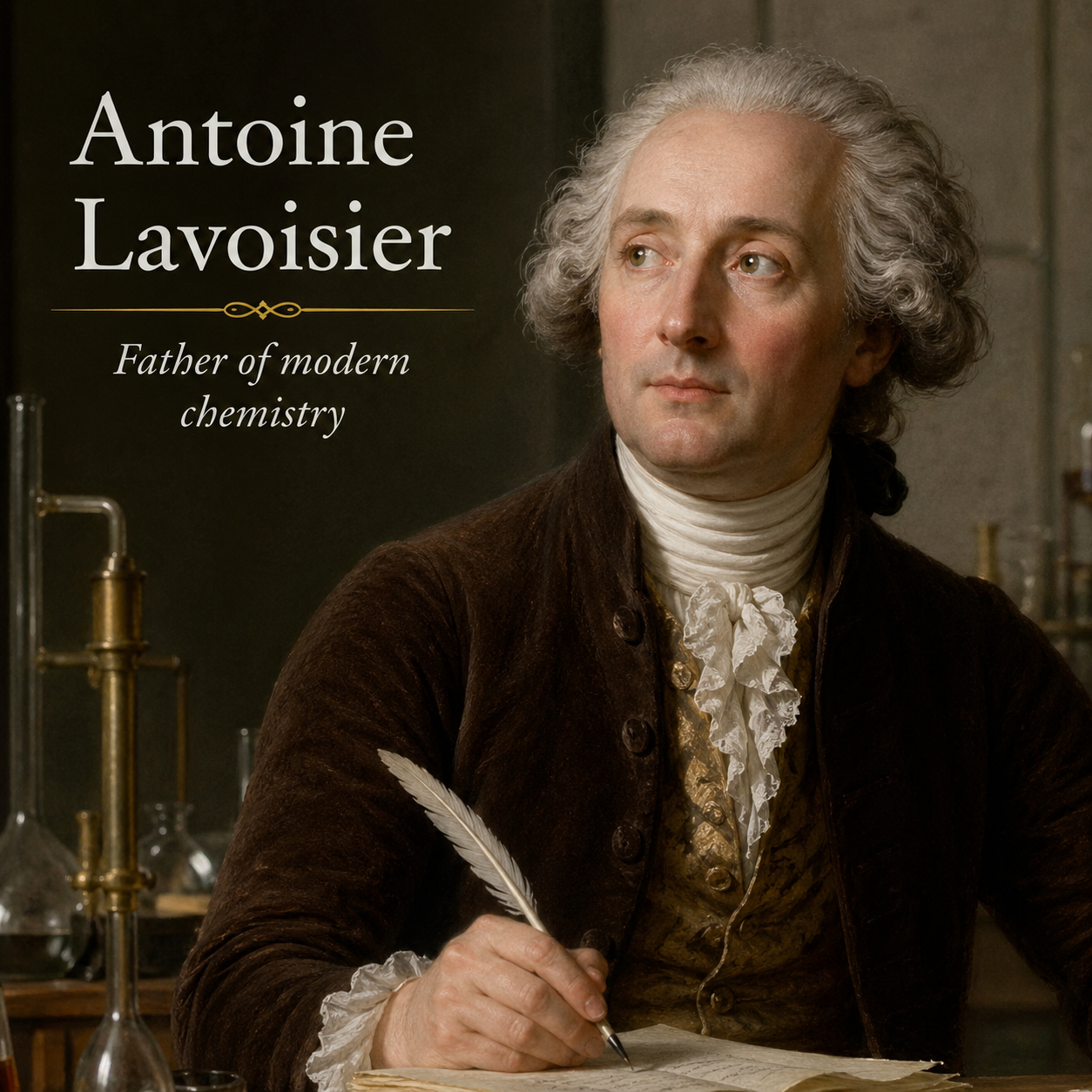
Antoine Lavoisier — "We must trust to nothing but facts, for we are to have no other guide."
We must trust to nothing but facts, for we are to have no other guide.
We must trust to nothing but facts, for we are to have no other guide.
Click any product to generate a realistic preview. Up to 3 at a time.
* Initial load can take up to 90 seconds — revising the preview in another color is nearly instant.
"I have been so lucky in life, that I have had nothing to do but to collect the fruits of the labours of others."
"The value of a discovery consists not in its novelty, but in its truth."
"It is not enough to observe; one must make experiments."
"I have endeavored to make chemistry a science of reasoning, and not of memory."
"I have lived long enough to be certain that the world will not be ready for my discoveries until at least a hundred years after my death."
Found in 1 providers: grok
1 source checked
Empirical evidence—observable, measurable facts—must be the sole foundation of knowledge. Personal opinion, tradition, and untested theory cannot reliably guide us. Truth emerges only from what can be observed and verified. Don't trust assumptions, anecdotes, or authority; test claims against reality. The only legitimate basis for any conclusion is what the evidence actually shows, nothing more and nothing less.
Lavoisier dismantled the centuries-old phlogiston theory by meticulously weighing substances before and after combustion, proving oxygen's role in burning and respiration. He insisted on precise measurement over inherited doctrine. His landmark Traité Élémentaire de Chimie (1789) organized chemistry around verified facts rather than speculation, and he standardized chemical nomenclature so findings could be communicated with exactness. Evidence, not authority, was his constant method.
The late 18th century Enlightenment saw thinkers across Europe challenge religious authority and inherited dogma in favor of reason and observation. In chemistry, alchemical traditions and phlogiston theory still dominated educated circles. Lavoisier's era witnessed the formalization of the scientific method—systematic experimentation, quantitative measurement, and published proof replacing speculation. The French Revolution simultaneously challenged political authority; Lavoisier challenged intellectual authority through the same uncompromising empirical spirit.
AI-generated insights based on extensive research and information for context. Factual errors? Email [email protected].
Your cart is empty