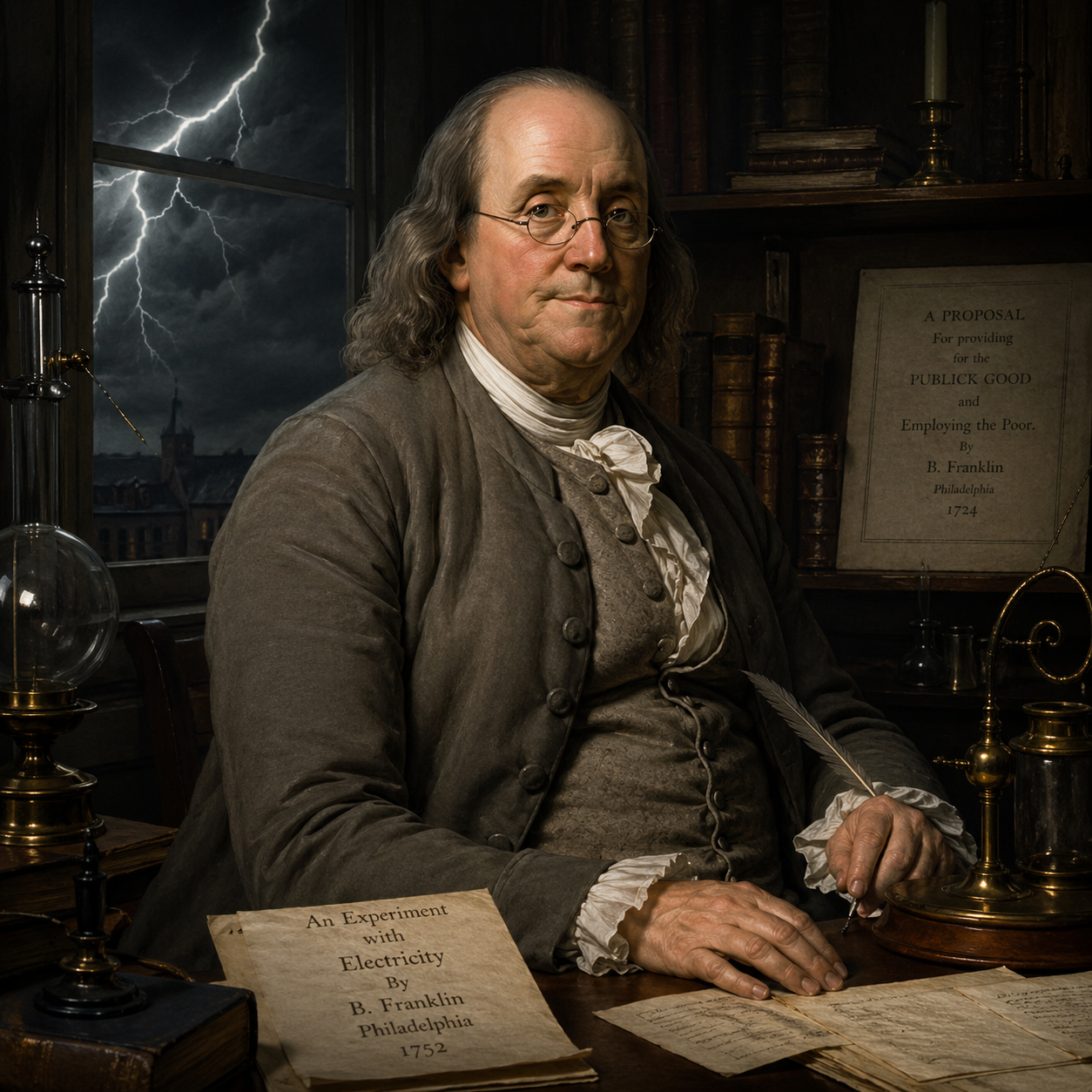
Benjamin Franklin — "Well done is better than well said."
Well done is better than well said.
Well done is better than well said.
Click any product to generate a realistic preview. Up to 3 at a time.
* Initial load can take up to 90 seconds — revising the preview in another color is nearly instant.
"The working man is fit and fed, and stabs the sluggard in his bed."
"Search others for their virtues, thy self for thy vices."
"Save a penny every year and you shall die a millionaire."
"What is wit, or wealth, or form, or learning, when compared with virtue?"
"A good example is the best sermon."
Polymath Founding Father, diplomat, and Poor Richard's Almanack author who helped draft the Declaration of Independence and the Constitution. Closely associated with John Adams (fellow Founder, Massachusetts statesman) and Thomas Jefferson (fellow Declaration drafter). For an intellectual contrast, see Thomas Hutchinson, last royal governor of colonial Massachusetts — Franklin leaked Hutchinson's loyalist correspondence to Boston in 1772 to inflame revolutionary sentiment — Hutchinson represented the colonial-aristocrat crown-loyalty that Franklin's revolution was organized to dismantle.
Found in 3 providers: deepseek,grok,gemini
3 sources checked
Actions matter more than words. Whatever you actually accomplish is worth more than whatever you promise or proclaim. Talking skillfully about a task — however eloquently — doesn't substitute for completing it with quality. Results are the true measure of a person, not reputation built on speech. Stop announcing what you plan to do and focus instead on delivering something real and well-executed.
Franklin lived this maxim completely. A self-taught printer turned publisher, he didn't theorize — he ran lightning experiments proving electricity's nature, invented bifocals and the lightning rod, founded Philadelphia's first lending library and fire company, and negotiated the French alliance that saved the Revolution. His Poor Richard's Almanack repeatedly championed practical industry over boastful talk, reflecting his lifelong devotion to useful work over mere reputation.
Colonial America was saturated with political pamphlets, sermons, and oratory — the printing press had made bold proclamations cheap. Yet colonial survival demanded real competence in farming, construction, and trade. Franklin wrote during an era when the rhetorical class often promised but under-delivered, and the Age of Reason prized empirical results over inherited authority, making this a direct rebuke to Europe's aristocratic tradition of deriving status through lineage and eloquence rather than honest labor.
AI-generated insights based on extensive research and information for context. Factual errors? Email [email protected].
Your cart is empty