Isaac Newton — "What goes up must come down."
What goes up must come down.
What goes up must come down.
Click any product to generate a realistic preview. Up to 3 at a time.
* Initial load can take up to 90 seconds — revising the preview in another color is nearly instant.
"I can calculate the motion of heavenly bodies, but not the madness of people."
"I build my philosophy upon the shoulders of giants."
"Every body continues in its state of rest, or of uniform motion in a right line, unless it is compelled to change that state by forces impressed upon it."
"As a blind man has no idea of colours, so have we no idea of the manner by which the all-wise God perceives and understands all things."
"It is possible that gravity may be essential to matter."
A popular simplification of his law of universal gravitation, not a direct quote from his writings in this exact phrasing.
Date: N/A
GeneralFound in 1 providers: grok
1 source checked
This saying expresses the universal principle that gravity pulls everything earthward — anything launched upward will inevitably return. It captures the intuitive truth that upward momentum is temporary while gravity is constant and inescapable. In modern terms it describes projectile motion: no matter how forcefully something is thrown skyward, Earth's gravitational pull continuously decelerates it until it reverses course. It also works as a metaphor for ambition and fortune — nothing rises without eventually falling.
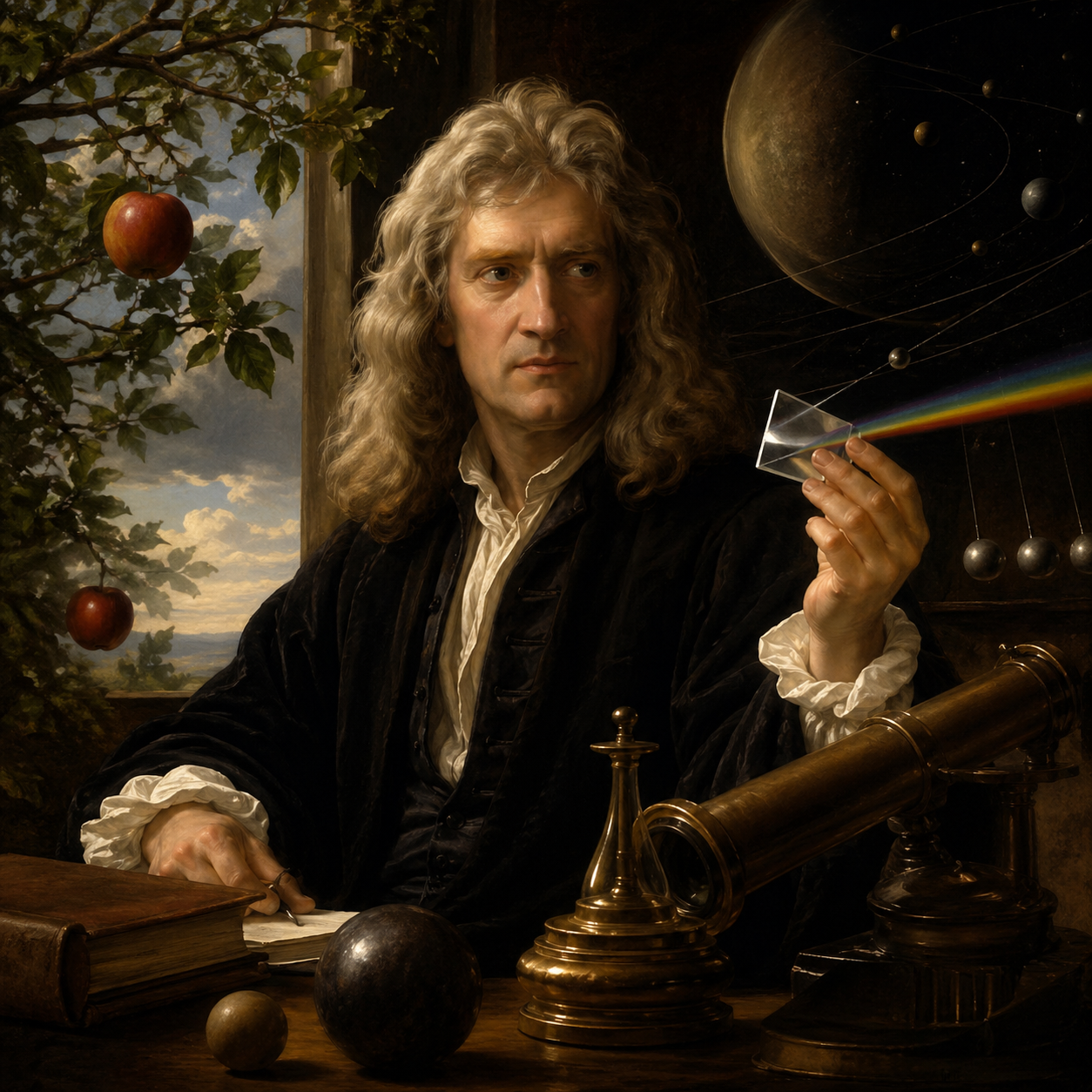
Newton formalized gravitational laws after, legend holds, observing a falling apple at Woolsthorpe Manor around 1666. His Principia Mathematica (1687) mathematically quantified why projectiles follow parabolic arcs and return to Earth. Ironically, his equations also revealed escape velocity — the threshold at which objects permanently leave Earth's pull — showing the saying has limits. Still, this simple observation of falling bodies was the seed of his universal law of gravitation, his most transformative contribution to science.
In 17th-century Europe, natural philosophy was dismantling Aristotelian physics, which held that earthly and celestial motion obeyed entirely separate rules. Galileo's experiments and Kepler's planetary laws had fractured the old framework. Newton's era demanded mathematical, empirical explanations for nature. Unifying terrestrial falling bodies with planetary orbits under one gravitational law was genuinely radical — the claim that a cannonball and the Moon obey identical mathematics challenged scholastic tradition and helped define the Scientific Revolution's core ambition.
AI-generated insights based on extensive research and information for context. Factual errors? Email [email protected].
Your cart is empty