Soren Kierkegaard — "What if everything in the world were a misunderstanding, what if laughter were r…"
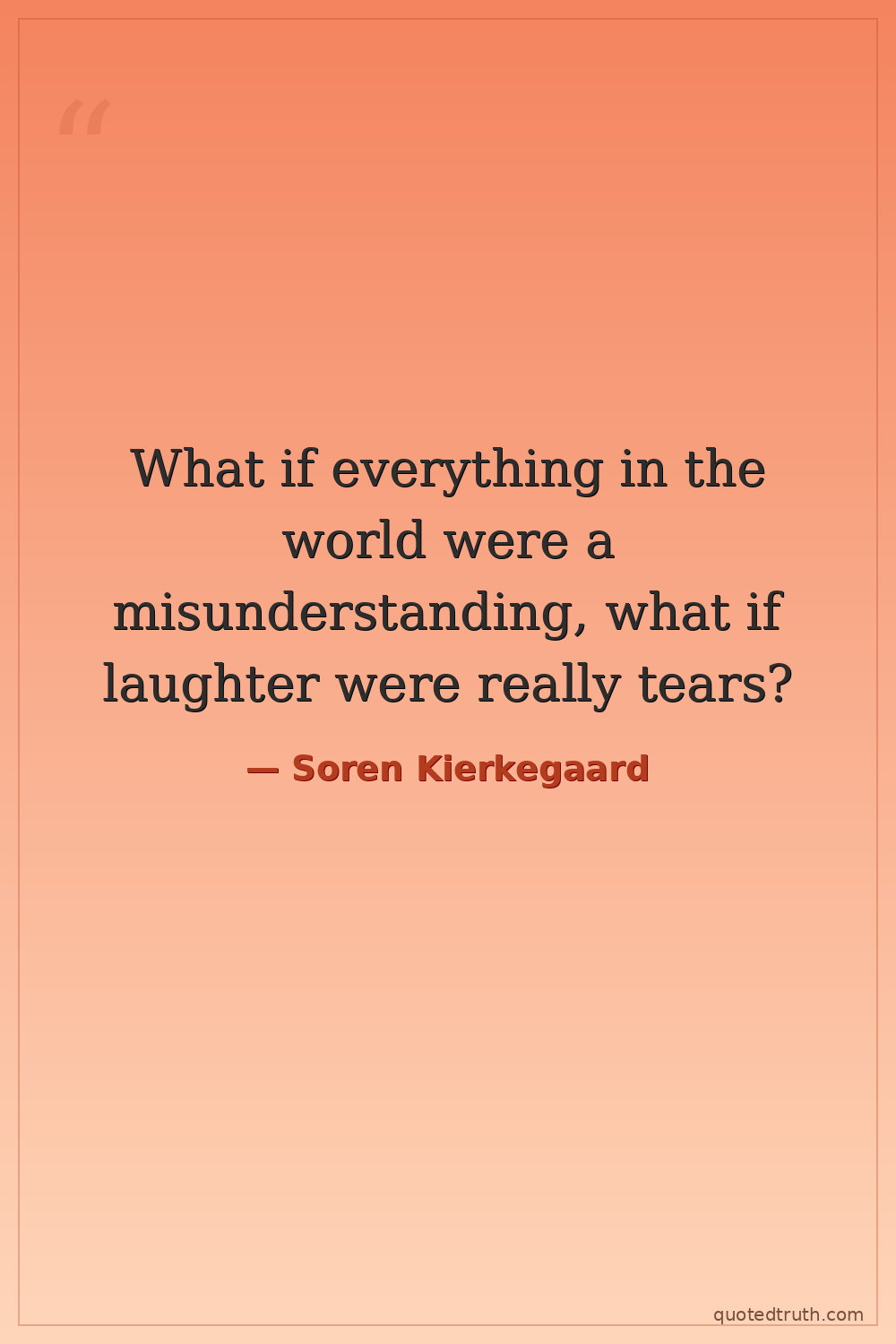
What if everything in the world were a misunderstanding, what if laughter were really tears?
What if everything in the world were a misunderstanding, what if laughter were really tears?
Click any product to generate a realistic preview. Up to 3 at a time.
* Initial load can take up to 90 seconds — revising the preview in another color is nearly instant.
"The more one thinks, the more one is confused."
"The knight of faith is the only happy man, the heir of the finite, whereas the knight of infinite resignation is a stranger and a sojourner."
"It is not the path I have chosen, but the path I am choosing."
"The greatest thing is to be able to do nothing."
"Faith is the highest passion in a human being."
Danish philosopher and theologian considered the founder of existentialism; Either/Or (1843) and Fear and Trembling (1843) explored the leap of faith. Closely associated with Friedrich Nietzsche (his existentialist successor working in the opposite theological direction) and Fyodor Dostoevsky (literary parallel exploring faith-and-despair). For an intellectual contrast, see G.W.F. Hegel, German Idealist of the totalizing system — Kierkegaard called Hegel's system a 'palatial residence' that nobody could actually live in — his entire authorship is structured against Hegelian abstraction in favor of the existing individual's inwardness.
The standard scholarly entry points to Soren Kierkegaard's work: Joakim Garff (University of Copenhagen, Søren Kierkegaard Research Centre) — Søren Kierkegaard: A Biography (2000); Walter Lowrie (Princeton, his major postwar English translator) — A Short Life of Kierkegaard (1942); C. Stephen Evans (Baylor University, philosophy of religion) — Kierkegaard: An Introduction (2009). These are the works graduate seminars cite when teaching Soren Kierkegaard.
Your cart is empty