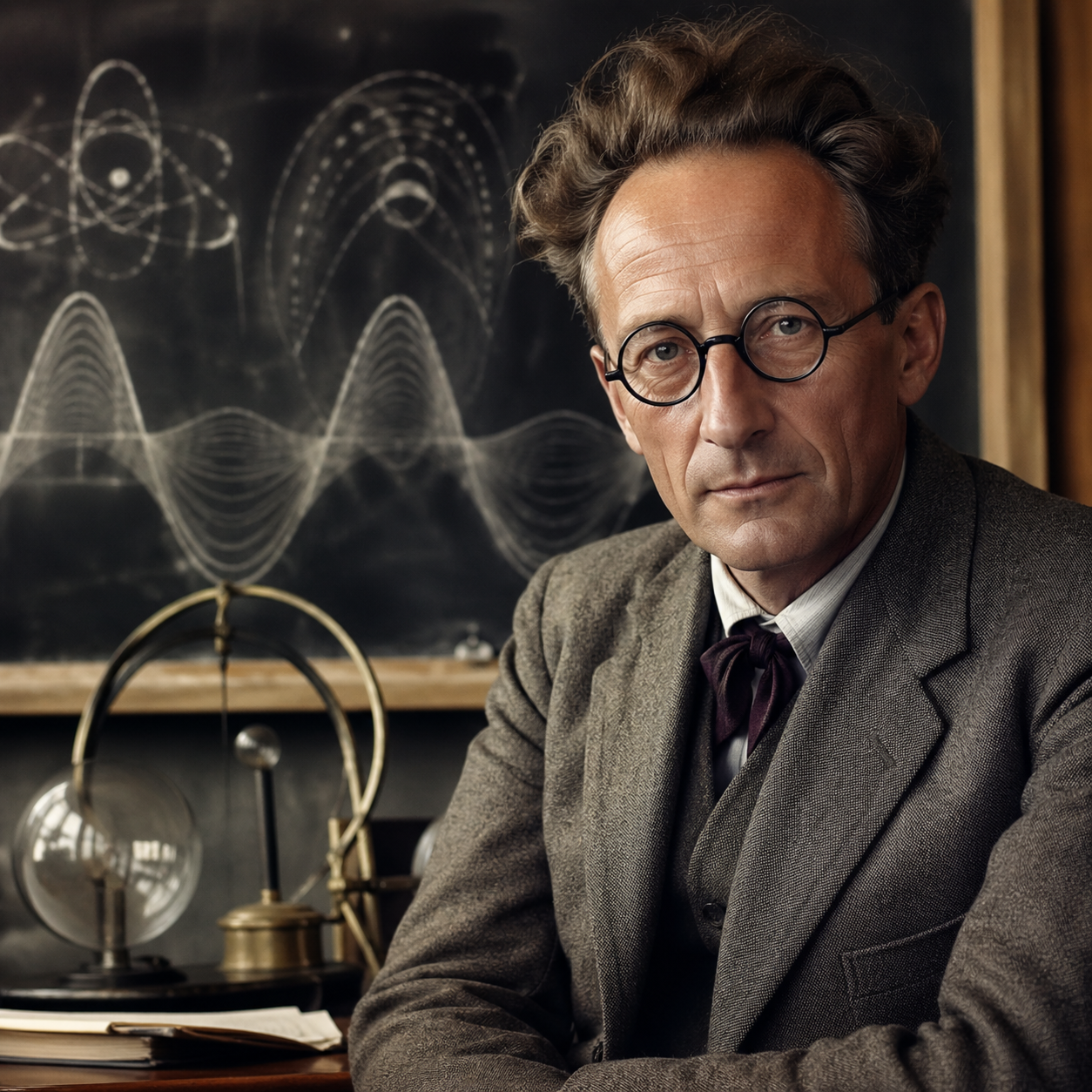
Erwin Schrodinger — "What is life? The answer to this question is not what one expects."
What is life? The answer to this question is not what one expects.
What is life? The answer to this question is not what one expects.
Click any product to generate a realistic preview. Up to 3 at a time.
* Initial load can take up to 90 seconds — revising the preview in another color is nearly instant.
"The idea that there is a 'mind' or 'consciousness' that is separate from the physical world is a delusion. It is a product of our language and our limited way of thinking."
"The task is not so much to see what no one has yet seen; but to think what nobody has yet thought, about that which everybody sees."
"The present is the only thing that has no end."
"I am no friend of probability theory, I have hated it from the first moment when our dear friend Max Born gave it birth."
"The fact that the world is in a constant state of flux is the very reason why it can be understood."
Austrian physicist who shared the 1933 Nobel for the wave equation that bears his name and the famous cat thought-experiment. Closely associated with Werner Heisenberg (matrix-mechanics rival who reached the same physics by different math) and Albert Einstein (his pen-pal on quantum interpretation). For an intellectual contrast, see Niels Bohr, Danish physicist and architect of the Copenhagen interpretation — Schrödinger's cat thought-experiment was specifically designed to ridicule Bohr's 'observer-dependent reality' reading of quantum mechanics — Schrödinger thought the Copenhagen interpretation was absurd; the cat was meant as reductio ad absurdum.
Found in 1 providers: grok
1 source checked
Life defies the simple, mechanical answers we instinctively reach for. When you investigate it rigorously, you find something stranger and more profound than common sense predicts — order emerging from chaos, complexity arising from chemistry, consciousness from matter. The honest answer unsettles comfortable assumptions and demands an entirely different framework of thinking than everyday experience provides.
Schrödinger literally wrote a 1944 book called 'What Is Life?' that pioneered applying quantum physics to biology — directly inspiring Watson and Crick's DNA discovery. A physicist explaining heredity and cellular order through thermodynamics and quantum mechanics was itself unexpected. His wave equation redefined how particles behave, training him to expect that deep questions yield counterintuitive, mathematically strange answers.
In the 1940s, biology and physics were separate disciplines. The structure of DNA was unknown, quantum mechanics was still shocking mainstream science, and the idea that a physicist could explain living organisms through entropy and atomic order was radical. Post-WWII science was expanding its ambitions — Schrödinger's cross-disciplinary leap reflected an era questioning the boundaries of what each science could claim to explain.
AI-generated insights based on extensive research and information for context. Factual errors? Email [email protected].
Your cart is empty