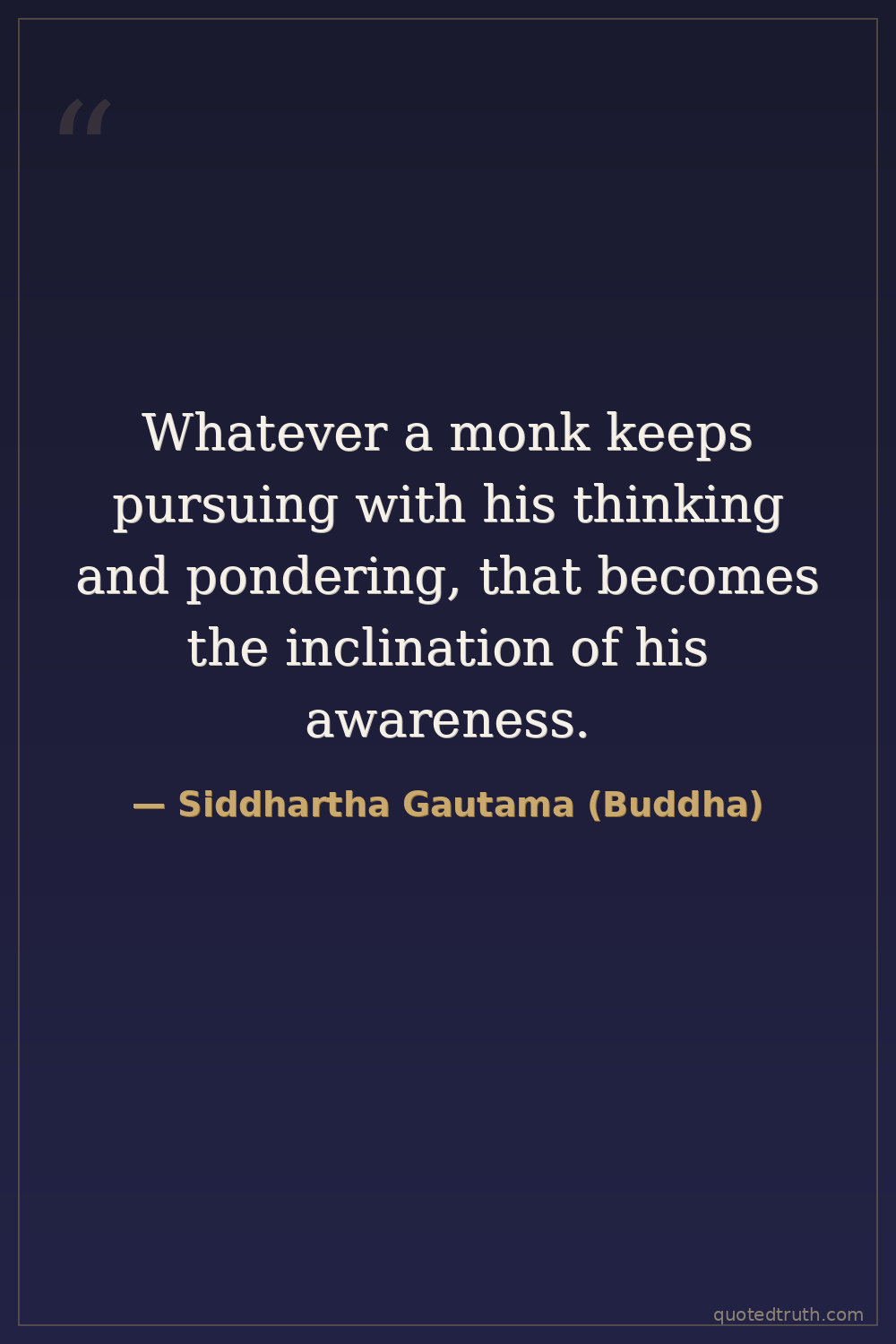
Siddhartha Gautama (Buddha) — "Whatever a monk keeps pursuing with his thinking and pondering, that becomes the…"
Whatever a monk keeps pursuing with his thinking and pondering, that becomes the inclination of his awareness.
Whatever a monk keeps pursuing with his thinking and pondering, that becomes the inclination of his awareness.
Click any product to generate a realistic preview. Up to 3 at a time.
* Initial load can take up to 90 seconds — revising the preview in another color is nearly instant.
"Just as a solid rock is not shaken by the storm, even so the wise are not affected by praise or blame."
"One who acts on truth is happy in this world and beyond."
"Where self is, truth is not. Where truth is, self is not."
"The greatest gift is to give people your enlightenment, to share it. It has to be the greatest."
"The greatest prayer is patience."
From the Majjhima Nikaya, a teaching on the power of focus
Date: c. 5th-6th Century BCE
PhilosophicalFound in 1 providers: gemini
1 source checked
What you repeatedly think about shapes who you become. The mind bends toward whatever occupies it most often, so dwelling on anger makes you angry, dwelling on kindness makes you kind. Your habitual thoughts are not neutral observations passing through; they carve grooves in your character. Over time, the topics you return to in private become the default settings of your attention, your reactions, and ultimately your identity.
The Buddha built his entire path around training the mind, having spent six years as a wandering ascetic observing how thought patterns trap people in suffering. After his awakening under the Bodhi tree around 528 BCE, he taught Right Mindfulness and Right Effort as core parts of the Eightfold Path. This saying reflects his practical psychology: liberation begins not with belief but with noticing and redirecting what the mind habitually chews on.
In 5th-century BCE northern India, the Shramana movement was challenging Vedic ritualism, and wandering monks debated how to escape the cycle of rebirth. Most schools emphasized extreme asceticism or elaborate sacrifices. The Buddha's focus on mental cultivation as the engine of transformation was radical: liberation came through disciplined attention, not caste, priests, or self-torture. Urbanizing kingdoms like Magadha produced a literate merchant class hungry for exactly this kind of interior, do-it-yourself spiritual technology.
AI-generated insights based on extensive research and information for context. Factual errors? Email [email protected].
Your cart is empty