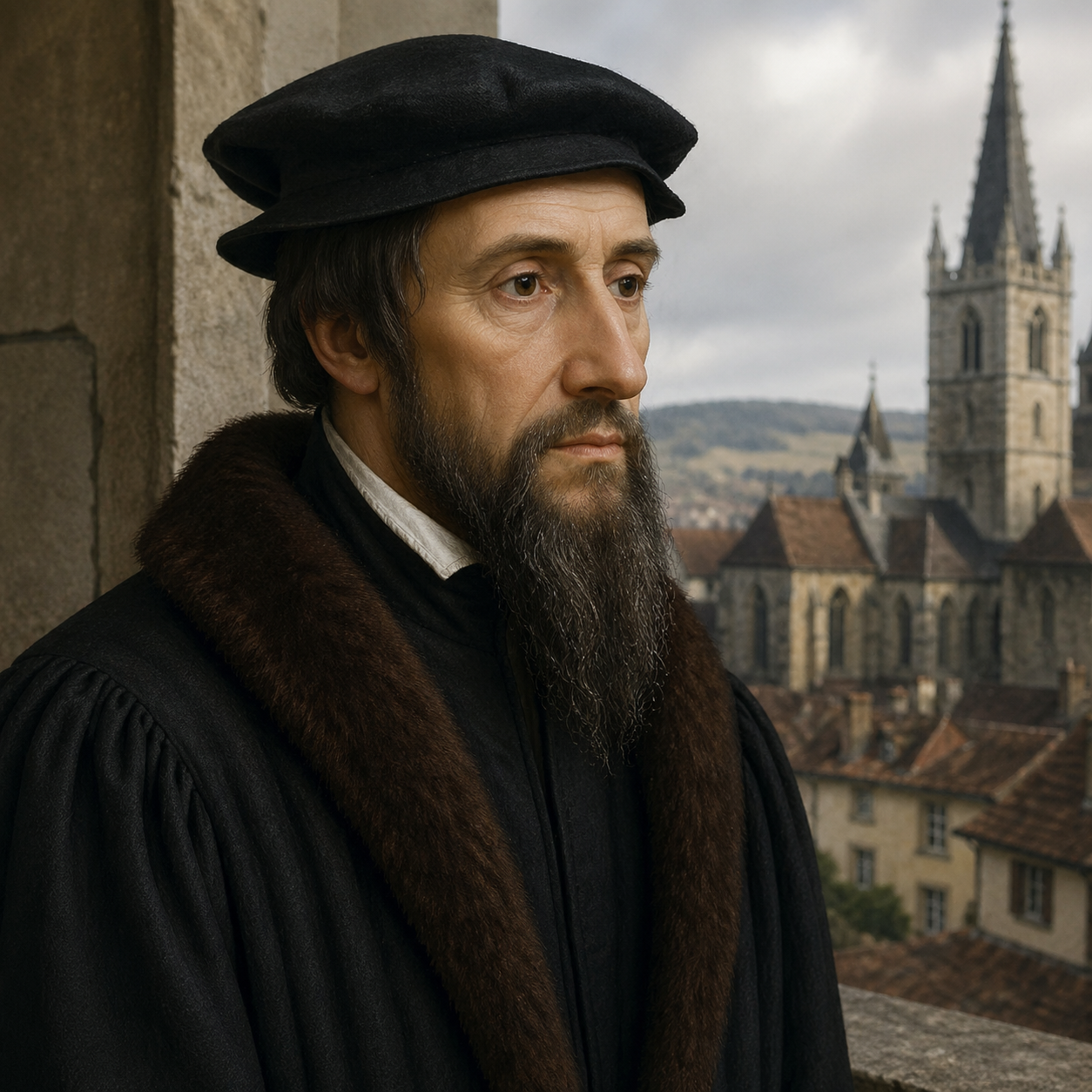
John Calvin — "When God chooses a man, he does not consider what he is, but what he will make h…"
When God chooses a man, he does not consider what he is, but what he will make him.
When God chooses a man, he does not consider what he is, but what he will make him.
Click any product to generate a realistic preview. Up to 3 at a time.
* Initial load can take up to 90 seconds — revising the preview in another color is nearly instant.
"God's love is the fountain of all our blessings."
"The Word of God is the scepter by which he governs his church."
"Therefore, the bondage of the will to sin remains and yet such slavery is a voluntary and willful captivity."
"For the mind of man is so entirely alienated from the righteousness of God that it can neither conceive, desire, nor design anything but what is vicious, perverted, impure, and iniquitous."
"God uses wicked men as his instruments to execute his judgments."
French theologian whose Institutes of the Christian Religion (1536) systematized Protestant Reformed doctrine, including predestination. Closely associated with Martin Luther (Reformation founder, Calvin's predecessor). For an intellectual contrast, see Jacobus Arminius, Dutch Reformed theologian (1560-1609) — Arminius's rejection of strict double-predestination founded Arminianism — the theological tradition modern Methodism, most evangelicalism, and Pentecostalism descend from. The Calvinist-Arminian debate has divided Protestantism for 400 years.
Found in 1 providers: grok
1 source checked
God's selection of people has nothing to do with their current moral record, social standing, or personal achievement. The choice is forward-looking: it concerns the person God will sculpt them into, not what they are at the moment of calling. Human unworthiness is irrelevant to divine purpose. Election is an act of transformation, not recognition — God doesn't find qualified people; he qualifies the people he chooses.
Calvin's Institutes of the Christian Religion argued that God's election is unconditional — never based on foreseen faith or moral merit. Calvin himself was a French lawyer with no intention of leading a reformation until Guillaume Farel pressured him into staying in Geneva. He saw his own transformation into Protestantism's chief systematizer as living proof: God took a reluctant legal scholar and forged a theologian. The quote reflects his life as evidence of the doctrine.
The Reformation erupted partly because the Catholic Church sold indulgences — the idea that merit, money, and works could purchase salvation. Luther cracked the door; Calvin kicked it open theologically. In the 1500s, Europe was fracturing along religious lines into conflicts that would kill millions. The question of who God saves — and on what basis — wasn't abstract: it determined your church, your ruler's allegiance, and sometimes your execution.
AI-generated insights based on extensive research and information for context. Factual errors? Email [email protected].
Your cart is empty