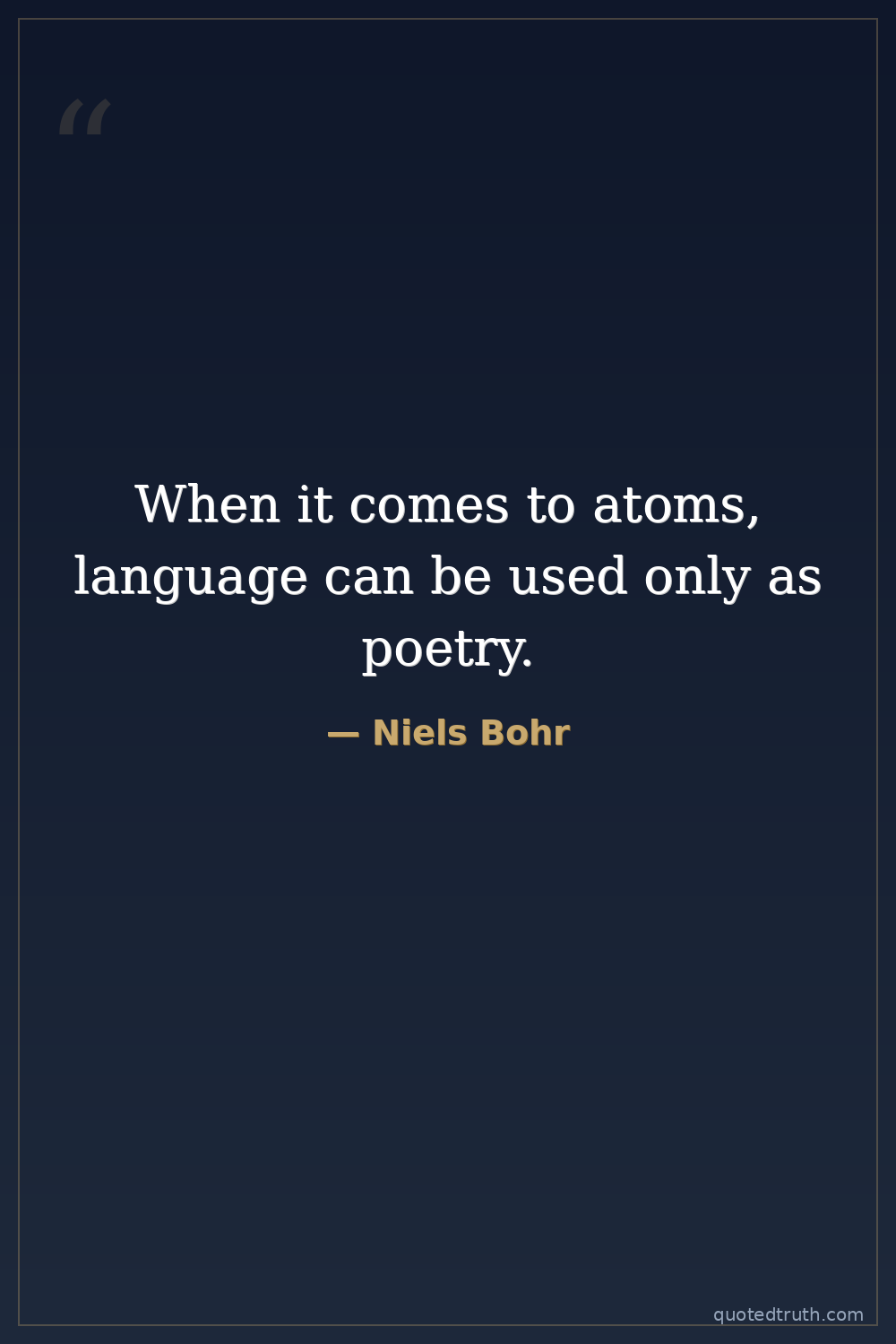
Niels Bohr — "When it comes to atoms, language can be used only as poetry."
When it comes to atoms, language can be used only as poetry.
When it comes to atoms, language can be used only as poetry.
Click any product to generate a realistic preview. Up to 3 at a time.
* Initial load can take up to 90 seconds — revising the preview in another color is nearly instant.
"The goal of science is to understand the world, and the goal of life is to live it."
"The very nature of our subject, quantum physics, forces us to realize that we are suspended in language."
"The role of consciousness in quantum mechanics is still a mystery."
"I often say that there is no quantum world. There is only an abstract quantum physical description. It is wrong to think that the task of physics is to find out how nature is. Physics concerns what we…"
"The problem is not to know what the world is, but what we can say about it."
Attributed, emphasizing the limitations of classical language for quantum phenomena.
Date: Mid 20th century
Life & AgingFound in 1 providers: grok
1 source checked
Ordinary language was built to describe everyday objects we can see and touch. Atoms operate by quantum rules that have no direct human equivalent. When we say an electron is 'in orbit' or a particle has 'spin,' we're using metaphor, not literal description. Words can only gesture toward quantum reality, the way poems evoke feelings without defining them precisely.
Bohr spent his career grappling with the paradoxes of quantum mechanics, famously developing complementarity — the idea that light is simultaneously wave and particle, two contradictory descriptions both required. He understood that classical concepts like position and trajectory simply break down at atomic scales, making him uniquely positioned to recognize that human language, built for classical intuitions, fundamentally cannot capture quantum reality.
The 1920s–30s saw physicists like Bohr, Heisenberg, and Schrödinger dismantling centuries of Newtonian certainty. The Copenhagen Interpretation emerged from heated debates at Solvay conferences, where even Einstein resisted quantum indeterminacy. Science was confronting the limit of human cognition itself — measurement disturbs what is measured, causality blurs, and the universe resists visualization, forcing thinkers to admit language and logic had met their boundary.
AI-generated insights based on extensive research and information for context. Factual errors? Email [email protected].
Your cart is empty