Carl Linnaeus — "When the spiritual light is concentrated in the brain, everything else must be s…"
When the spiritual light is concentrated in the brain, everything else must be sinking in the dark.
When the spiritual light is concentrated in the brain, everything else must be sinking in the dark.
Click any product to generate a realistic preview. Up to 3 at a time.
* Initial load can take up to 90 seconds — revising the preview in another color is nearly instant.
"There are as many species as the infinite being created diverse forms in the beginning, which, following the laws of generation, produced many others, but always similar to them: therefore there are a…"
"God's wisdom is as infinite as His power."
"Nature is never exhausted; she has always new wonders for our admiration."
"I have been as happy as a king, and happier."
"Blessed be the Lord for the beauty of summer and spring, for the air, the water, the verdure, and the song of birds."
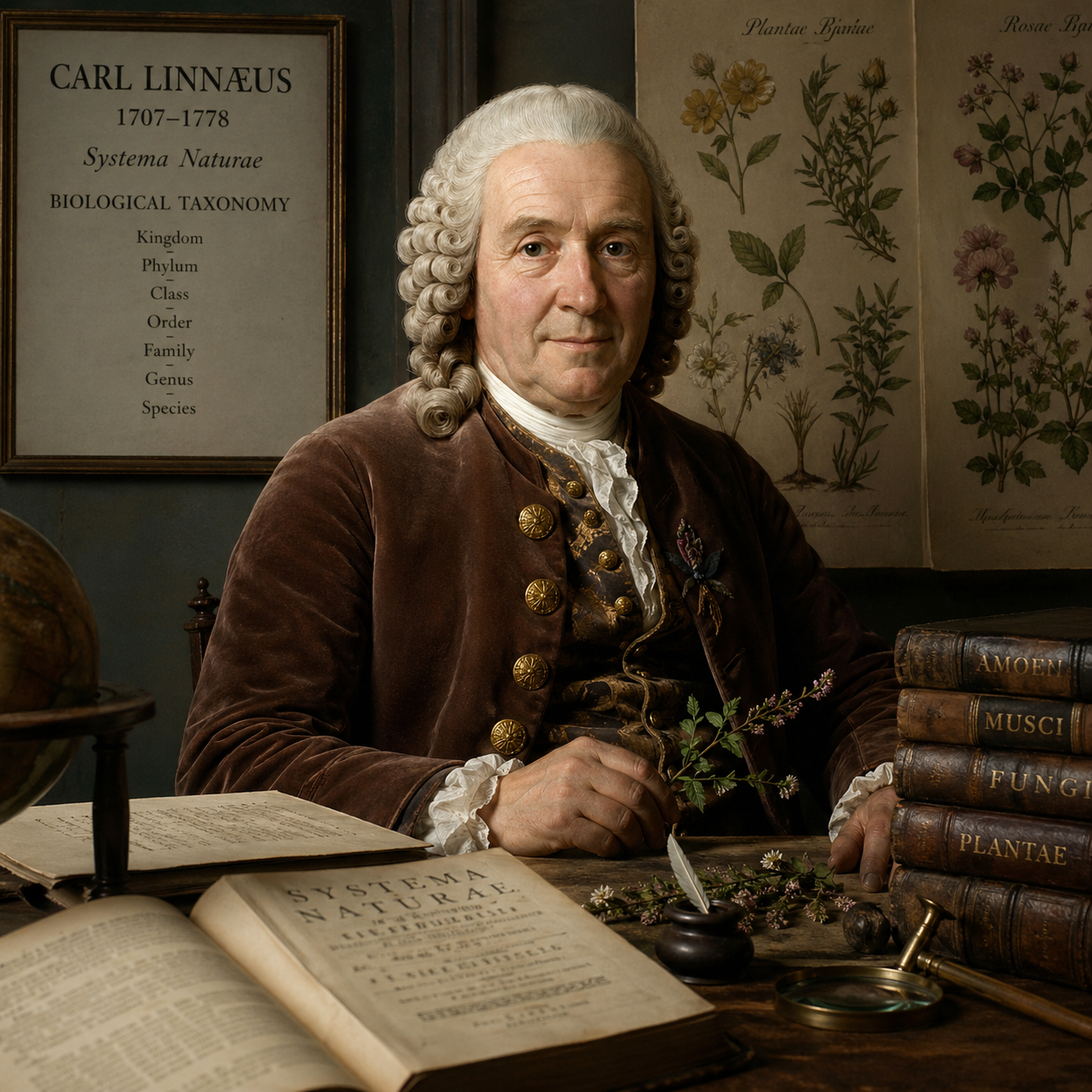
Swedish botanist and the father of modern taxonomy whose Systema Naturae (1735) introduced binomial nomenclature for naming all species. Closely associated with Joseph Banks (British naturalist who carried Linnaean classification on Cook's voyages). For an intellectual contrast, see Comte de Buffon, French naturalist and Histoire Naturelle author (1749-1788) — Buffon explicitly attacked Linnaean fixed-categories taxonomy as artificial and rejected the binomial system; his gradualist, environment-shaped natural history was the explicit alternative. Anticipates the fixed-species-vs-evolution debate Darwin would later resolve.
A profound statement on the intensity of focused spiritual or intellectual activity.
Date: 18th Century
PhilosophicalFound in 1 providers: gemini
1 source checked
Intense intellectual focus carries a hidden cost: when the mind absorbs all available awareness and energy, the rest of life — body, emotion, relationships, the outer world — recedes into shadow. Supreme mental concentration is not free; it displaces other forms of attention. True insight may illuminate one corner of existence while leaving everything surrounding it comparatively dark, untended, and unseen.
Linnaeus spent decades in obsessive classification of every known organism, famously associated with the phrase 'God creates, Linnaeus organizes.' His intellectual mission consumed him entirely — he catalogued thousands of species while neglecting health and finances. Late in life he suffered debilitating strokes, experiencing the very darkness his brain had cast over his body. His Calvinist faith framed science as revealing divine order, fusing spiritual and rational light into one consuming purpose.
The Enlightenment named itself after light — reason as illumination displacing ignorance. As 18th-century natural philosophers pushed theology aside for empirical observation, thinkers faced mounting tension between spiritual tradition and rational inquiry. Cartesian dualism had already split existence into thinking substance and physical matter. In this climate, spiritual light concentrated in the brain — at the expense of everything else — captured the Enlightenment's double-edged promise: clarity purchased through dangerous narrowing.
AI-generated insights based on extensive research and information for context. Factual errors? Email [email protected].
Your cart is empty