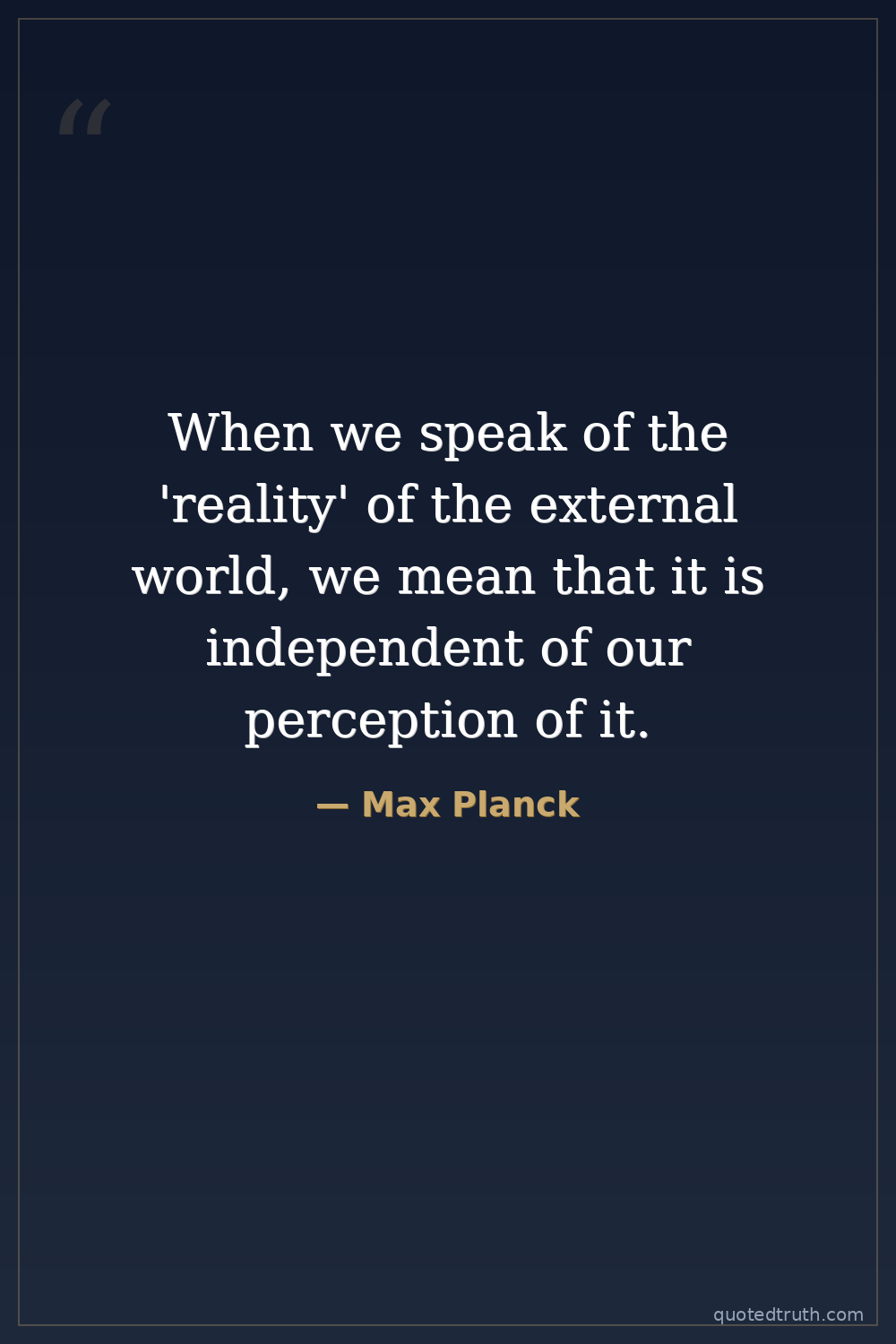
Max Planck — "When we speak of the 'reality' of the external world, we mean that it is indepen…"
When we speak of the 'reality' of the external world, we mean that it is independent of our perception of it.
When we speak of the 'reality' of the external world, we mean that it is independent of our perception of it.
Click any product to generate a realistic preview. Up to 3 at a time.
* Initial load can take up to 90 seconds — revising the preview in another color is nearly instant.
"I consider the consciousness as fundamental. I consider matter as derivative from consciousness. We cannot get behind consciousness. Everything that we talk about, everything that we regard as existin…"
"The scientist's task is to find the laws of nature, not to invent them."
"The future of humanity depends on our ability to understand and harness the power of science."
"The quantum hypothesis will never be overthrown."
"There is no matter as such. All matter originates and exists only by virtue of a force."
Found in 1 providers: grok
1 source checked
Reality exists on its own terms, regardless of whether anyone observes, measures, or believes in it. The external world is not a product of our minds or senses; it continues to operate by its own laws even when we look away. Our perceptions are attempts to access that world, but they do not create or define it. Truth is mind-independent, not something we construct.
Planck spent his career uncovering laws governing energy and matter at scales no human eye could see, trusting that mathematical structure reflected something real. Despite founding quantum theory, which introduced probability and observer effects, he remained a committed scientific realist who rejected pure subjectivism. He believed physics described an objective cosmos, and he often clashed with colleagues who treated quantum mechanics as merely a predictive tool about observations.
Planck worked as quantum mechanics fractured classical certainty in early 20th-century Europe. Heisenberg's uncertainty principle and Bohr's Copenhagen interpretation suggested observation shaped reality, sparking fierce philosophical debate. Einstein famously resisted, insisting the moon exists when no one looks. Amid two world wars, Nazi ideology distorting German science, and positivism dominating philosophy, Planck defended the realist view that nature has structure independent of human minds, a position increasingly contested by his own discoveries.
AI-generated insights based on extensive research and information for context. Factual errors? Email [email protected].
Your cart is empty