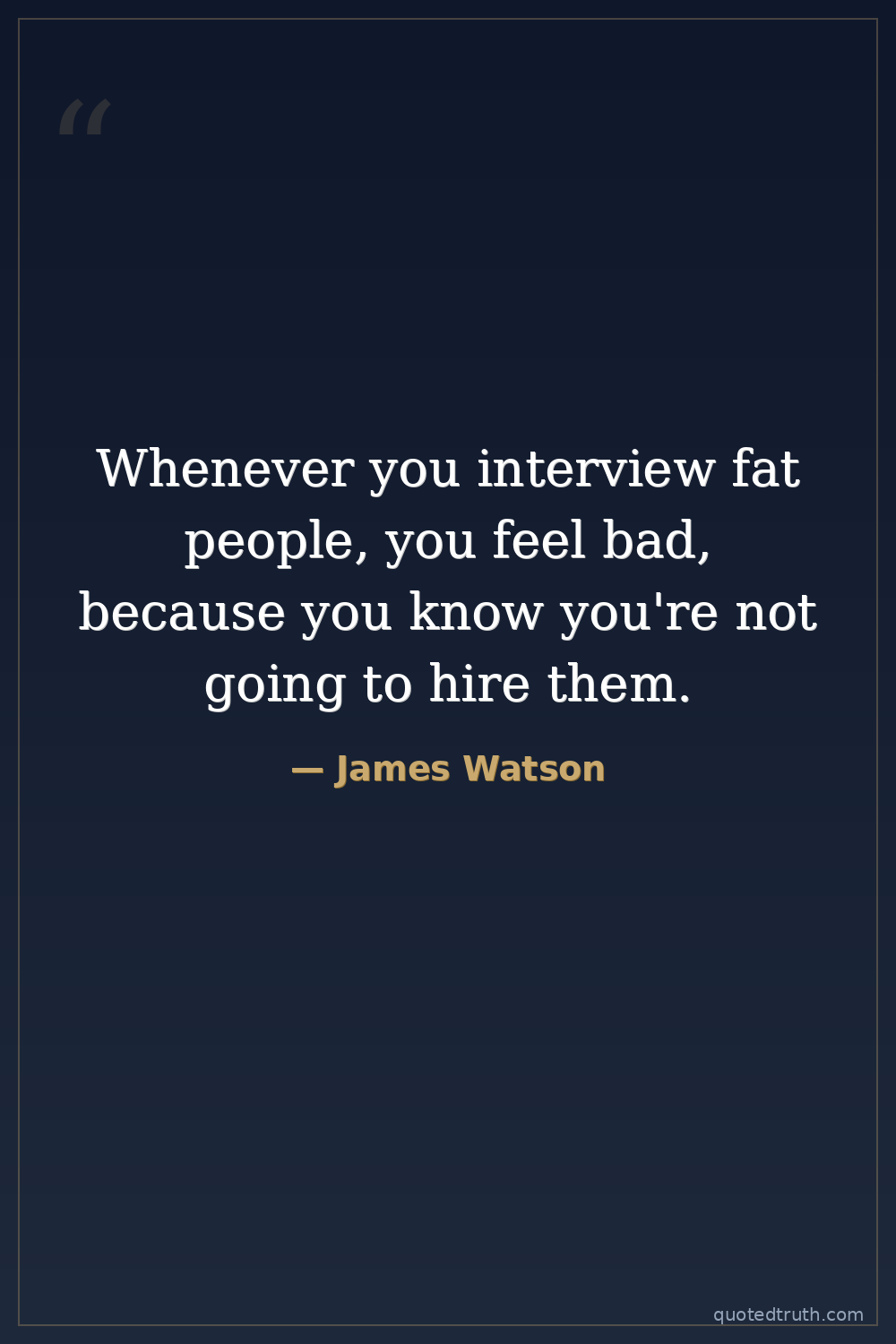
James Watson — "Whenever you interview fat people, you feel bad, because you know you're not goi…"
Whenever you interview fat people, you feel bad, because you know you're not going to hire them.
Whenever you interview fat people, you feel bad, because you know you're not going to hire them.
Click any product to generate a realistic preview. Up to 3 at a time.
* Initial load can take up to 90 seconds — revising the preview in another color is nearly instant.
"I don't mind if I'm unpopular. I've always been unpopular."
"I'm not politically correct, and I don't care."
"If you could find a way to make all girls pretty, you'd be a hero."
"I'm a very impatient person."
"I'm not a very good speaker."
Found in 1 providers: deepseek
1 source checked
Watson claims interviewers feel moral discomfort during job interviews with obese candidates because they know weight bias will determine the outcome — they won't be hired. It is a candid admission that appearance-based discrimination operates in hiring, framed not as a critique of bias but as a straightforward observation of how interviewers actually behave, with the discriminatory outcome treated as inevitable rather than wrong.
Watson's career was marked by brilliant science shadowed by blunt, often discriminatory remarks. He made notorious comments about race, intelligence, and women in science, leading Cold Spring Harbor Laboratory to strip his honorary titles in 2019. This quote fits his pattern of treating prejudice as biological or social fact rather than injustice — a scientist who mapped life's code yet applied reductive thinking to human worth.
The quote surfaced around 2003, when weight discrimination lacked federal legal protection in the U.S. — the ADA rarely covered obesity. That decade saw rising obesity rates, growing media moralizing about weight, and employer bias widely documented but minimally challenged legally. Workplace diversity conversations centered on race and gender; size discrimination was broadly normalized, making Watson's blunt statement controversial but not legally actionable.
AI-generated insights based on extensive research and information for context. Factual errors? Email [email protected].
Your cart is empty