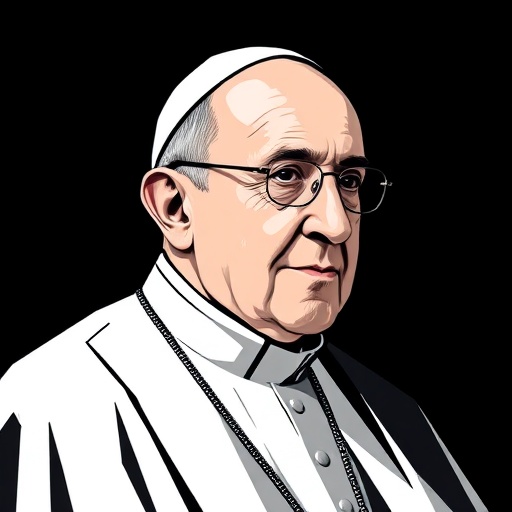
Pope Francis — "Who am I to judge a gay person seeking the Lord with good will?"
Who am I to judge a gay person seeking the Lord with good will?
Who am I to judge a gay person seeking the Lord with good will?
Click any product to generate a realistic preview. Up to 3 at a time.
* Initial load can take up to 90 seconds — revising the preview in another color is nearly instant.
"The greatest evil that can happen in the Church is spiritual worldliness."
"The measure of a society is its treatment of the poor and vulnerable."
"God always surprises us."
"It is not possible to resolve the problems of the poor by ignoring their existence."
"The world needs mercy, not condemnation."
First Latin American and Jesuit pope (2013-), who has steered the Catholic Church toward pastoral inclusion on LGBTQ pastoral care, divorced Catholics, and climate. Closely associated with Pope John XXIII (the Vatican II reformer pope) and Cardinal Walter Kasper (his theological ally on pastoral reform). For an intellectual contrast, see Cardinal Raymond Burke, American traditionalist cardinal, former head of the Vatican Apostolic Signatura — Burke is the public face of Catholic traditionalism that views Francis's pastoral approach as doctrinally dangerous — he has formally challenged Amoris Laetitia and other Francis reforms.
Found in 1 providers: grok
1 source checked
A declaration of humility and non-judgment: Francis refuses to condemn gay people who sincerely seek God. He's not changing Church doctrine on homosexuality, but he's insisting that pastoral mercy overrides personal condemnation. The phrase 'with good will' is key — he's talking about sincere faith, not behavior. It reframes the Church's posture from judge to witness, emphasizing that discerning another's soul is God's role, not his.
Bergoglio spent decades as a Jesuit priest in Buenos Aires, where he developed a pastoral theology centered on encounter with the marginalized. He chose the name Francis to signal humility and service. His trademark phrase 'field hospital' captures his view of the Church as healer, not courtroom. This quote embodies that instinct — he consistently resisted the Church presenting itself as a moral police force, even while upholding traditional teaching.
Francis spoke these words in July 2013, the same week the US Supreme Court struck down the Defense of Marriage Act. Same-sex marriage was legalizing across Western nations; the Church faced intense pressure over its anti-gay stances. Catholic countries were voting on marriage equality. His remark — casual, airborne, unscripted — landed as a seismic tonal shift, generating global headlines and debates about whether doctrine itself might eventually follow the mercy.
AI-generated insights based on extensive research and information for context. Factual errors? Email [email protected].
Your cart is empty