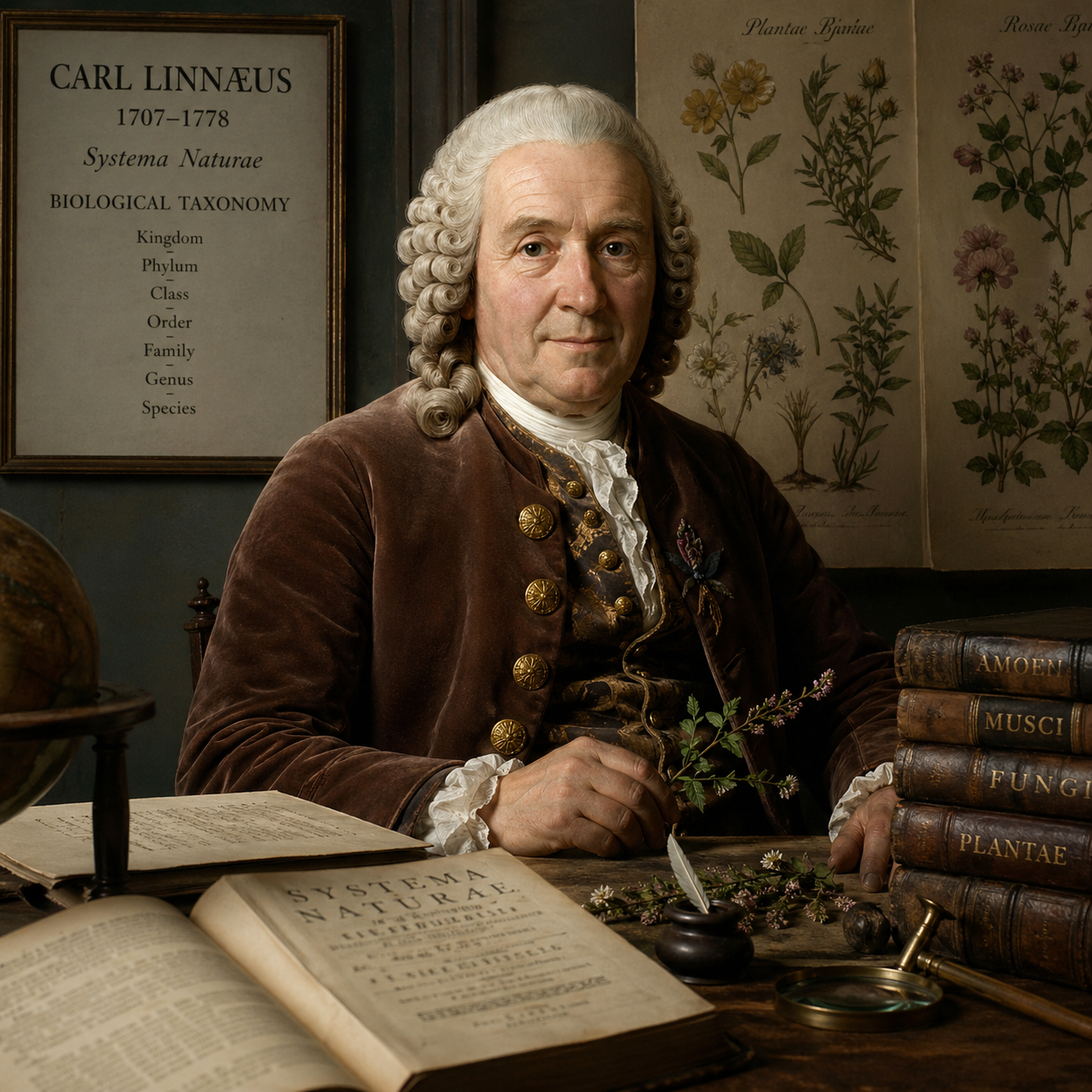
Carl Linnaeus — "Whoever wishes to be a good botanist must be a good observer."
Whoever wishes to be a good botanist must be a good observer.
Whoever wishes to be a good botanist must be a good observer.
Click any product to generate a realistic preview. Up to 3 at a time.
* Initial load can take up to 90 seconds — revising the preview in another color is nearly instant.
"These stones alone whisper in the midst of general silence."
"Every plant is a book, which, if we want to understand, we must learn its language."
"¿Qué tiene de extraño que yo no vea a Dios si no puedo ver siquiera al Yo que vive en mí?"
"I have not seen the genus Homo. I have seen many individuals."
"Nature has always been my school, and my teachers have been the trees, the flowers, and the stones."
Swedish botanist and the father of modern taxonomy whose Systema Naturae (1735) introduced binomial nomenclature for naming all species. Closely associated with Joseph Banks (British naturalist who carried Linnaean classification on Cook's voyages). For an intellectual contrast, see Comte de Buffon, French naturalist and Histoire Naturelle author (1749-1788) — Buffon explicitly attacked Linnaean fixed-categories taxonomy as artificial and rejected the binomial system; his gradualist, environment-shaped natural history was the explicit alternative. Anticipates the fixed-species-vs-evolution debate Darwin would later resolve.
Found in 1 providers: grok
1 source checked
To truly understand plants, you must train yourself to notice details carefully and accurately. Success in botany requires sharp, disciplined observation — noticing subtle differences in shape, color, structure, and growth — rather than relying on hearsay, casual glances, or secondhand descriptions. Careful attention to what is actually present, not what you expect to see, is the foundation of real botanical knowledge.
Linnaeus built his entire taxonomic system on meticulous observation, personally examining thousands of specimens to identify distinguishing features. His Species Plantarum and Systema Naturae succeeded precisely because he standardized what observers must record. He trained generations of students — his 'apostles' — sending them worldwide with rigorous observational methods, believing sloppy fieldwork undermined all scientific classification.
In the 18th century, natural history was plagued by inconsistent naming and poor descriptions inherited from herbalists using local folklore. Explorers returned with exotic specimens that defied existing categories. Linnaeus worked amid this chaos, when empirical observation was displacing scholastic authority. The Scientific Revolution had established that nature must be directly examined, not merely inherited from ancient texts like Dioscorides or Pliny.
AI-generated insights based on extensive research and information for context. Factual errors? Email [email protected].
Your cart is empty