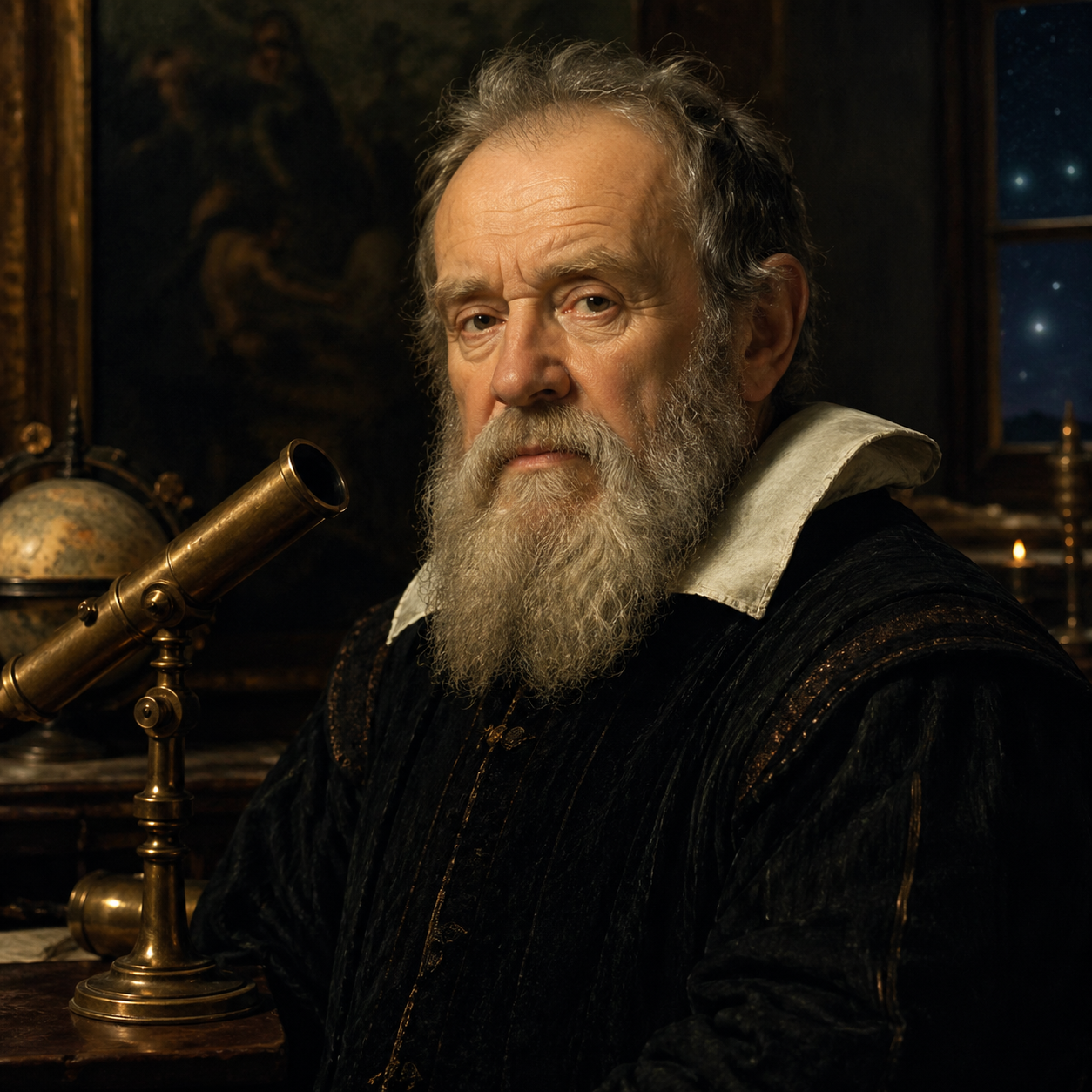
Galileo Galilei — "With the telescope, I have discovered many things that contradict the ideas of a…"
With the telescope, I have discovered many things that contradict the ideas of ancient philosophers.
With the telescope, I have discovered many things that contradict the ideas of ancient philosophers.
Click any product to generate a realistic preview. Up to 3 at a time.
* Initial load can take up to 90 seconds — revising the preview in another color is nearly instant.
"Philosophy is written in this grand book, the universe, which stands continually open to our gaze. But the book cannot be understood unless one first learns to comprehend the language and interpret th…"
"Nature is relentless and unchangeable, and it is indifferent as to whether its hidden reasons and actions are understandable to man or not."
"It is a great error to believe that the truths of faith are in any way contrary to the truths of reason."
"I do not think it is necessary to believe that the same God who gave us our senses, our reason, and our intellect, also intended us to forego their use."
"I have written up many reasons and refutations on the subject, but I have not dared until now to bring them into the open, being warned by the fortunes of Copernicus himself, our master, who procured …"
Found in 1 providers: grok
1 source checked
Direct observation reveals truths that overturn long-held assumptions. No matter how prestigious or ancient a theory, empirical evidence takes precedence. When instruments extend human perception beyond its natural limits, the world discloses itself differently than tradition claimed — and those discoveries demand we revise even our most confident inherited beliefs about nature.
Galileo built and refined the telescope around 1609, training it on the heavens and finding Jupiter's moons, lunar craters, and Venus's phases — all contradicting Aristotelian cosmology. He valued systematic observation over inherited authority, a stance that drove his conflict with the Church and ultimately led to his 1633 trial and house arrest for defending Copernican heliocentrism.
In early modern Europe, Aristotle's natural philosophy and Ptolemaic geocentrism underpinned both academic learning and Church doctrine. Challenging them was intellectually and physically dangerous. The Scientific Revolution was just beginning to prize direct experimentation over textual authority. Galileo's telescopic discoveries arrived precisely when print culture was spreading ideas rapidly, making his challenge to ancient consensus explosive and culturally transformative.
AI-generated insights based on extensive research and information for context. Factual errors? Email [email protected].
Your cart is empty