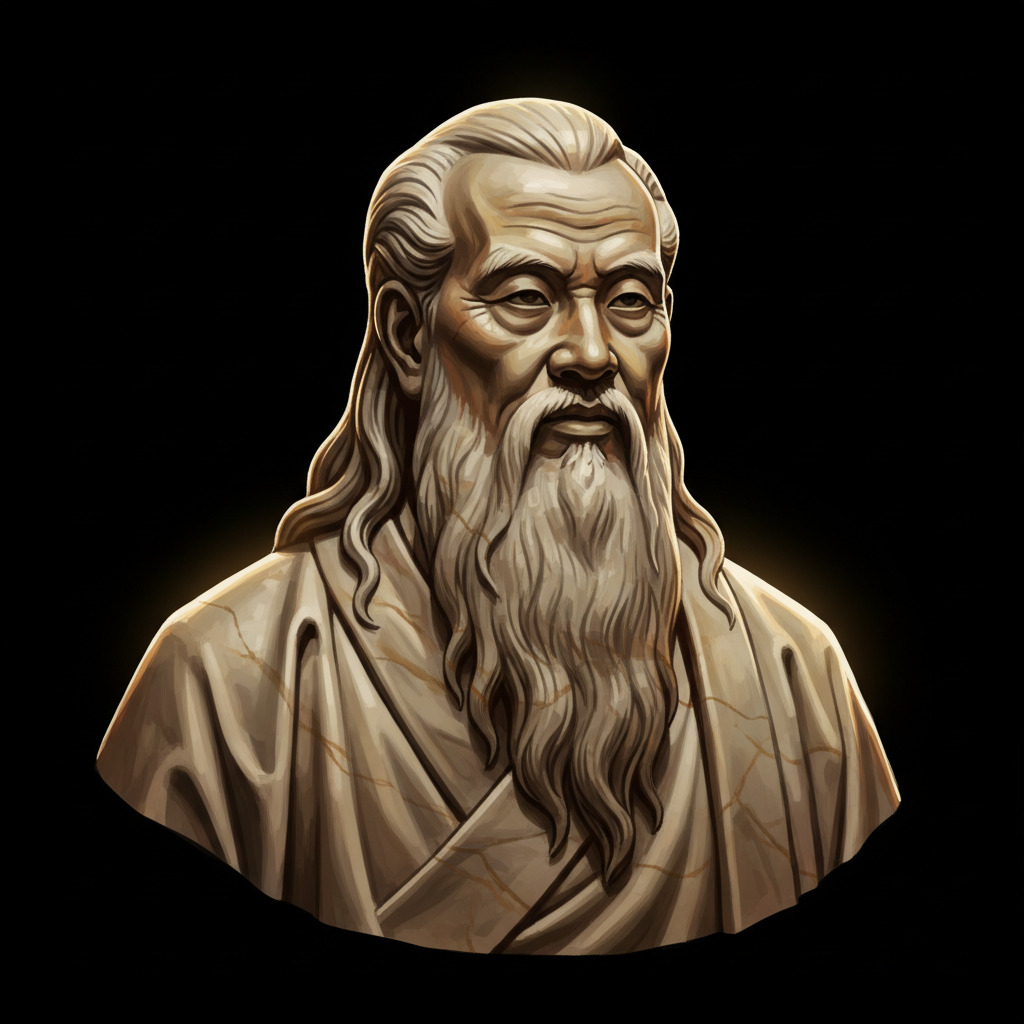
Laozi — "Without going outside, you may know the whole world."
Without going outside, you may know the whole world.
Without going outside, you may know the whole world.
Click any product to generate a realistic preview. Up to 3 at a time.
* Initial load can take up to 90 seconds — revising the preview in another color is nearly instant.
"When the people are ignorant, they are easy to control."
"He who boasts of his own achievements will not endure."
"The best way to manage is to manage very little."
"If you would take, you must first give, this is the beginning of intelligence."
"The best rulers are those the people barely know exist. The next best are those the people praise and acclaim. The next best are those the people fear. The worst are those the people despise."
Reputed founder of Taoism and author of the Tao Te Ching, whose wu wei (effortless action) shaped East Asian philosophy. Closely associated with Zhuangzi (later Taoist who extended Laozi's framework). For an intellectual contrast, see Confucius, near-contemporary Chinese sage of social ritual and duty — Confucius systematized social order through ritual and hierarchy; Laozi argued that all such systems were the disease, not the cure — the two founding poles of Chinese moral philosophy.
Found in 1 providers: grok
1 source checked
True understanding doesn't require travel or extensive external experience. By observing your own inner nature and the patterns within yourself, you can grasp universal principles that apply everywhere. The human mind mirrors the world's workings, so deep introspection reveals truths about reality, relationships, and existence. Running around chasing information often distracts from the clarity available through quiet reflection and self-awareness right where you already are.
Laozi served as a court archivist in the Zhou dynasty, surrounded by records and scholars, yet reportedly grew disillusioned with bookish pursuits and political striving. His philosophy of wu wei (effortless action) and inward cultivation shaped Taoism's emphasis on stillness over striving. Legend says he left civilization entirely, suggesting he valued intuitive wisdom over accumulated external knowledge gained through worldly engagement and travel.
Laozi lived during the turbulent late Zhou dynasty, around the 6th century BCE, as China fractured into warring states. Scholars and advisors traveled between courts seeking patronage, peddling strategies for conquest and governance. Against this restless backdrop of political scheming and intellectual marketplaces, Laozi's inward turn was radical. The era birthed competing schools—Confucianism, Legalism, Mohism—each prescribing external remedies, while Taoism uniquely pointed inward for answers.
AI-generated insights based on extensive research and information for context. Factual errors? Email [email protected].
Your cart is empty