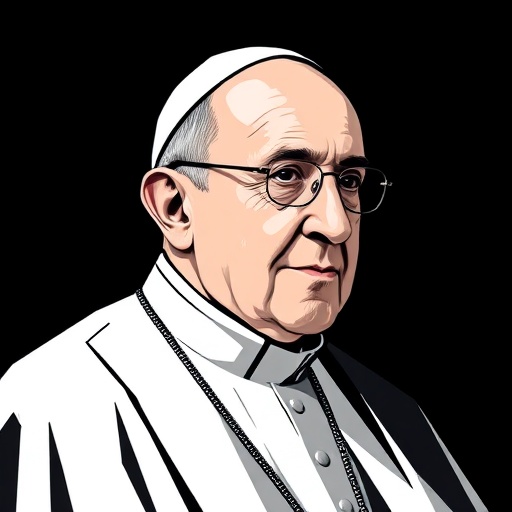
Pope Francis — "You cannot provoke, you cannot insult the faith of others, you cannot make fun o…"
You cannot provoke, you cannot insult the faith of others, you cannot make fun of faith.
You cannot provoke, you cannot insult the faith of others, you cannot make fun of faith.
Click any product to generate a realistic preview. Up to 3 at a time.
* Initial load can take up to 90 seconds — revising the preview in another color is nearly instant.
"Some people think that, excuse me if I use the word, in order to be good Catholics, we have to be like rabbits, but no."
"I will give everything to the Church. I will not keep anything for myself. I will give everything to the Church. I will not keep anything for myself."
"If a person is gay and seeks God and has good will, who am I to judge them?"
"We have forgotten to weep. We have forgotten to weep for the victims of war, for the poor, for the discarded."
"The globalized technological paradigm has inverted the order of priorities: the useful is now the criterion of truth."
First Latin American and Jesuit pope (2013-), who has steered the Catholic Church toward pastoral inclusion on LGBTQ pastoral care, divorced Catholics, and climate. Closely associated with Pope John XXIII (the Vatican II reformer pope) and Cardinal Walter Kasper (his theological ally on pastoral reform). For an intellectual contrast, see Cardinal Raymond Burke, American traditionalist cardinal, former head of the Vatican Apostolic Signatura — Burke is the public face of Catholic traditionalism that views Francis's pastoral approach as doctrinally dangerous — he has formally challenged Amoris Laetitia and other Francis reforms.
Found in 1 providers: deepseek
1 source checked
Respecting others' religious beliefs is a fundamental obligation, not optional courtesy. Freedom of expression has limits when it deliberately attacks what people hold sacred. Provoking, mocking, or insulting sincere faith crosses a boundary — not because criticism is forbidden, but because gratuitous ridicule of deeply held belief violates the basic dignity owed to every person and their genuine spiritual convictions.
Francis leads 1.3 billion Catholics and has championed interfaith dialogue throughout his papacy, meeting with Muslim, Jewish, and Orthodox leaders repeatedly. As a Jesuit, he values intellectual engagement over inflammatory rhetoric. His Argentine background, shaped by diverse religious communities and liberation theology, instilled deep respect for how faith sustains the marginalized and vulnerable.
Francis spoke these words days after the January 2015 Charlie Hebdo attacks in Paris, where cartoonists were killed over Muhammad caricatures. The moment forced a global debate about free speech versus religious respect. Europe faced rising Islamophobia alongside terrorist violence, making this statement a deliberate call for mutual dignity amid civilization-level tensions over secularism and religious identity.
AI-generated insights based on extensive research and information for context. Factual errors? Email [email protected].
Your cart is empty