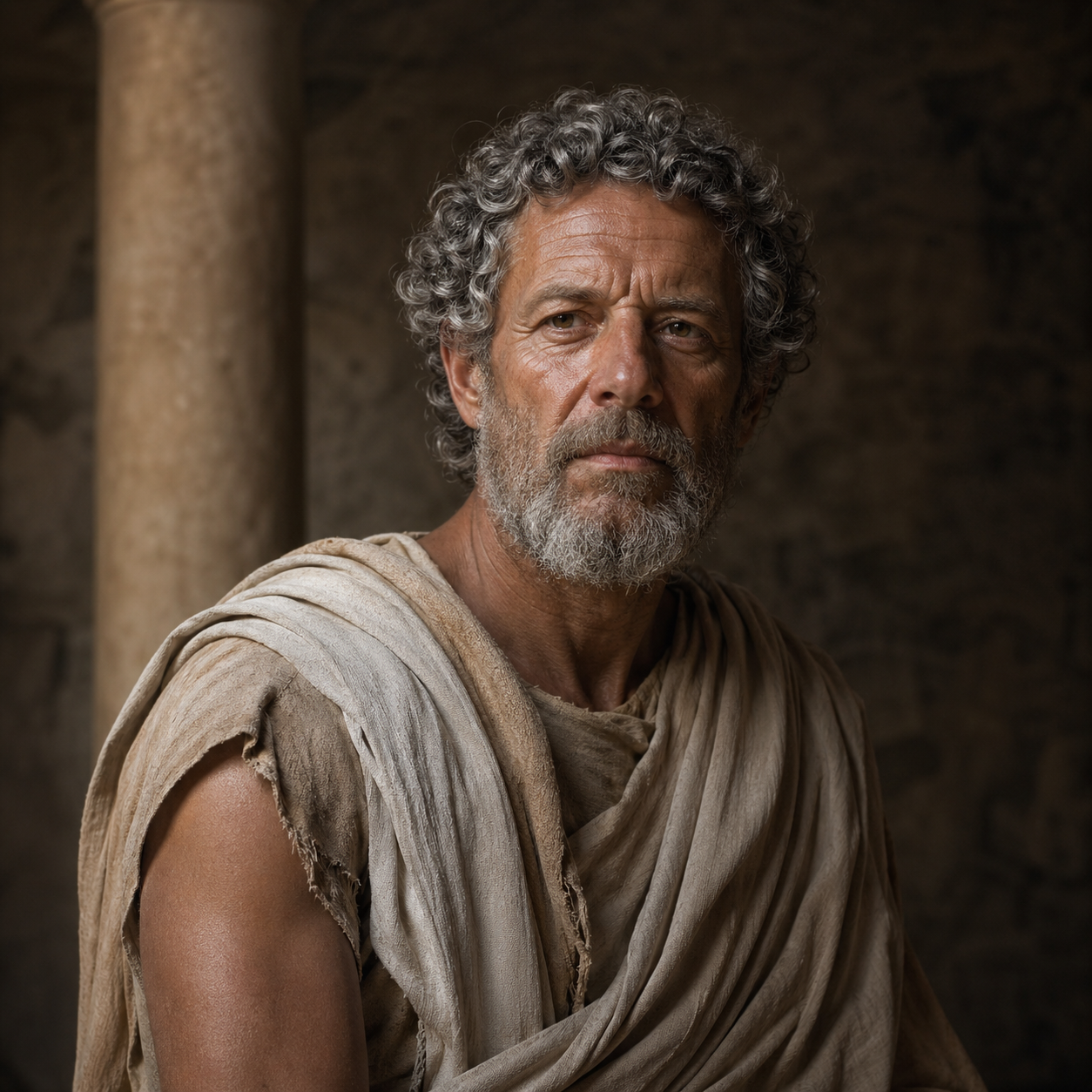
Epictetus — "You may fetter my leg, but Zeus himself cannot get the better of my free will."
You may fetter my leg, but Zeus himself cannot get the better of my free will.
You may fetter my leg, but Zeus himself cannot get the better of my free will.
Click any product to generate a realistic preview. Up to 3 at a time.
* Initial load can take up to 90 seconds — revising the preview in another color is nearly instant.
"I must die. I must be imprisoned. I must suffer exile. But must I die groaning? Must I whine as well? Can anyone hinder me from going into exile with a smile? The master threatens to chain me: what sa…"
"You are not your body, you are a soul."
"You are a little soul carrying around a corpse."
"No man can rob us of our will."
"The world turns aside to let any man pass who knows where he is going."
Greek Stoic philosopher and former slave whose Discourses (recorded by his student Arrian) shaped Marcus Aurelius and the modern Stoic revival. Closely associated with Seneca (earlier Roman Stoic) and Marcus Aurelius (his student-by-text on the imperial throne). For an intellectual contrast, see Epicurus, Greek philosopher of pleasure-as-tranquility — the Stoic-Epicurean rivalry was the central philosophical debate of the Hellenistic and Roman world for 400 years — Epicurean materialist hedonism is the precise alternative the Stoic discipline-of-acceptance was built against.
The standard scholarly entry points to Epictetus's work: A.A. Long (UC Berkeley, Classics) — Epictetus: A Stoic and Socratic Guide to Life (2002); Pierre Hadot (Collège de France) — Philosophy as a Way of Life (1995); Anthony R. Birley (Manchester, Roman historian) — Marcus Aurelius (1987) — the standard biography of Epictetus's most famous student. These are the works graduate seminars cite when teaching Epictetus.
Your cart is empty