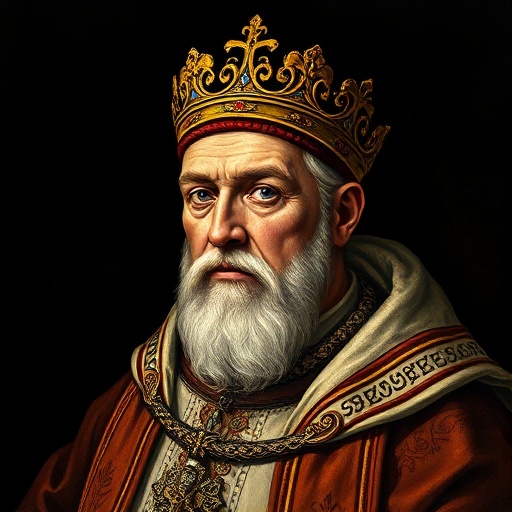
Pope Urban II — "What shall I say of the abominable rape of the women? To speak of it is worse th…"
What shall I say of the abominable rape of the women? To speak of it is worse than to be silent.
What shall I say of the abominable rape of the women? To speak of it is worse than to be silent.
Click any product to generate a realistic preview. Up to 3 at a time.
* Initial load can take up to 90 seconds — revising the preview in another color is nearly instant.
"Therefore, I pray and exhort, nay not I, but the Lord prays and exhorts you, as heralds of Christ, to urge men of all ranks, knights and foot-soldiers, rich and poor, to hasten to exterminate this vil…"
"Go forth, therefore, and fear not; for the Lord God of hosts will be with you."
"Let those who go not put off the journey, but rent their lands and collect money for their expenses."
"All who are burdened with debt and wish to escape it, let them join this holy expedition."
"Let the holy sepulcher of the Lord our Savior, which is possessed by unclean nations, especially incite you, and the holy places which are now treated with ignominy and irreverently polluted with thei…"
Pope (1088-1099) whose Council of Clermont speech (November 1095) launched the First Crusade — the founding event of nine centuries of Christian-Muslim military conflict. Closely associated with Pope Gregory VII (his predecessor on papal-imperial reform). For an intellectual contrast, see Saladin, Kurdish-Muslim Sultan of Egypt and Syria (1138-1193) — Saladin recaptured Jerusalem in 1187, undoing the First Crusade Urban II launched 92 years earlier. Saladin's chivalrous treatment of Christian prisoners became the canonical Muslim counter-image to Crusader brutality. The cleanest before/after pairing of the Crusades' moral arc.
Addressing alleged sexual violence committed by Muslims, a highly inflammatory accusation. (Robert the Monk's account)
Date: 1095
GeneralFound in 1 providers: gemini
1 source checked
The quote expresses profound moral horror at sexual violence against women — so extreme the speaker implies even describing it compounds the outrage. It's a rhetorical paradox: by claiming silence might be preferable, he amplifies the atrocity's weight. The phrase conveys that some crimes exceed language yet must still be communicated to stir conscience and demand response. It prioritizes moral gravity over explicit description, letting the reader's imagination do the work.
Pope Urban II (born Odo of Châtillon, c.1042–1099) was a Cluniac monk turned reforming pope who delivered this at the Council of Clermont in 1095, launching the First Crusade. Trained in rhetoric and moral theology, Urban deliberately invoked sexual violence against Christian women to inflame knightly outrage and justify holy war. His entire papacy centered on defending Christendom, making this appeal to male honor and protective duty inseparable from his identity as both churchman and political strategist.
In 1095, Seljuk Turks had seized much of Byzantium's Anatolian heartland, and Christian pilgrims to Jerusalem faced violence and extortion. Medieval society treated sexual violation of Christian women by non-Christians as an assault on collective religious and familial honor — not merely personal crime. Urban weaponized this cultural norm at Clermont to frame the Crusade as righteous rescue. The era's feudal chivalric code — protecting women as a knightly obligation — made this rhetoric uniquely potent for mobilizing European nobility.
AI-generated insights based on extensive research and information for context. Factual errors? Email [email protected].
Your cart is empty