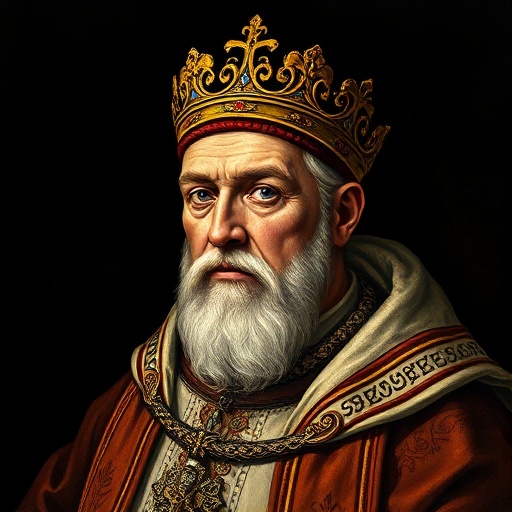
Pope Urban II — "That land, as the Scripture says, 'floweth with milk and honey,' and Jerusalem i…"
That land, as the Scripture says, 'floweth with milk and honey,' and Jerusalem is the navel of the world.
That land, as the Scripture says, 'floweth with milk and honey,' and Jerusalem is the navel of the world.
Click any product to generate a realistic preview. Up to 3 at a time.
* Initial load can take up to 90 seconds — revising the preview in another color is nearly instant.
"Let those who have formerly been mercenaries at low wages, now gain eternal rewards. Let those who have been striving to the detriment both of body and soul, now labor for a two-fold reward."
"Let our lives be stronger than death to fight against the enemies of the Christian people."
"We grant to them, by the power of God, absolution for all their sins."
"It is no longer a matter of avenging just the injuries made to men, but rather those made to God. It is no longer a matter of attacking a city or a castle, but of conquering the Holy Places. If you tr…"
"We command all of you to prepare yourselves for the journey."
Pope (1088-1099) whose Council of Clermont speech (November 1095) launched the First Crusade — the founding event of nine centuries of Christian-Muslim military conflict. Closely associated with Pope Gregory VII (his predecessor on papal-imperial reform). For an intellectual contrast, see Saladin, Kurdish-Muslim Sultan of Egypt and Syria (1138-1193) — Saladin recaptured Jerusalem in 1187, undoing the First Crusade Urban II launched 92 years earlier. Saladin's chivalrous treatment of Christian prisoners became the canonical Muslim counter-image to Crusader brutality. The cleanest before/after pairing of the Crusades' moral arc.
Found in 1 providers: grok
1 source checked
This quote frames the Holy Land as both physically abundant and cosmically central. Drawing on the Old Testament description of Canaan flowing with 'milk and honey,' Urban asserts the land's extraordinary richness. Calling Jerusalem the 'navel of the world' invokes the medieval conviction that it stood at the literal center of creation — making it uniquely sacred, uniquely valuable, and uniquely worth reclaiming. The core claim: no place on earth matters more.
Pope Urban II, a Cluniac monk turned reformer pope, grounded his authority in Scripture and ecclesiastical tradition. His 1095 sermon at Clermont launched the First Crusade using exactly this kind of biblical rhetoric — weaving Old Testament promise into urgent military appeal. Urban was a masterful preacher; invoking Scripture gave divine legitimacy to what was also a geopolitical strategy to relieve Byzantine pressure and reunite Eastern and Western Christianity under Rome's moral leadership.
In 1095, the Seljuk Turks controlled Jerusalem and had made Christian pilgrimage genuinely dangerous. Medieval mappa mundi literally placed Jerusalem at the earth's geographic center. European knights were consumed by feudal violence the Church wanted redirected outward. With the Byzantine Empire weakened after Manzikert and the Great Schism of 1054 still raw, Urban saw reclaiming Jerusalem as a means to unify fractured Christendom and reassert the papacy's spiritual and temporal authority.
AI-generated insights based on extensive research and information for context. Factual errors? Email [email protected].
Your cart is empty