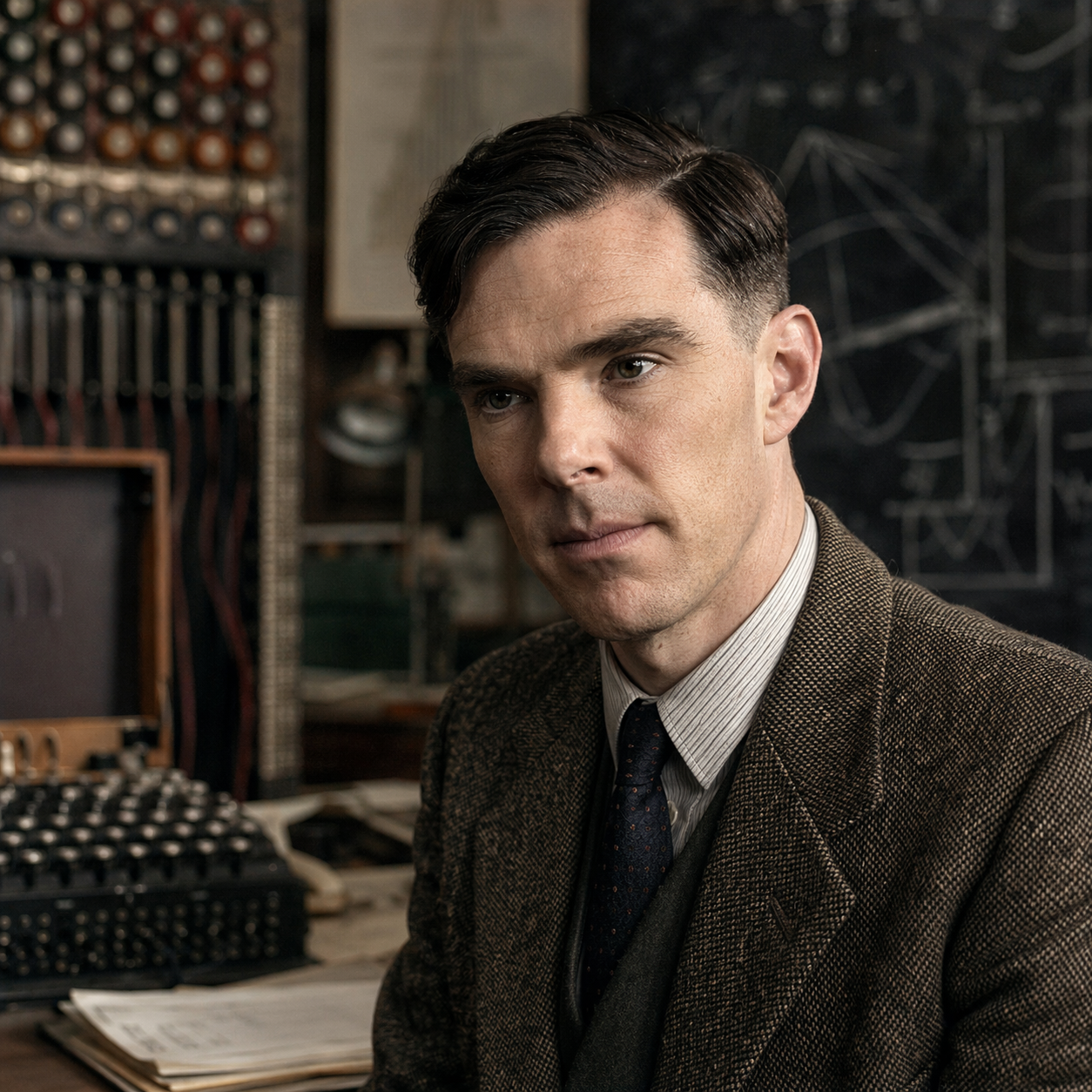
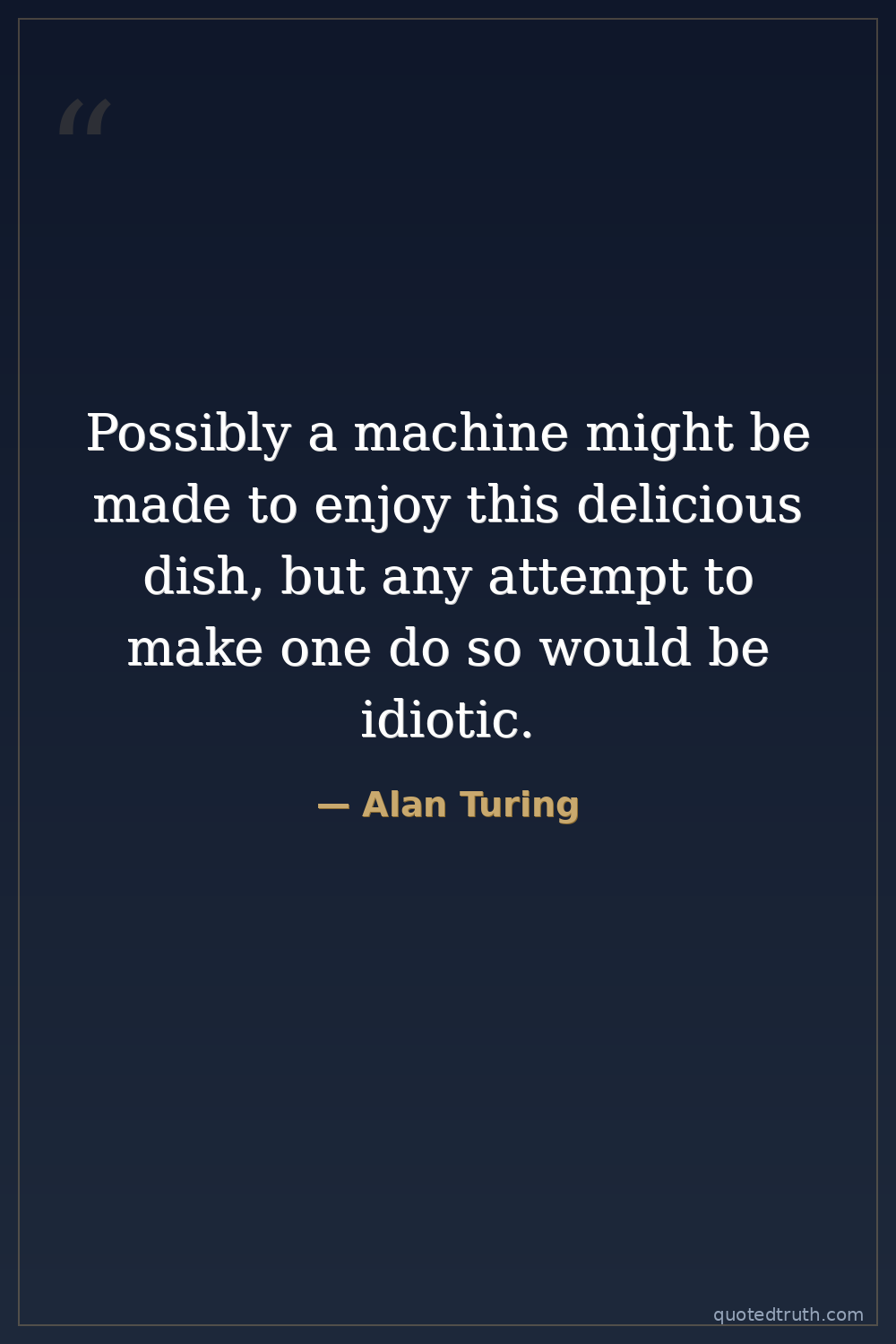
Alan Turing — "Possibly a machine might be made to enjoy this delicious dish, but any attempt t…"
Possibly a machine might be made to enjoy this delicious dish, but any attempt to make one do so would be idiotic.
Possibly a machine might be made to enjoy this delicious dish, but any attempt to make one do so would be idiotic.
Click any product to generate a realistic preview. Up to 3 at a time.
* Initial load can take up to 90 seconds — revising the preview in another color is nearly instant.
"The machine should be able to make mistakes."
"The most important thing for a mathematician is intuition."
"We can only see a short distance ahead, but we can see plenty there that needs to be done."
"I do not wish to give the impression that I think there is no mystery about consciousness. There is, for instance, something of a paradox connected with any attempt to localize it."
"Mathematics, rightly viewed, possesses not only truth, but supreme beauty—a beauty cold and austere, like that of sculpture, without appeal to any part of our weaker nature, without the gorgeous trapp…"
Found in 1 providers: gemini
1 source checked
A machine could theoretically be engineered to simulate enjoying food, but doing so would be pointless and wasteful. Turing is drawing a pragmatic boundary: not every human experience is worth replicating in machines. The goal of machine intelligence is reasoning and problem-solving—tackling real questions—not mimicking biological sensation. Chasing the wrong targets squanders the engineering effort that belongs on genuinely useful, testable capabilities.
Turing's 1950 paper introduced the Imitation Game to sidestep unanswerable questions about machine consciousness, focusing on observable behavior instead. His Bletchley Park codebreaking work embodied the same pragmatism—solve what matters, ignore the rest. This quote reflects that ethos precisely. Painfully, the state stripped Turing of his own humanity through forced chemical castration, lending his cool detachment about embodied machine pleasure a quietly tragic undertone.
Written in 1950 as the first stored-program computers emerged, this arrived during a philosophical free-for-all about machine minds. Behaviorism dominated psychology, Cold War pressure accelerated computing research, and society anxiously debated what made humans irreplaceable. Turing's framing—test for intelligent behavior, not inner experience—cut through speculative noise practically and philosophically, establishing the behavioral benchmark that still shapes artificial intelligence discourse today.
AI-generated insights based on extensive research and information for context. Factual errors? Email [email protected].
Your cart is empty