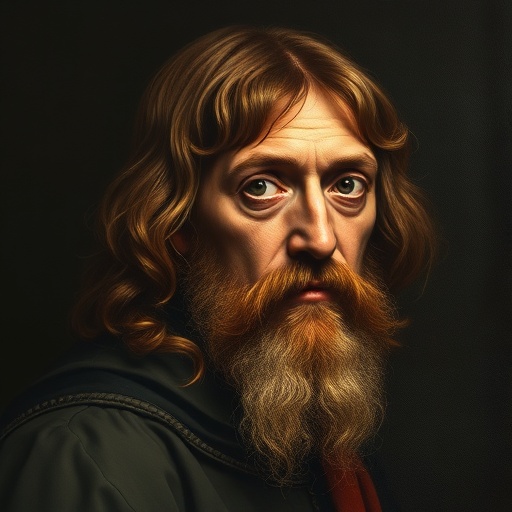
Nicolaus Copernicus — "For the Earth, which is a planet, must therefore move in a circle around the Sun…"
For the Earth, which is a planet, must therefore move in a circle around the Sun.
For the Earth, which is a planet, must therefore move in a circle around the Sun.
Click any product to generate a realistic preview. Up to 3 at a time.
* Initial load can take up to 90 seconds — revising the preview in another color is nearly instant.
"The scorn which I had reason to fear on account of the novelty and unconventionality of my opinion almost induced me to abandon completely the work which I had undertaken...."
"The earth also is spherical, since it presses upon its center from every direction."
"I am aware that I have made myself liable to be laughed at by those who consider it an absurdity to suppose that the earth moves."
"For what could be more beautiful than the heavens, which contain all things of beauty?"
"For I am not so enamored of my own opinions that I would disregard what others may think of them."
Found in 1 providers: grok
1 source checked
Earth is not a fixed, unique center of the universe but a planet like others—and planets orbit the Sun. The word 'therefore' is key: it frames Earth's motion as a logical conclusion, not a guess. Once Earth is classified alongside other wandering bodies, it must follow the same rules they do, circling a central star rather than sitting still while everything else revolves around it.
Copernicus spent decades as a church canon in Warmia while privately building his heliocentric model through geometric reasoning and naked-eye observation. His 1543 masterwork De Revolutionibus Orbium Coelestium presented Earth's motion not as speculation but as mathematical necessity. This statement reflects his character: methodical, logical, unwilling to accept inherited authority over rigorous deduction. He delayed publication for years, suggesting caution—but the conclusion itself he held as inescapable.
In the early 16th century, Ptolemy's geocentric model had dominated Western thought for 1,400 years, backed by Aristotelian physics and Catholic theology. The Renaissance was loosening dogmatic grip on classical knowledge, and astronomers were struggling to make geocentric calculations match observed planetary positions. Asserting Earth moved was not merely scientific dissent—it threatened the Church's cosmological worldview, which is why Copernicus reportedly received his published book only on his deathbed in 1543.
AI-generated insights based on extensive research and information for context. Factual errors? Email [email protected].
Your cart is empty