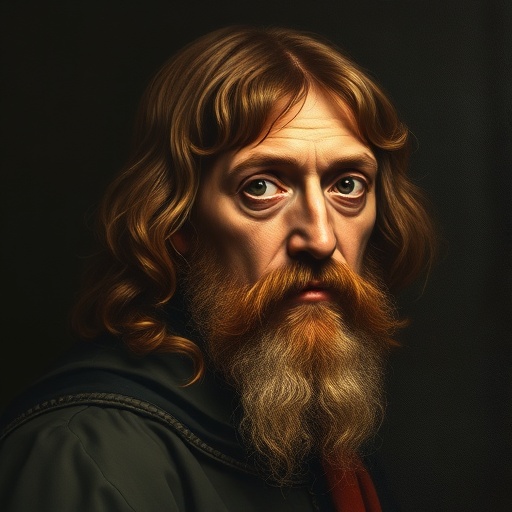
Nicolaus Copernicus — "The earth also is spherical, since it presses upon its center from every directi…"
The earth also is spherical, since it presses upon its center from every direction.
The earth also is spherical, since it presses upon its center from every direction.
Click any product to generate a realistic preview. Up to 3 at a time.
* Initial load can take up to 90 seconds — revising the preview in another color is nearly instant.
"The Sun, the Moon, and the Earth, are all parts of one great system."
"For these I care nothing, and I shall even despise their judgment as reckless."
"For the motion of the earth is of such a nature that it can account for all the apparent motions of the heavenly bodies."
"For I have found that the motions of the planets are more regular and orderly if the Earth is assumed to move."
"In the middle of all sits the Sun enthroned. In this most beautiful temple, could we place this luminary in any better position from which he can illuminate the whole at once?"
Found in 1 providers: deepseek
1 source checked
The Earth takes a spherical shape because gravity pulls all matter equally toward its center from every direction. When mass compresses symmetrically inward, a sphere is the inevitable result — every surface point equidistant from the core. This is a geometric-physical argument: uniform inward pressure produces uniform curvature. Copernicus is explaining sphericity not through tradition or authority, but through a reasoned principle about how matter under central force must behave.
Copernicus, a Polish canon and mathematician who published De Revolutionibus in 1543, built his heliocentric model on geometric consistency. By explaining Earth's spherical shape through internal pressure symmetry, he treated Earth as physically governed by the same forces as other heavenly bodies — a prerequisite for placing it among the planets. This logical, evidence-grounded reasoning style defined his life's work: replacing inherited cosmology with principled natural philosophy.
In early sixteenth-century Europe, Ptolemy's geocentric model held firm, and the Church shaped cosmological authority. Though scholars since Aristotle accepted Earth's roundness, they maintained a sharp divide between imperfect terrestrial matter and perfect celestial spheres. Copernicus's era was one of Renaissance recovery of ancient texts and growing empirical confidence. Explaining Earth's shape through physical law — treating it like any other body in space — was quietly dissolving that ancient terrestrial-celestial boundary.
AI-generated insights based on extensive research and information for context. Factual errors? Email [email protected].
Your cart is empty