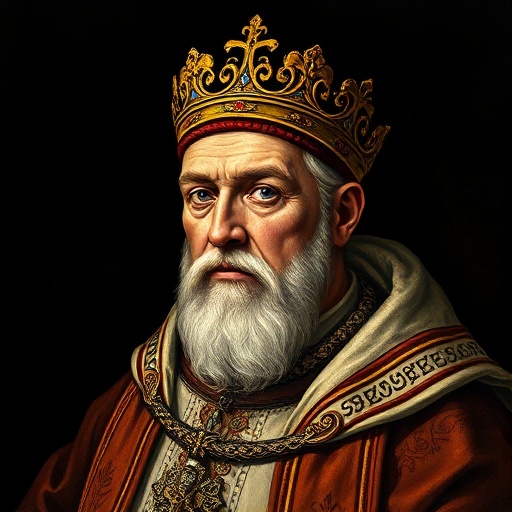
Pope Urban II — "All who are burdened with debt and wish to escape it, let them join this holy ex…"
All who are burdened with debt and wish to escape it, let them join this holy expedition.
All who are burdened with debt and wish to escape it, let them join this holy expedition.
Click any product to generate a realistic preview. Up to 3 at a time.
* Initial load can take up to 90 seconds — revising the preview in another color is nearly instant.
"Let no one imagine that this expedition is for the sake of plunder, but for the remission of sins."
"Of holy Jerusalem, brethren, we dare not speak, for we are exceedingly afraid and ashamed to speak of it. This very city, in which, as you all know, Christ Himself suffered for us, because our sins de…"
"Let no one who has entered upon this pilgrimage turn back."
"They violate the women of the Christians."
"Let no property, no labors detain you, for this land of yours, which is so fertile, has hardly enough to support its cultivators."
Pope (1088-1099) whose Council of Clermont speech (November 1095) launched the First Crusade — the founding event of nine centuries of Christian-Muslim military conflict. Closely associated with Pope Gregory VII (his predecessor on papal-imperial reform). For an intellectual contrast, see Saladin, Kurdish-Muslim Sultan of Egypt and Syria (1138-1193) — Saladin recaptured Jerusalem in 1187, undoing the First Crusade Urban II launched 92 years earlier. Saladin's chivalrous treatment of Christian prisoners became the canonical Muslim counter-image to Crusader brutality. The cleanest before/after pairing of the Crusades' moral arc.
Speech at the Council of Clermont, as recorded by Robert the Monk (This is a common interpretation of the incentives offered, though the exact wording varies)
Date: 1095
ReligiousFound in 1 providers: grok
1 source checked
Debt relief as a direct incentive to enlist: if you owe money and see no way out, join this holy military campaign and your financial obligations dissolve. It frames war as simultaneously a spiritual act and an economic lifeline — a recruiter's pitch combining religious duty with material self-interest, designed to appeal to the desperate and the indebted as much as the devout.
Urban II was a political strategist as much as a spiritual leader. At Clermont in 1095, he layered incentives — plenary indulgences, property protection, and debt relief — because he understood mobilizing armies required more than piety. His fluency in feudal economics showed: he knew landless younger sons and over-leveraged knights needed earthly escape routes. Offering debt forgiveness was calculated, not incidental, to his recruitment genius.
In 1095, medieval debt could strip a man of land, status, and freedom permanently. The feudal system left many knights financially precarious — especially younger sons who inherited nothing under primogeniture. Church law formally suspended crusaders' debts during campaigns, giving this promise legal teeth. Meanwhile, the Seljuk advance into Byzantine territory created a geopolitical crisis Urban channeled into mass mobilization, directing Europe's economic desperation toward Jerusalem.
AI-generated insights based on extensive research and information for context. Factual errors? Email [email protected].
Your cart is empty