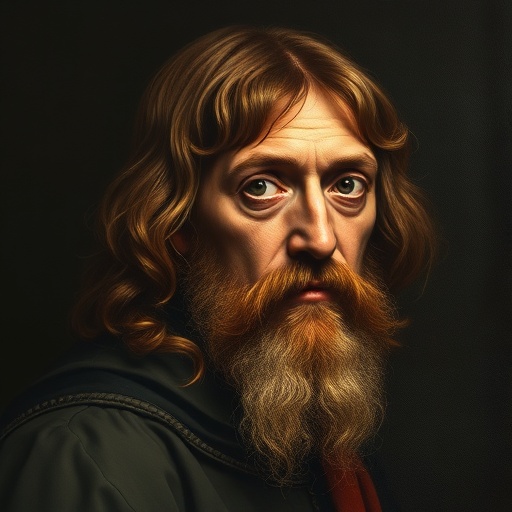
Nicolaus Copernicus — "The sphere of the fixed stars is immovable and embraces all things."
The sphere of the fixed stars is immovable and embraces all things.
The sphere of the fixed stars is immovable and embraces all things.
Click any product to generate a realistic preview. Up to 3 at a time.
* Initial load can take up to 90 seconds — revising the preview in another color is nearly instant.
"The celestial sphere is finite and spherical."
"The world is not a machine, but a living body, with a soul and a mind."
"Perhaps there will be babblers who, although completely ignorant of mathematics, nevertheless dare to pass judgment on these things and, on the strength of some passage in Scripture, twisted to their …"
"Knowledge makes a bloody entrance."
"For I am convinced that the world is a single, unified system, and that all its parts are interrelated."
Found in 1 providers: grok
1 source checked
The universe has a definite outer boundary — an immovable sphere studded with stars that contains all of creation within it. Everything observable — planets, Sun, Earth — exists inside this vast, unchanging celestial shell. This is a structural claim: the cosmos has limits, and those limits are fixed and eternal. The stars do not drift relative to each other; they form a permanent, all-encompassing framework around which everything else is measured.
Copernicus revolutionized astronomy by placing the Sun at the universe's center and displacing Earth — yet he retained this ancient concept of a fixed stellar sphere as the outer boundary. His 1543 *De revolutionibus* reveals a thinker bold enough to overturn geocentrism but anchored to tradition where disruption wasn't essential. As a Catholic canon who published with extreme caution, Copernicus preserved familiar cosmic architecture while relocating its engine — a calculated, partial dismantling of the Ptolemaic order.
In the early 16th century, Ptolemaic geocentrism — endorsed by the Church and embedded in medieval scholasticism — treated the fixed-star sphere as divine and eternal. Copernicus published *De revolutionibus* in 1543, the year he died, partly to deflect Church condemnation. Retaining the immovable stellar sphere was both scientifically conservative and politically shrewd: it preserved the cosmos's divine orderliness and familiar structure while shifting only Earth's privileged position within it.
AI-generated insights based on extensive research and information for context. Factual errors? Email [email protected].
Your cart is empty