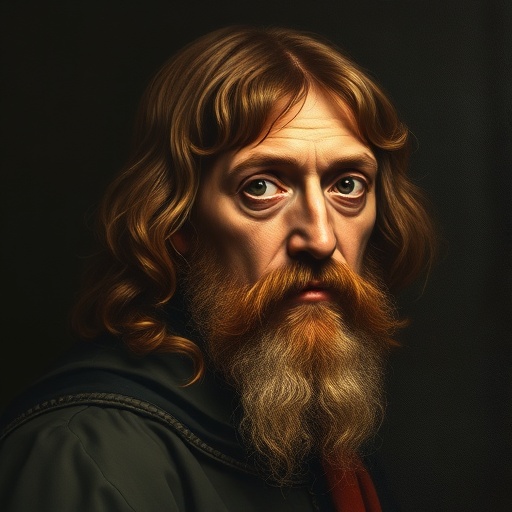
Nicolaus Copernicus — "For the motions of the planets are so much more orderly and harmonious if they a…"
For the motions of the planets are so much more orderly and harmonious if they are referred to the sun as the center.
For the motions of the planets are so much more orderly and harmonious if they are referred to the sun as the center.
Click any product to generate a realistic preview. Up to 3 at a time.
* Initial load can take up to 90 seconds — revising the preview in another color is nearly instant.
"Having thus assumed the motions which I ascribe to the earth, I have, after long and careful investigation, finally discovered that, if the motions of the other planets be related to the revolution of…"
"The earth also is spherical, since it presses upon its center from every direction."
"For it is manifest that the movements of the planets are not uniform, but sometimes faster, sometimes slower, sometimes direct, sometimes retrograde."
"For it is the duty of an astronomer to compose the history of the celestial motions through careful and expert study."
"For I am convinced that the world is a single, unified system, and that all its parts are interrelated."
Found in 1 providers: grok
1 source checked
Planetary motion becomes far simpler and more mathematically elegant when the sun, not Earth, sits at the center of the solar system. Placing Earth at the center forces astronomers to invent complex workarounds — epicycles, equants — to explain why planets sometimes appear to move backward. With the sun as center, those irregularities dissolve into clean, consistent orbits. The universe isn't chaotic; we were just looking at it from the wrong point of reference.
Copernicus spent over thirty years refining his heliocentric model before publishing De Revolutionibus in 1543. A trained mathematician, physician, and church canon in Poland, he was driven by a Pythagorean conviction that nature favors elegance — complexity in a theory signaled a flawed premise. The Ptolemaic system's endless epicycles offended his mathematical sensibility. This quote captures his core argument: simplicity and harmony weren't aesthetic preferences but evidence that heliocentric theory was correct.
In early 16th-century Europe, the Ptolemaic geocentric model had been scientific and theological orthodoxy for nearly 1,400 years. The Church taught that Earth occupied God's central, privileged position in creation. Challenging this carried serious risks — Galileo would be tried for it decades later. Meanwhile, European explorers navigating new continents demanded more accurate astronomical tables, making planetary motion a practical, not just philosophical, concern. Copernicus's claim that the sun anchors cosmic order was revolutionary on every front.
AI-generated insights based on extensive research and information for context. Factual errors? Email [email protected].
Your cart is empty