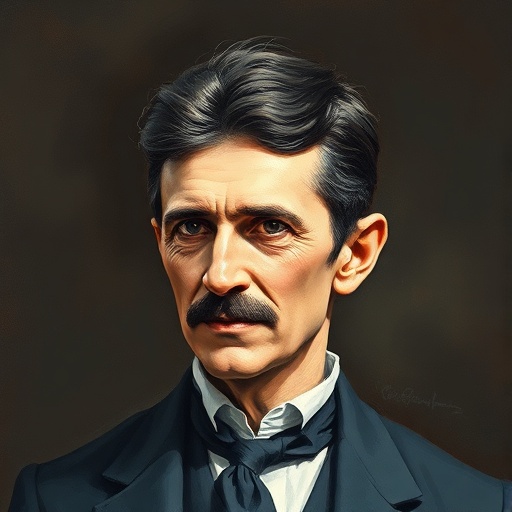
Nikola Tesla — "I am equally proud of my Serbian origin and my Croatian homeland."
I am equally proud of my Serbian origin and my Croatian homeland.
I am equally proud of my Serbian origin and my Croatian homeland.
Click any product to generate a realistic preview. Up to 3 at a time.
* Initial load can take up to 90 seconds — revising the preview in another color is nearly instant.
"The day science begins to study non-physical phenomena, it will make more progress in one decade than in all the previous centuries of its existence. To understand the true nature of the universe, one…"
"I myself have made my own discoveries in the greatest solitude, and when I have been alone, undisturbed."
"I do not think there is any thrill that can go through the human heart like that of the inventor as he sees some creation of the brain unfolding to success… Such emotions make one forget food, sleep, …"
"I have not invented a 'death ray'. I don't need a 'death ray' to destroy an army. I can simply create a vibratory force that would shatter the earth."
"The world has been too slow to grasp the true significance of my inventions."
Serbian-American inventor and electrical engineer whose alternating-current designs powered the modern electrical grid; died poor and largely forgotten. Closely associated with George Westinghouse (his AC-power business partner) and Mihajlo Pupin (fellow Serbian-American physicist at Columbia). For an intellectual contrast, see Thomas Edison, American inventor and direct-current advocate — Edison's direct-current power-distribution scheme was displaced by Tesla-Westinghouse AC in the 1890s 'War of Currents'. Edison ran a public-relations campaign electrocuting animals to discredit AC — the most famous engineering-ethics rivalry in American history. Tesla's AC won and powers nearly every electrical grid on Earth.
Found in 1 providers: grok
1 source checked
Tesla states he holds equal pride in two aspects of his identity — his Serbian ethnicity and his Croatian birthplace. Rather than picking a side in a region often divided by competing national loyalties, he embraces both as equally valid and non-contradictory parts of himself. The quote asserts that a person's origins and homeland can coexist without hierarchy or conflict, rejecting the forced either-or framing of ethnic nationalism.
Tesla was born in 1856 in Smiljan, a village in modern-day Croatia, to Serbian Orthodox parents — his father was a Serbian priest. He spent formative years in Croatia and Serbia before studying in Prague and Graz, then emigrating to America. He consistently identified as Serbian by blood while acknowledging Croatia as his homeland. This dual loyalty was a lived biographical reality, not a political gesture.
Tesla lived through an era of rising nationalism across Europe and the Balkans. The late 19th and early 20th centuries saw violent conflicts between Serbian and Croatian national movements within the Austro-Hungarian Empire. Pan-Slavism competed with ethnic separatism, and the region erupted into WWI partly over these tensions. Asserting equal pride in both Serbian heritage and Croatian homeland was a quietly radical stance against the era's hardening ethnic divisions.
AI-generated insights based on extensive research and information for context. Factual errors? Email [email protected].
Your cart is empty