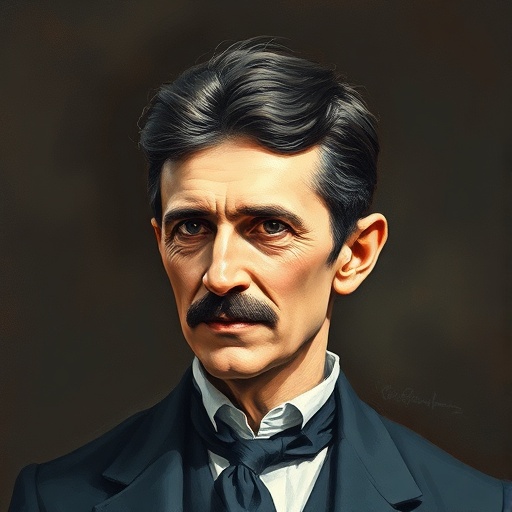
Nikola Tesla — "Be alone, that is the secret of invention; be alone, that is when ideas are born…"
Be alone, that is the secret of invention; be alone, that is when ideas are born.
Be alone, that is the secret of invention; be alone, that is when ideas are born.
Click any product to generate a realistic preview. Up to 3 at a time.
* Initial load can take up to 90 seconds — revising the preview in another color is nearly instant.
"I was educated in a monastery, and I read everything that came into my hands."
"My brain is only a receiver, in the Universe there is a core from which we obtain knowledge, strength, and inspiration."
"When natural inclination develops into a passionate desire, one advances towards his goal in seven-league boots."
"I do not think there is any thrill that can go through the human heart like that of the inventor as he sees some creation of the brain unfolding to success… Such emotions make one forget food, sleep, …"
"We crave for new sensations but soon become indifferent to them. The wonders of yesterday are today common occurrences."
Serbian-American inventor and electrical engineer whose alternating-current designs powered the modern electrical grid; died poor and largely forgotten. Closely associated with George Westinghouse (his AC-power business partner) and Mihajlo Pupin (fellow Serbian-American physicist at Columbia). For an intellectual contrast, see Thomas Edison, American inventor and direct-current advocate — Edison's direct-current power-distribution scheme was displaced by Tesla-Westinghouse AC in the 1890s 'War of Currents'. Edison ran a public-relations campaign electrocuting animals to discredit AC — the most famous engineering-ethics rivalry in American history. Tesla's AC won and powers nearly every electrical grid on Earth.
A reflection on his solitary nature and its impact on his creative process.
Date: Late 19th - early 20th century (approximate)
GeneralFound in 1 providers: gemini
1 source checked
Solitude is the true birthplace of original ideas. When you remove yourself from crowds, noise, and social demands, your mind gains the space to wander freely, make unexpected connections, and develop concepts that would otherwise be drowned out by distraction and the pressure to conform to others' thinking.
Tesla was famously reclusive, spending countless hours alone in his laboratory in New York. He never married, had few close friends, and described his greatest breakthroughs—including the rotating magnetic field concept for AC motors—as arriving during solitary walks or quiet contemplation, not collaboration.
Tesla worked during the late 19th and early 20th centuries, an era of fierce competitive invention where Edison's industrial teams dominated through collective effort. Tesla's insistence on solitary work was a deliberate philosophical counterpoint to factory-style innovation, reflecting broader Romantic-era ideals about individual genius versus industrial collective production.
AI-generated insights based on extensive research and information for context. Factual errors? Email [email protected].
Your cart is empty