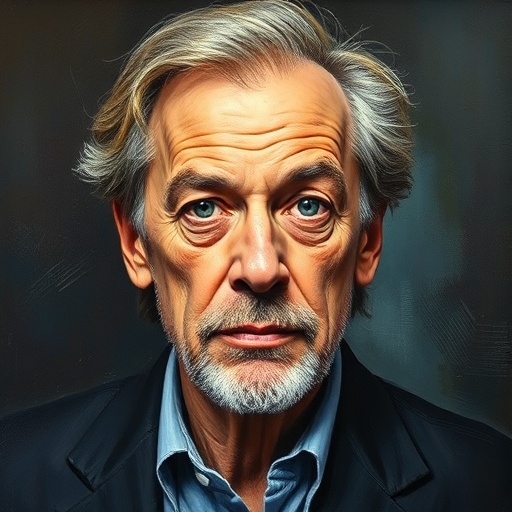
Richard Feynman — "You see my physics students don't understand it... That is because I don't under…"
You see my physics students don't understand it... That is because I don't understand it. Nobody does.
You see my physics students don't understand it... That is because I don't understand it. Nobody does.
Click any product to generate a realistic preview. Up to 3 at a time.
* Initial load can take up to 90 seconds — revising the preview in another color is nearly instant.
"I don't understand the world in the way that I think other people claim to understand it."
"I don't like to be told what to do."
"I can live with doubt and uncertainty and not knowing. I think it's much more interesting to live not knowing than to have answers which might be wrong."
"I was born with an ability to do mathematics, which is what they want in physics. I can think of problems and solve them. So what? I'm not very good at anything else. I can't dance, I can't sing, I ca…"
"Fall in love with some activity, and do it! Nobody ever figures out what life is all about, and it doesn't matter. Explore the world. Immediately pay attention to anything that grabs you, and then, wi…"
American theoretical physicist who shared the 1965 Nobel for QED, developed Feynman diagrams, and wrote the Feynman Lectures on Physics. Closely associated with Julian Schwinger (co-Nobelist for QED) and Murray Gell-Mann (Caltech rival and Eightfold-Way physicist). For an intellectual contrast, see Deepak Chopra, physician and quantum-mysticism author — Feynman's Caltech 'cargo cult science' commencement address is the precise template for what he saw as misuse of physics terminology — Chopra-style appropriation of quantum vocabulary for metaphysical claims is the canonical example of what Feynman called 'fooling yourself'.
Found in 1 providers: gemini
1 source checked
Quantum mechanics is genuinely incomprehensible to human intuition, not merely complex. Even experts who can calculate its predictions perfectly cannot explain why the universe behaves that way at the subatomic level. Understanding the math and understanding the reality are entirely different things. Honesty about that gap is more intellectually rigorous than pretending mastery where none exists.
Feynman won the 1965 Nobel Prize for quantum electrodynamics, the most precisely verified theory in physics, yet famously insisted nobody truly understands quantum mechanics. He taught at Caltech and wrote the legendary Feynman Lectures. His entire career celebrated curiosity and radical honesty over false authority, making this admission characteristic rather than surprising.
Feynman worked through mid-20th century physics when quantum mechanics was reshaping science, yet Cold War culture pressured experts to project certainty and authority. The Space Race demanded confident scientists. Against that backdrop, publicly admitting fundamental incomprehension was countercultural and intellectually brave, modeling a scientific humility that influenced generations of physicists and educators.
AI-generated insights based on extensive research and information for context. Factual errors? Email [email protected].
Your cart is empty