Johannes Kepler — "I have often tried to grasp that which I have found."
I have often tried to grasp that which I have found.
I have often tried to grasp that which I have found.
Click any product to generate a realistic preview. Up to 3 at a time.
* Initial load can take up to 90 seconds — revising the preview in another color is nearly instant.
"So long as the mother, Ignorance, lives, it is not safe for Science, the offspring, to divulge the hidden causes of things."
"I much prefer the sharpest criticism of a single intelligent man to the thoughtless approval of the masses."
"I have discovered the harmony of the spheres."
"God gives every animal the means of saving its life—why object if he gives astrology to the astronomer?"
"I have been a philosopher, and I have pondered the meaning of life."
Found in 1 providers: grok
1 source checked
The speaker admits that even after making a discovery, truly understanding what they have found is a separate and ongoing struggle. Finding something is not the same as comprehending it. Insights often arrive before the mind can fully absorb their meaning, so the thinker must return repeatedly to their own results, wrestling with implications that outrun the initial flash of recognition.
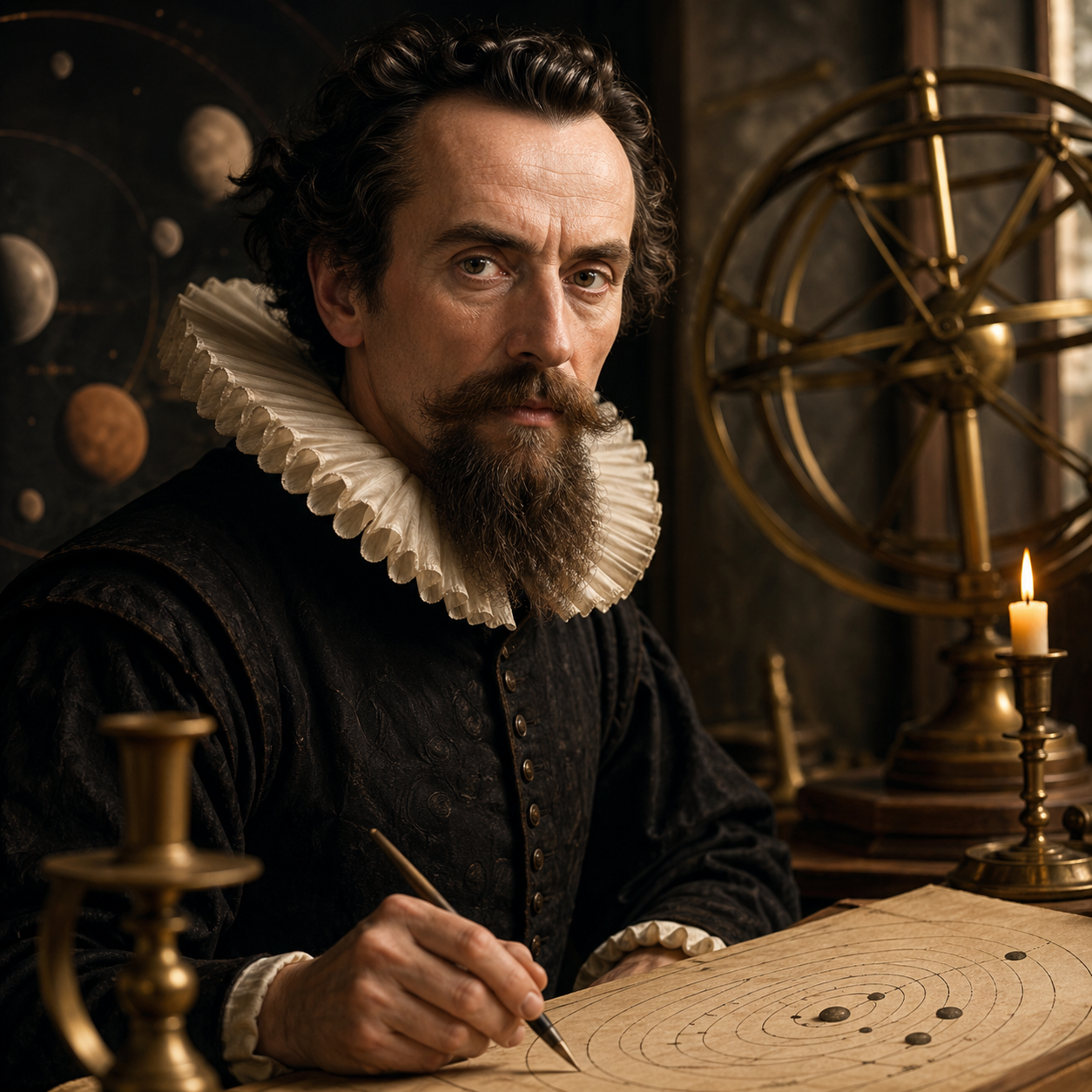
Kepler spent decades reducing Tycho Brahe's Mars data into three laws of planetary motion, and he repeatedly rewrote his conclusions as he grasped their deeper meaning. Harmonices Mundi and Astronomia Nova show a mind circling back on its own breakthroughs. Deeply Lutheran and mystical, he saw elliptical orbits as divine geometry whose full significance he kept chasing long after the equations were solved.
In the early 1600s, astronomy was shifting from Ptolemaic circles to Copernican heliocentrism amid the Thirty Years' War and Counter-Reformation pressures. Galileo's telescope had just opened the skies, yet mathematical proof lagged behind observation. Scholars worked without calculus, calculating by hand across years. Kepler's era prized discovery, but the tools to interpret nature's patterns were primitive, making the gap between finding and understanding unusually wide.
AI-generated insights based on extensive research and information for context. Factual errors? Email [email protected].
Your cart is empty