Grace Hopper — "I handed my passport to the immigration officer, and he looked at it and looked …"
I handed my passport to the immigration officer, and he looked at it and looked at me and said, 'What are you?'
I handed my passport to the immigration officer, and he looked at it and looked at me and said, 'What are you?'
Click any product to generate a realistic preview. Up to 3 at a time.
* Initial load can take up to 90 seconds — revising the preview in another color is nearly instant.
"I love to teach. I love to talk to young people."
"There are two things that are hard in computer science: cache invalidation, naming things, and off-by-one errors."
"The only constant in the computer industry is change."
"The difficulty lies, not in the new ideas, but in escaping from the old ones."
"That's why I'm still here. I enjoy it."
Recalling an amusing encounter at immigration while being the oldest active-duty officer in the U.S. military.
Date: 1986 (60 Minutes interview, August 24)
Work & MoneyFound in 1 providers: gemini
1 source checked
Being asked 'What are you?' instead of 'Who are you?' reduces a person to an anomaly. It captures the experience of existing so far outside expected categories that others can't process your identity normally. The question dehumanizes by treating a person as a puzzle to classify rather than someone to acknowledge. It reflects how trailblazers confuse systems designed around rigid assumptions about who belongs in certain roles or spaces.
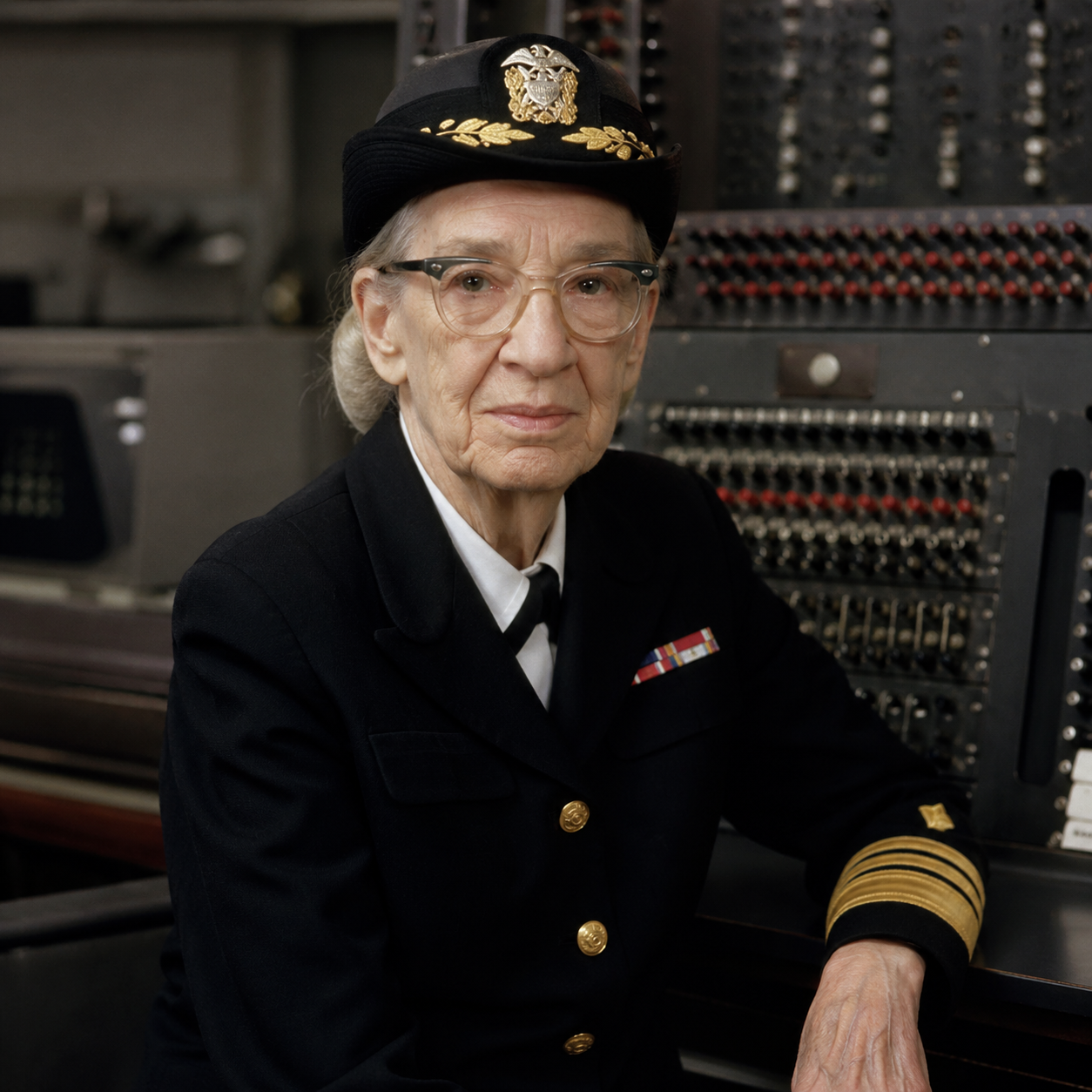
Grace Hopper was a U.S. Navy rear admiral and pioneering computer scientist who invented the first compiler and helped create COBOL — a woman in two fields almost entirely male. Throughout her career she repeatedly encountered the disbelief of people who couldn't place her: a uniformed female officer who also debugged early computers defied every category institutions held. Her passport moment crystallized a lifelong reality of being genuinely unclassifiable by those around her.
Hopper's career spanned the 1940s through 1980s, the decades when modern computing was invented, the Cold War militarized technology, and strict gender roles confined women to clerical work. Women holding real technical authority or military rank were so uncommon that institutions literally lacked mental models for them. An immigration officer encountering a female naval officer with a technical career wasn't being hostile — the categories simply didn't exist in the culture yet.
AI-generated insights based on extensive research and information for context. Factual errors? Email [email protected].
Your cart is empty