Grace Hopper — "I always say the Mark I was the most fun."
I always say the Mark I was the most fun.
I always say the Mark I was the most fun.
Click any product to generate a realistic preview. Up to 3 at a time.
* Initial load can take up to 90 seconds — revising the preview in another color is nearly instant.
"It's a beautiful thing, a computer. It's a wonderful thing."
"Humans are allergic to change. They love to say, 'We've always done it this way.' I try to fight that. That's why I have a clock on my wall that runs counter-clockwise."
"The only phrase I've ever disliked is, 'Why, we've always done it that way.' I always tell young people, 'Go ahead and do it. You can always apologize later.'"
"The greatest danger is not in failure, but in succeeding too easily."
"If you do something once, people will call it an accident. If you do it twice, they call it a coincidence. But do it a third time and you've just proven a natural law!"
Found in 1 providers: grok
1 source checked
A candid expression of nostalgia for her earliest computing work. The Harvard Mark I was a massive electromechanical machine—primitive by any later standard—yet Hopper singles it out as her most enjoyable experience. The comment captures the irreplaceable thrill of working at the absolute frontier, where every problem was genuinely new, every solution invented from scratch, and the sheer novelty of the machine made each day feel like discovery.
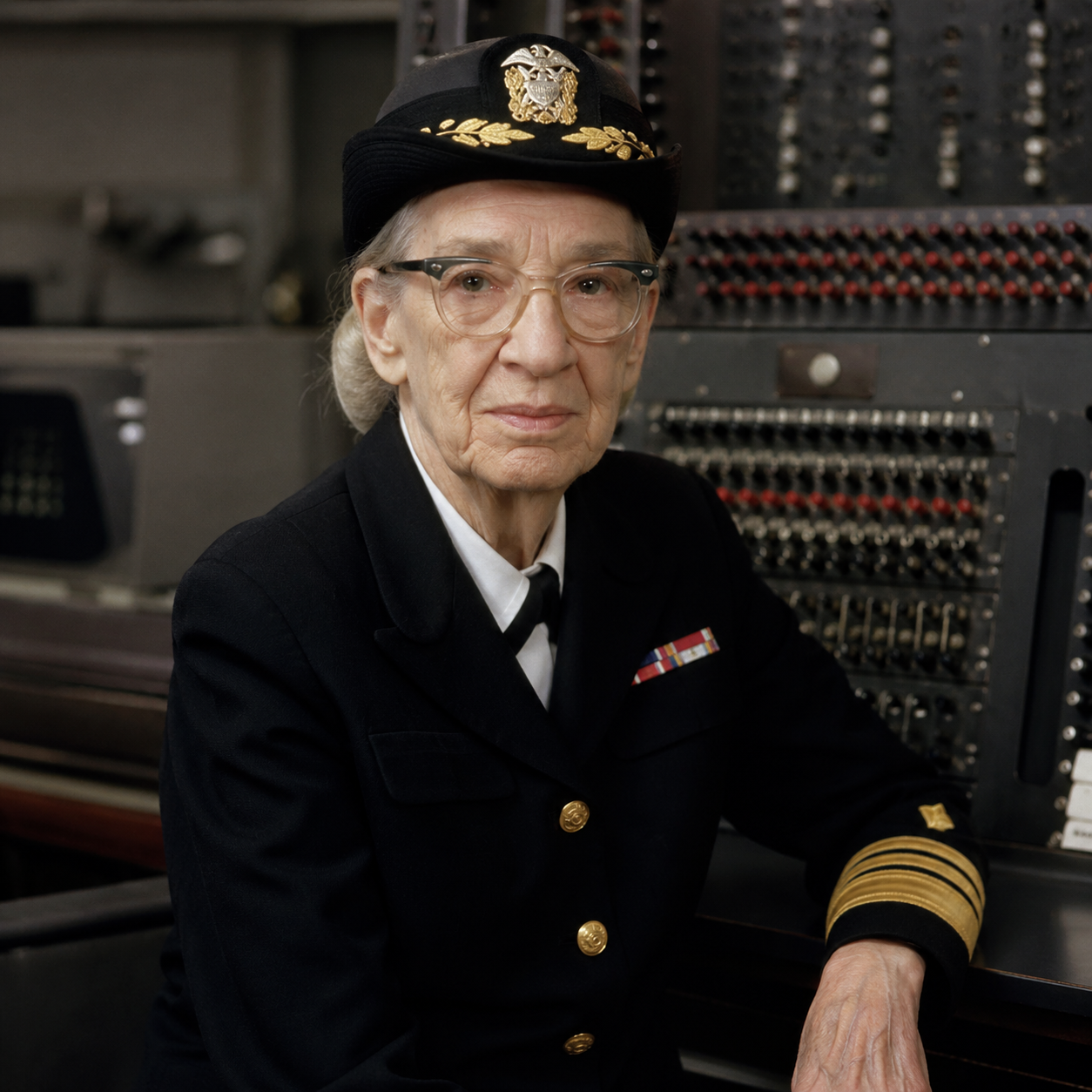
In 1944, Hopper—a Navy Reserve lieutenant—was assigned to Howard Aiken's lab at Harvard, where she became one of the Mark I's first programmers and co-authored its operating manual. She later invented the first compiler and led development of COBOL, achievements that shaped modern computing. Yet she cherished the Mark I most, revealing a character defined by hands-on problem-solving and the joy of pioneering something genuinely unprecedented.
The Harvard Mark I was completed in 1944, mid-World War II, when it computed ballistic firing tables and other wartime calculations. It represented the dawn of programmable computing—before transistors, before stored-program architecture—an electromechanical behemoth of 530 miles of wire. Women like Hopper were recruited into computing roles through wartime necessity, transforming a military emergency into the founding moment of modern computer science.
AI-generated insights based on extensive research and information for context. Factual errors? Email [email protected].
Your cart is empty