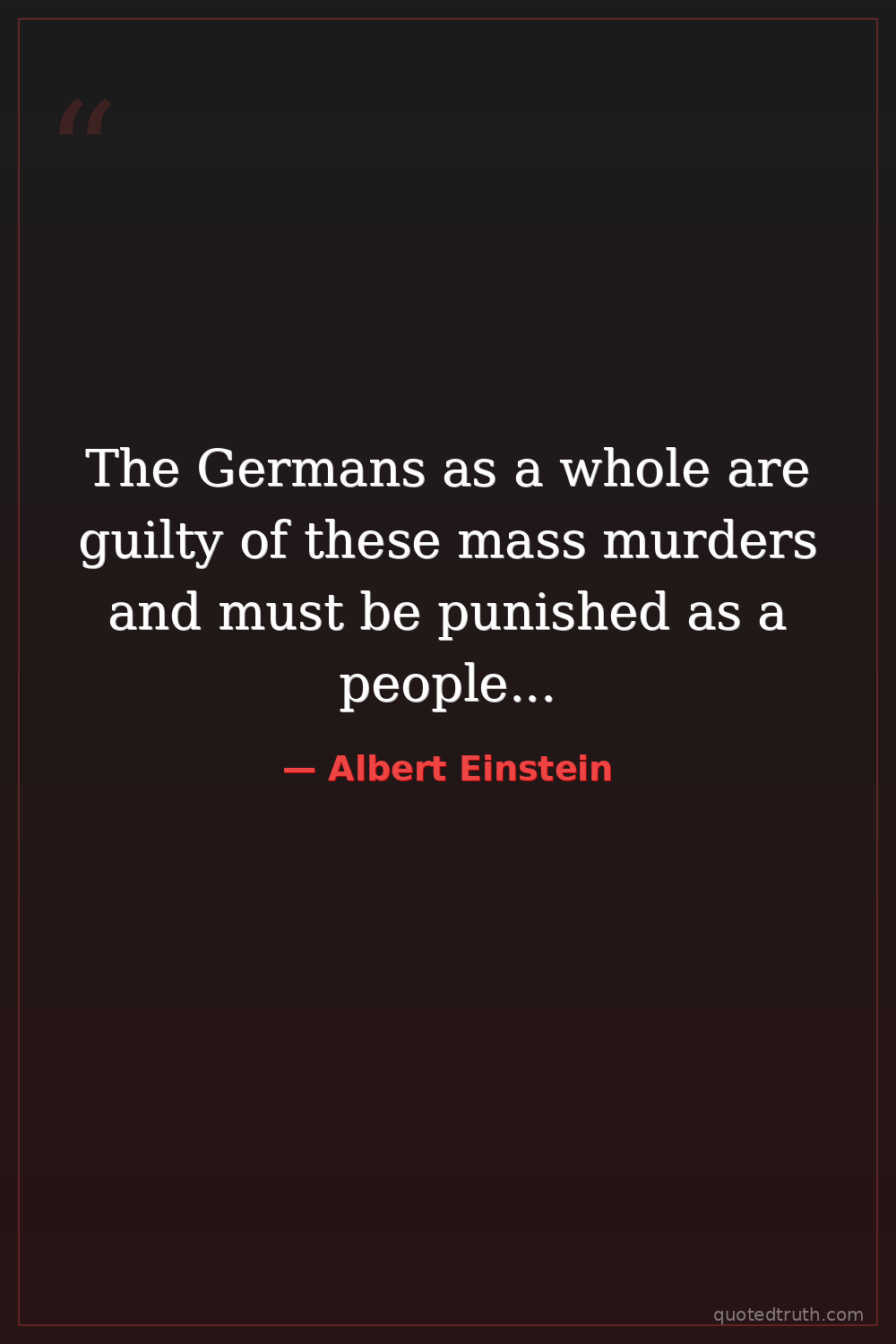
Albert Einstein — "The Germans as a whole are guilty of these mass murders and must be punished as …"
The Germans as a whole are guilty of these mass murders and must be punished as a people...
The Germans as a whole are guilty of these mass murders and must be punished as a people...
Click any product to generate a realistic preview. Up to 3 at a time.
* Initial load can take up to 90 seconds — revising the preview in another color is nearly instant.
"The important thing is not to stop questioning. Curiosity has its own reason for existence. One cannot help but be in awe when one contemplates the mysteries of eternity, of life, of the marvelous str…"
"Life without playing music is inconceivable for me. I live my daydreams in music. I see my life in terms of music. I get most joy in life out of music."
"The important thing is not to stop questioning. Curiosity has its own reason for existence."
"The only way to do great work is to love what you do."
"The problems that exist in the world today cannot be solved by the level of thinking that created them."
Found in 1 providers: deepseek
1 source checked
The quote asserts collective moral responsibility: that an entire nation cannot escape guilt for systematic atrocities carried out in its name. It rejects the defense that ordinary citizens were uninvolved bystanders, arguing that passive acceptance of genocide — through silence, compliance, or civic support — constitutes shared culpability. The people who enabled, tolerated, or simply did nothing to stop mass murder bear responsibility alongside those who directly committed the crimes.
Einstein was a German-born Jewish physicist who fled Nazi Germany in 1933 after Hitler rose to power. His work was denounced as 'Jewish physics,' his citizenship revoked, and his property seized. Colleagues and fellow Jews were murdered in the Holocaust. He permanently refused to return to Germany after the war and advocated strongly for Jewish statehood. This quote reflects a deeply personal reckoning — not abstract philosophy — from someone who experienced Nazi persecution firsthand.
Spoken in the immediate postwar period (circa 1945–1948), when the full scale of the Holocaust was being documented and the Nuremberg Trials were underway. A fierce debate emerged globally about whether ordinary Germans bore responsibility or could claim ignorance. Denazification programs, Allied occupation policy, and the moral foundations of postwar Germany all hinged on this question of collective versus individual guilt, making Einstein's blunt position both controversial and historically significant.
AI-generated insights based on extensive research and information for context. Factual errors? Email [email protected].
Your cart is empty