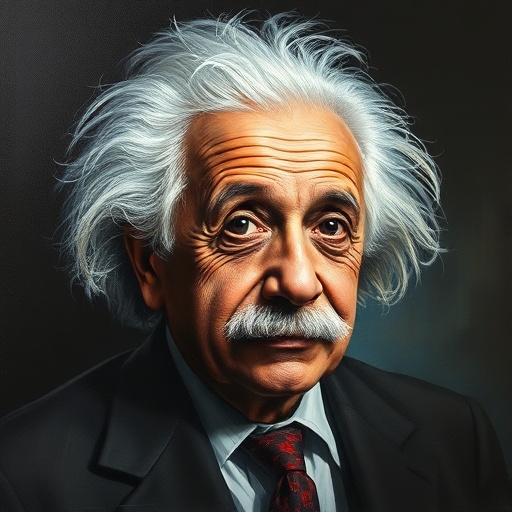
Albert Einstein — "The problems that exist in the world today cannot be solved by the level of thin…"
The problems that exist in the world today cannot be solved by the level of thinking that created them.
The problems that exist in the world today cannot be solved by the level of thinking that created them.
Click any product to generate a realistic preview. Up to 3 at a time.
* Initial load can take up to 90 seconds — revising the preview in another color is nearly instant.
"It is not that I'm so smart, but I stay with problems longer."
"The definition of genius is taking the complex and making it simple."
"Science without religion is lame, religion without science is blind."
"My passion for social justice has often brought me into conflict with people, as has my aversion to all kinds of authority."
"Life without playing music is inconceivable for me. I live my daydreams in music. I see my life in terms of music. I get most joy in life out of music."
Attributed, exact source elusive, but consistent with his philosophical views.
Date: Undetermined
Art & CreativityFound in 1 providers: grok
1 source checked
When you're stuck in a problem, the same assumptions, habits, and mental frameworks that led you into it won't get you out. Real solutions require stepping back and thinking differently — questioning premises, adopting new perspectives, or reframing the entire situation. Progress demands a fundamental shift in how you approach the challenge, not just more effort applied to the same broken approach.
Einstein's entire career embodied this principle. Classical Newtonian physics was the dominant framework when he began working; rather than refining it, he questioned its foundational assumptions about time and space, producing special and general relativity. He repeatedly challenged scientific orthodoxy not by working harder within existing paradigms but by imagining entirely new ones — most famously through thought experiments that reframed reality.
Einstein lived through two World Wars, the rise of totalitarianism, and the Manhattan Project — crises largely created by nationalist ideologies, arms races, and industrial-age thinking. He became a vocal pacifist and advocate for world government, believing that the political thinking that produced modern warfare was incapable of preventing it. Only internationalism and a new ethical framework, he argued, could address humanity's self-created existential threats.
AI-generated insights based on extensive research and information for context. Factual errors? Email [email protected].
Your cart is empty