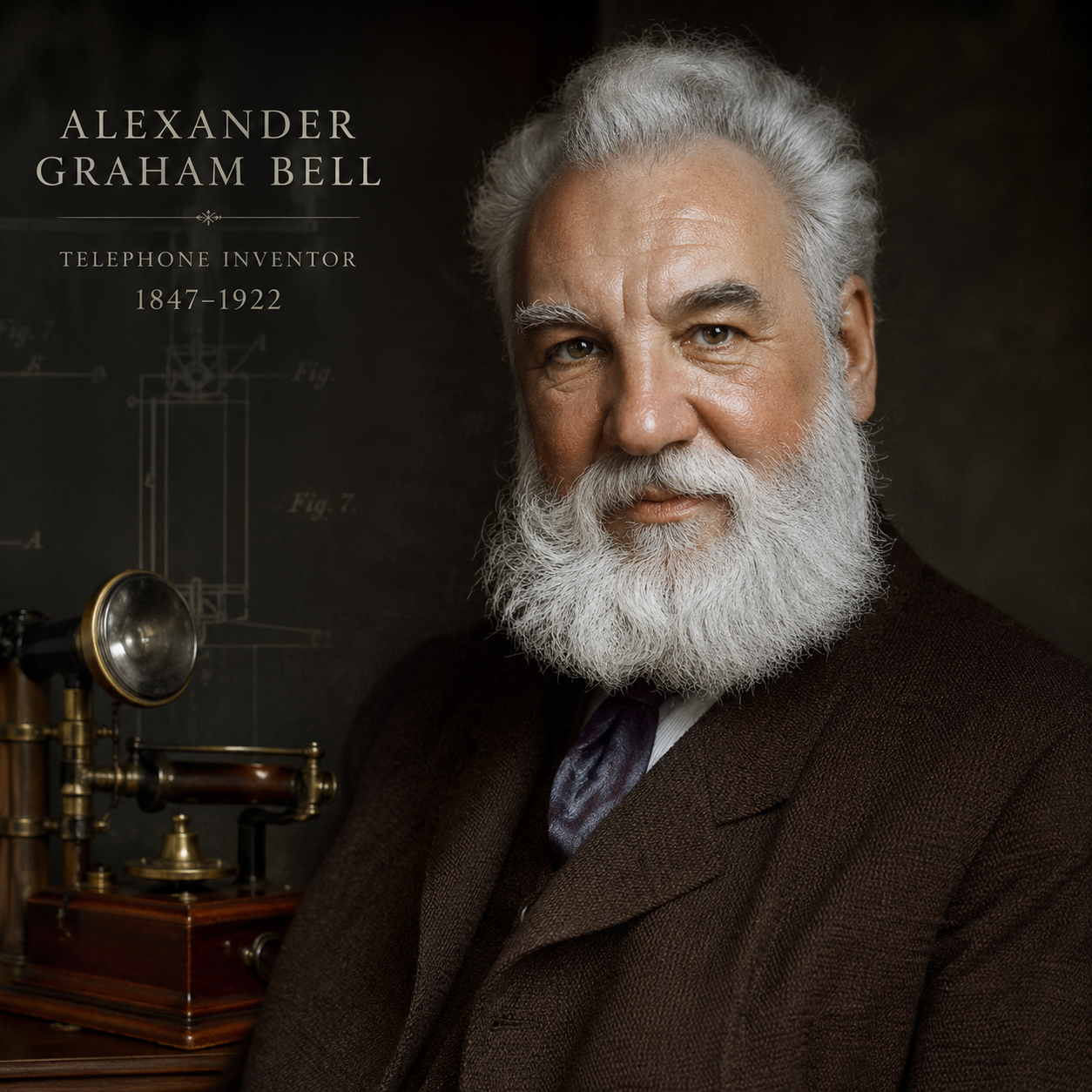
Alexander Graham Bell — "The telephone will be in every city, town, and village in the United States."
The telephone will be in every city, town, and village in the United States.
The telephone will be in every city, town, and village in the United States.
Click any product to generate a realistic preview. Up to 3 at a time.
* Initial load can take up to 90 seconds — revising the preview in another color is nearly instant.
"We are all too much inclined to follow the beaten paths of others, and it is only by striking out into new and untrodden ground that any discovery can be made."
"The only way to do great work is to love what you do. If you haven't found it yet, keep looking. Don't settle."
"I begin my work at about nine or ten o'clock in the evening and continue until four or five in the morning. Night is a more quiet time to work. It aids thought."
"Any one, if he will only observe, can find some little thing he does not understand as a starter for an investigation."
"The inventor... looks upon the world and is not contented with things as they are. He wants to improve whatever he sees, he wants to benefit the world; he is haunted by an idea. The spirit of inventio…"
Found in 1 providers: grok
1 source checked
Bell predicted the telephone would become universally available across America—not just in major cities but in small towns and rural villages alike. He foresaw a fully networked nation where speaking over distance would be ordinary for everyone. What sounds obvious today was radical optimism in 1877, when fewer than a dozen phones existed and most Americans had never heard a voice transmitted through wire.
Bell patented the telephone in 1876 and immediately began promoting it commercially. He co-founded the Bell Telephone Company in 1877, fighting aggressive competition and legal challenges. His confidence in universal adoption wasn't passive optimism—he actively lobbied investors, demonstrated the device publicly, and believed his invention would reshape society. This prediction reflects his missionary conviction that communication technology belonged to everyone, not just telegraph offices and businesses.
In the late 1870s, America's long-distance communication ran almost entirely through telegraph lines controlled by Western Union, which dominated business and government. The country was rapidly industrializing, railroads were stitching regions together, and rural communities were isolated from national life. Bell's prediction challenged Western Union's monopoly vision and aligned with a democratic impulse—that voice communication should follow America's expanding infrastructure into every corner of the country.
AI-generated insights based on extensive research and information for context. Factual errors? Email [email protected].
Your cart is empty