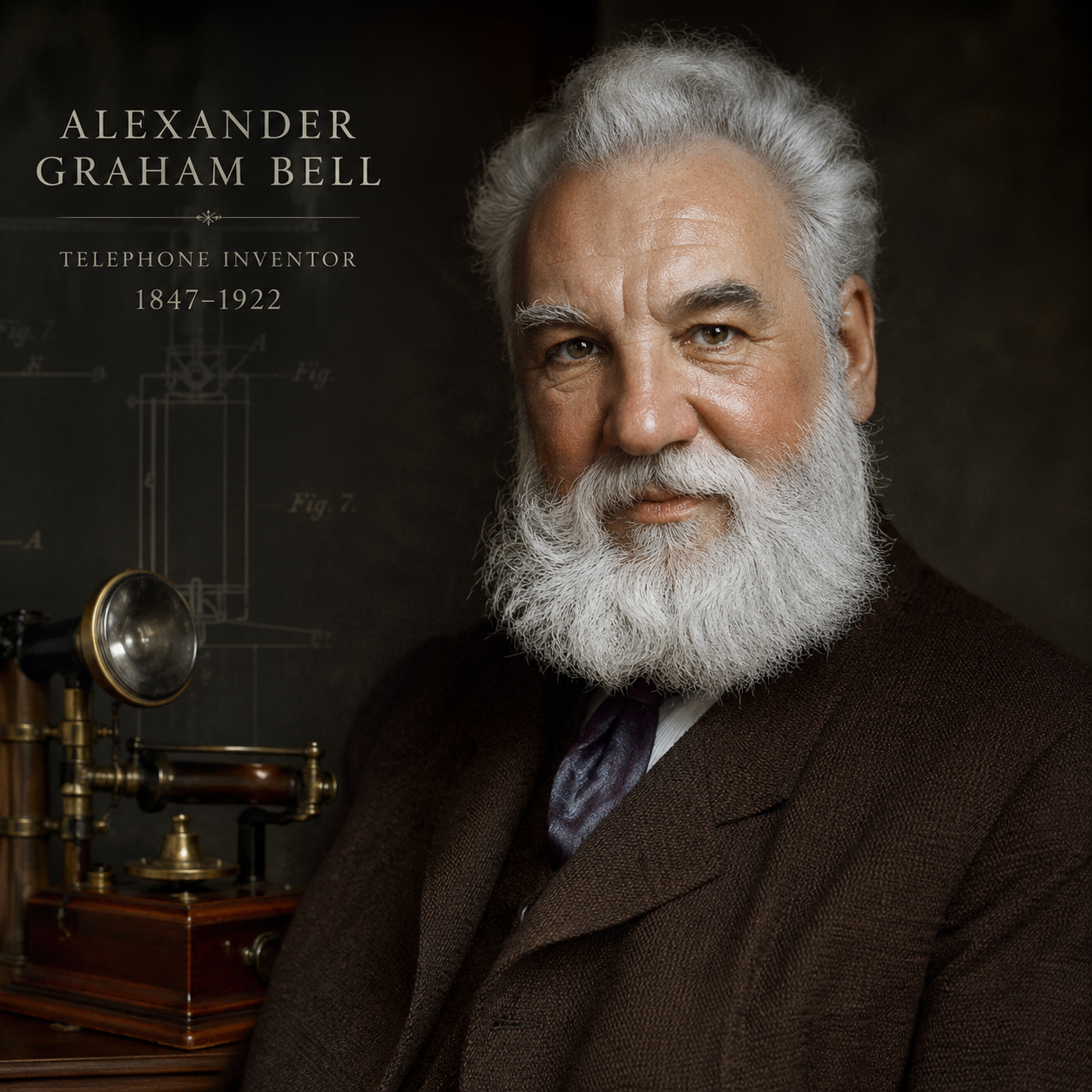
Alexander Graham Bell — "Any one, if he will only observe, can find some little thing he does not underst…"
Any one, if he will only observe, can find some little thing he does not understand as a starter for an investigation.
Any one, if he will only observe, can find some little thing he does not understand as a starter for an investigation.
Click any product to generate a realistic preview. Up to 3 at a time.
* Initial load can take up to 90 seconds — revising the preview in another color is nearly instant.
"Great discoveries and improvements invariably involve the cooperation of many minds. I may be given credit for having blazed the trail, but when I look at the subsequent developments I feel the credit…"
"America is a country of inventors, and the greatest of inventors are the newspaper men."
"Environment counts for a great deal. A man's particular idea may have no chance for growth or encouragement in his community. Real success is denied that man, until he finds a proper environment."
"The inventor... looks upon the world and is not contented with things as they are. He wants to improve whatever he sees, he wants to benefit the world; he is haunted by an idea. The spirit of inventio…"
"I am a believer in unconscious cerebration. The brain is working all the time, though we do not know it. At night it follows up what we think in the daytime. When I have worked a long time on one thin…"
From an address to the graduating class of the Friends' School, Washington, D.C.
Date: 1914
PhilosophicalFound in 1 providers: gemini
1 source checked
Curiosity-driven discovery is available to everyone, not just credentialed scientists. The starting point is simple: pay close attention to the world around you. Any small detail that seems puzzling or unexplained can become the seed of real investigation. You don't need a laboratory or a degree to begin—you need only the discipline to notice something and the will to ask why it works that way.
Bell himself began the work that produced the telephone not from a formal engineering commission but from observing how the human ear converts sound to nerve impulses and wondering whether electricity could replicate that. Trained as a speech therapist for the deaf, his curiosity about sound mechanics drove him. He co-founded the journal Science and spent his life investigating everything from sheep breeding to hydrofoils, proving his own maxim repeatedly.
Bell's most active years spanned the late 1800s to early 1900s, the height of the independent-inventor era. Formal science credentials were not yet standardized; Edison, Tesla, and Bell himself were largely self-directed. Public enthusiasm for electrical discovery was intense after the telegraph reshaped communication. The Victorian ethos held that systematic observation was a civic virtue open to all, and Bell's statement directly reinforces that democratizing spirit against a backdrop of rapid industrialization.
AI-generated insights based on extensive research and information for context. Factual errors? Email [email protected].
Your cart is empty