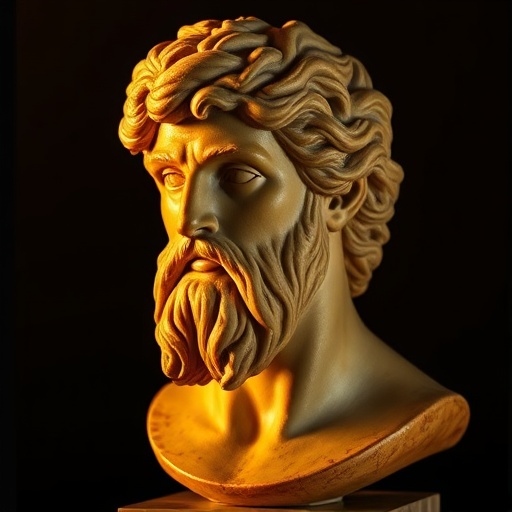
Pythagoras — "The Pythagoreans regarded 10, which contains all the numbers, as the holiest num…"
The Pythagoreans regarded 10, which contains all the numbers, as the holiest number.
The Pythagoreans regarded 10, which contains all the numbers, as the holiest number.
Click any product to generate a realistic preview. Up to 3 at a time.
* Initial load can take up to 90 seconds — revising the preview in another color is nearly instant.
"Educate the children and it won't be necessary to punish the men."
"Do not wear a ring."
"Five represents marriage because it is the sum of two and three (the Pythagoreans believed that even numbers were masculine and odd numbers were feminine)."
"Do only those things which will not harm thee, and deliberate before you act."
"Don't keep clawed birds."
Greek philosopher and mathematician whose school in Croton combined geometry (the Pythagorean theorem), number-mysticism, and a religious-vegetarian way of life. Closely associated with Thales of Miletus (earlier pre-Socratic and the first philosopher). For an intellectual contrast, see Heraclitus, pre-Socratic Greek philosopher of flux — Heraclitus called Pythagoras 'the chief of swindlers' — among the founding insults of the philosophical-rivalry tradition. Their 'all is flux' vs 'all is number' poles still organize the philosophy of mathematics today (Platonist vs anti-realist).
A central belief of Pythagorean numerology, referring to the Tetractys.
Date: c. 570-495 BCE (attributed later)
WisdomFound in 1 providers: gemini
1 source checked
The number 10 was considered sacred because 1+2+3+4=10, forming the tetractys, where those four numbers represent point, line, plane, and solid — all dimensions of existence. Ten symbolically contains all other numbers within it. This expresses the belief that mathematics is not merely practical but sacred, that specific numbers carry divine significance and serve as keys to understanding the deeper structure of the cosmos.
Pythagoras founded a mystical brotherhood in Croton, southern Italy, where mathematics and religion fused completely. He believed numbers were the universe's fundamental substance — not just tools but living truths. The tetractys was so revered that followers swore sacred oaths by it. His discovery that musical harmonics obey numerical ratios reinforced his conviction that numbers govern all reality, from celestial motion to the human soul.
In 6th-century BCE Greece, pre-Socratic philosophers debated reality's fundamental substance — Thales proposed water, Heraclitus fire. Against this backdrop, Pythagoras's claim that numbers were the true foundation was radical. Greek culture blended rationalism with religious mystery cults. His synthesis of Egyptian and Babylonian numerical traditions with Greek inquiry made sacred mathematics culturally resonant in ways pure abstraction alone could never achieve.
AI-generated insights based on extensive research and information for context. Factual errors? Email [email protected].
Your cart is empty