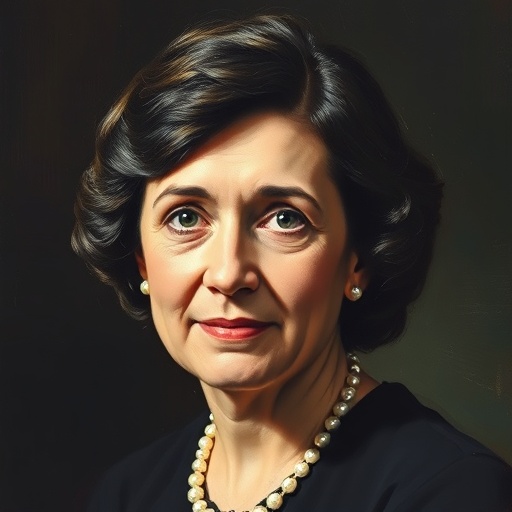
Rosalind Franklin — "I prefer to let my results do the talking."
I prefer to let my results do the talking.
I prefer to let my results do the talking.
Click any product to generate a realistic preview. Up to 3 at a time.
* Initial load can take up to 90 seconds — revising the preview in another color is nearly instant.
"The most important thing is to have an open mind and to be willing to follow the evidence wherever it leads."
"The results suggest a helical structure (which must be very closely packed) containing 2, 3, or 4 co‐axial nucleic acid chains per helical unit."
"You can't have a hypothesis unless you have some facts. And I haven't got any facts yet."
"I believe that science should be a collaborative effort, not a race."
"The structure of tobacco mosaic virus is quite intricate, and I'm enjoying the challenge."
Found in 1 providers: grok
1 source checked
This statement values evidence and demonstrated outcomes over self-promotion or rhetoric. Rather than arguing a position, lobbying for credit, or persuading through personality, the speaker chooses to let measurable findings, data, and finished work make the case. It reflects a quiet confidence that rigorous output speaks more credibly than words, and a discipline of withholding claims until the proof is visible and verifiable to others.
Franklin was a meticulous X-ray crystallographer whose Photo 51 supplied the empirical backbone for the DNA double helix, yet she rarely campaigned for recognition. Trained in physical chemistry at Cambridge, she trusted measurement, diffraction patterns, and reproducible technique over speculation. Watson and Crick built on her data, often without credit during her lifetime. Her later work on TMV and polio viruses showed the same ethic: careful experiments, precise images, and conclusions defended by the plate, not the personality.
Mid-twentieth-century science was male-dominated, clubby, and credit-driven, with women barred from common rooms at King's College London and routinely excluded from authorship politics. The 1950s race for DNA's structure rewarded bold conjecture and networking as much as data. Franklin worked in this climate, where female scientists who self-promoted were punished and those who stayed quiet were overlooked. The Nobel system, restricted to the living and to three names, further entrenched whose voices counted in the historical record.
AI-generated insights based on extensive research and information for context. Factual errors? Email [email protected].
Your cart is empty