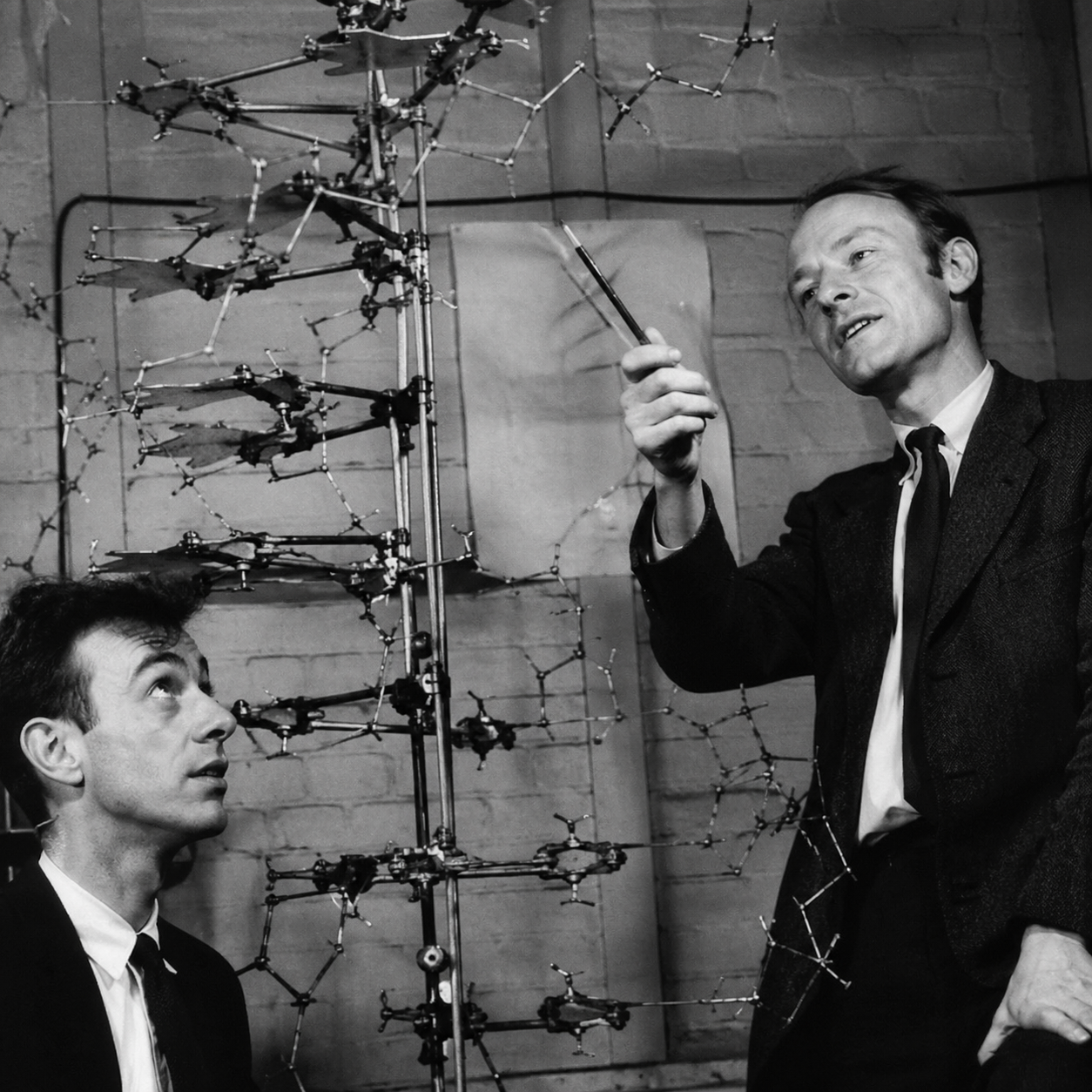
Francis Crick — "The origin of life is a scientific problem."
The origin of life is a scientific problem.
The origin of life is a scientific problem.
Click any product to generate a realistic preview. Up to 3 at a time.
* Initial load can take up to 90 seconds — revising the preview in another color is nearly instant.
"The more we know about the brain, the more we realize how complex it is."
"The idea that man was created in God's image is a myth."
"I was never a very good experimentalist."
"There is no scientific evidence for the existence of a soul."
"Chance is the only source of true novelty."
Found in 1 providers: grok
1 source checked
Crick is asserting that how life began is not a mystery reserved for theology or philosophy, but a question that can be investigated through observation, experiment, and physical laws. He treats biogenesis as tractable: chemistry, physics, and biology should eventually explain how non-living matter organized into self-replicating systems. The claim removes the supernatural from the table and places the question squarely inside the laboratory, where evidence and falsifiable hypotheses, not authority or tradition, decide answers.
Crick co-discovered the DNA double helix with Watson in 1953, then spent decades pushing biology toward molecular rigor. A trained physicist turned biologist and a lifelong atheist, he co-founded the Salk Institute and even proposed directed panspermia with Leslie Orgel as a testable hypothesis. He wrote 'Of Molecules and Men' attacking vitalism. For Crick, insisting life's origin is a scientific problem was consistent with his career-long campaign to replace mystical explanations with chemistry.
Crick worked from the 1950s through the 2000s, an era when molecular biology, the Miller-Urey experiment, RNA-world hypotheses, and exobiology programs at NASA were transforming abiogenesis from speculation into bench science. The Cold War space race, the genetic code's cracking, and later genome sequencing made biological questions feel solvable. Simultaneously, creationism and intelligent-design movements pushed back in U.S. courts and classrooms, so declaring life's origin a scientific problem was both a research stance and a cultural statement.
AI-generated insights based on extensive research and information for context. Factual errors? Email [email protected].
Your cart is empty