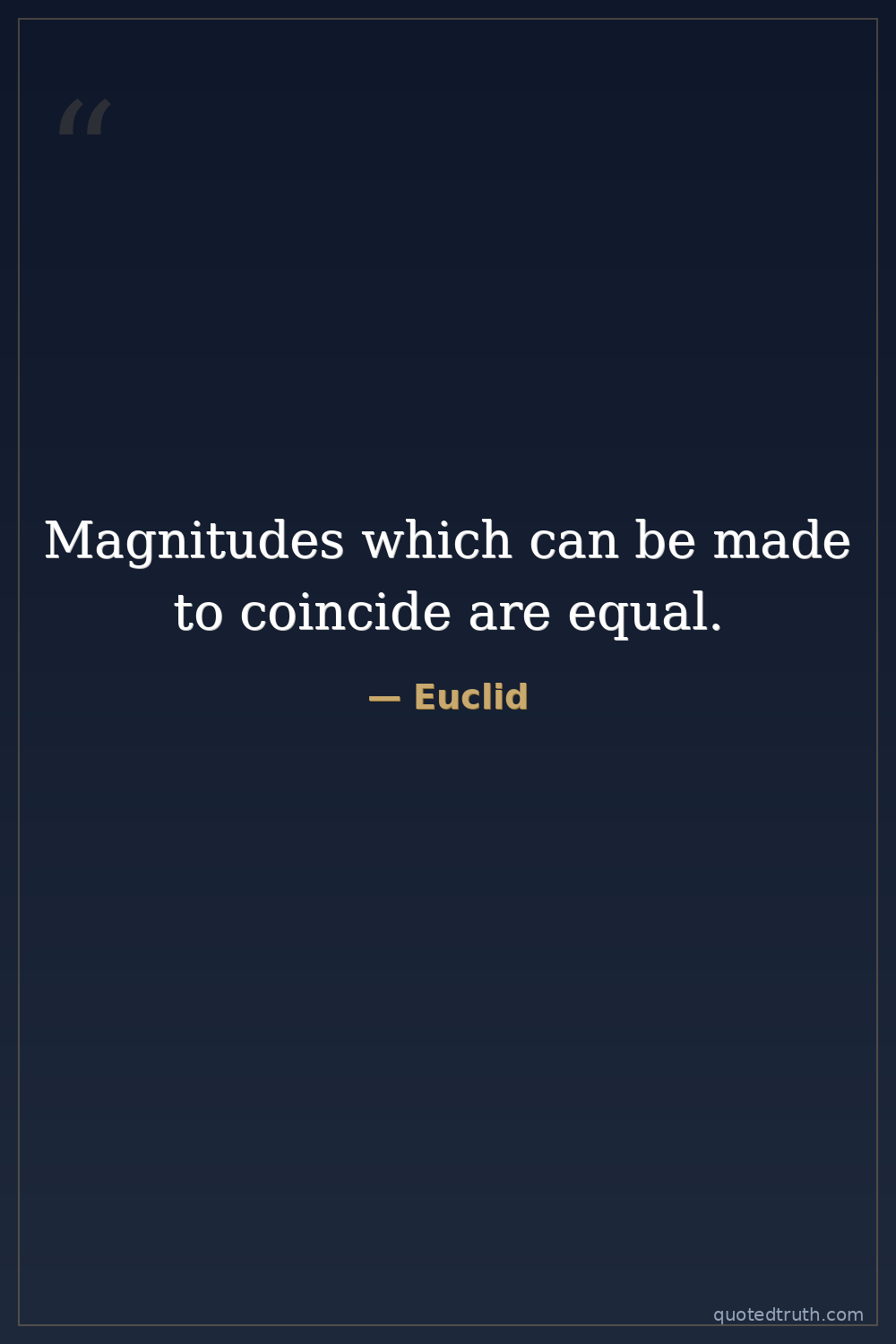
Euclid — "Magnitudes which can be made to coincide are equal."
Magnitudes which can be made to coincide are equal.
Magnitudes which can be made to coincide are equal.
Click any product to generate a realistic preview. Up to 3 at a time.
* Initial load can take up to 90 seconds — revising the preview in another color is nearly instant.
"A boundary is that which is an extremity of anything."
"Let it be granted that a circle may be described with any center and any radius."
"A figure is that which is contained by any boundary or boundaries."
"If a straight line be cut into two equal parts and also into two unequal parts, the rectangle contained by the unequal parts together with the square on the line between the points of section is equal…"
"A plane angle is the inclination of the lines to one another, when two lines meet one another, but are not in the same straight line."
Found in 1 providers: grok
1 source checked
Two things are equal if they can be perfectly overlaid on each other — no gaps, no overflow, complete overlap. Equality isn't declared abstractly; it's proven by physical or logical superposition. This is a concrete, testable definition of sameness, grounding abstract mathematics in observable reality rather than assumption or authority.
Euclid built geometry on rigorous axioms and definitions in his Elements, refusing to assume what could be proven. This principle reflects his insistence on demonstration over declaration. As a systematizer who compiled and formalized Greek mathematical knowledge around 300 BCE, he grounded every theorem in foundational truths exactly like this one.
In ancient Greece, mathematics was transitioning from practical measurement — land surveying, architecture, astronomy — to abstract logical proof. Euclid worked in Alexandria under Ptolemy I, where the great Library fostered intellectual rigor. This definition answered philosophical disputes about what 'equality' means, a live debate among Platonic and Aristotelian thinkers of his era.
AI-generated insights based on extensive research and information for context. Factual errors? Email [email protected].
Your cart is empty