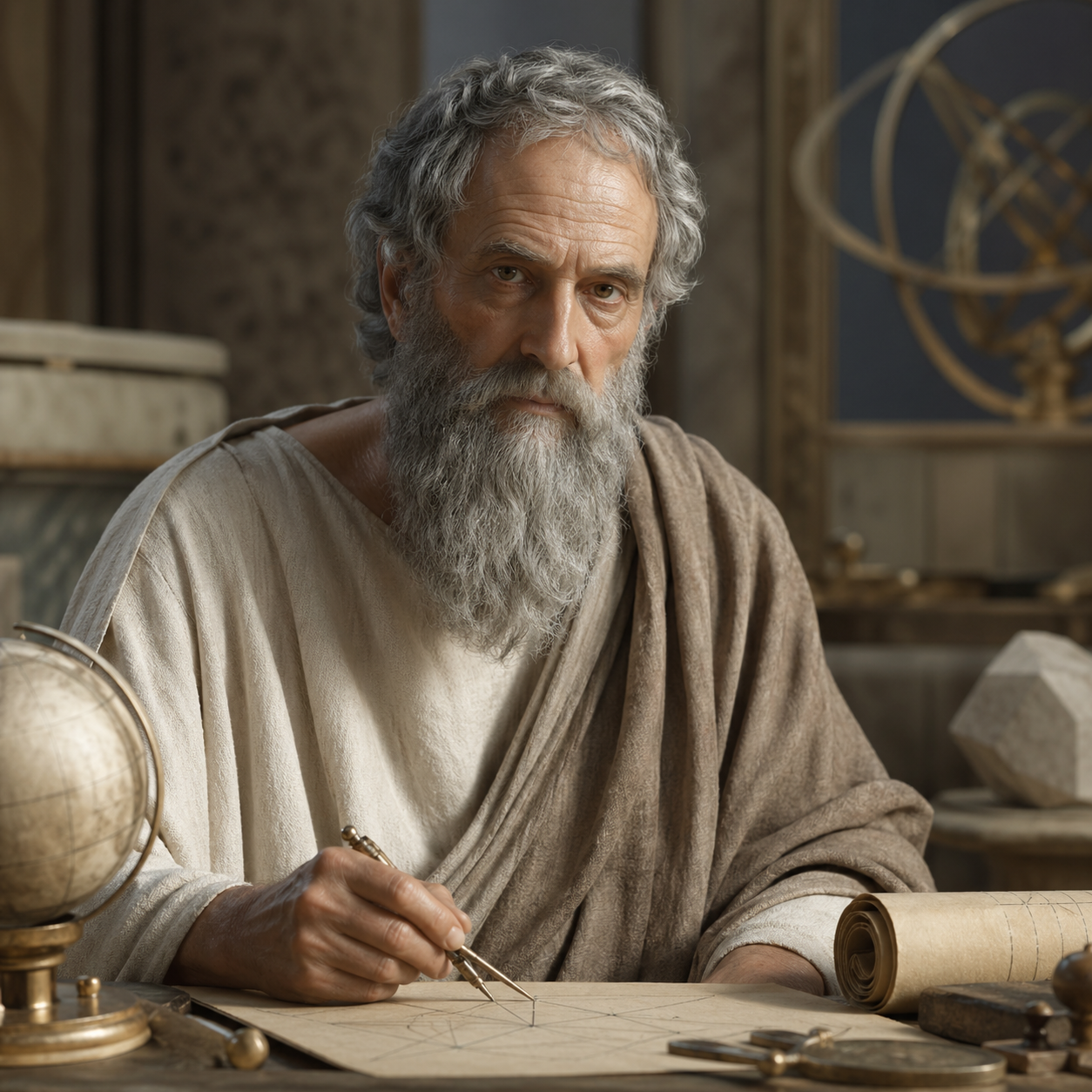
Euclid — "A figure is that which is contained by any boundary or boundaries."
A figure is that which is contained by any boundary or boundaries.
A figure is that which is contained by any boundary or boundaries.
Click any product to generate a realistic preview. Up to 3 at a time.
* Initial load can take up to 90 seconds — revising the preview in another color is nearly instant.
"The extremities of a line are points."
"To bisect a given rectilinear angle."
"Let it be granted that all right angles are equal to one another."
"Rectilineal figures are those which are contained by straight lines..."
"Parallel straight lines are straight lines which, being in the same plane and being produced indefinitely in both directions, do not meet one another in either direction."
Found in 2 providers: grok,deepseek
2 sources checked
A shape or form is defined entirely by whatever encloses it — its boundary is what makes it exist as a figure. Without a border, there is no shape, only open space. This is a foundational definition: before you can discuss triangles, circles, or polygons, you must agree on what a figure even is. The boundary is not decoration; it is the thing itself.
Euclid built all of geometry on precise definitions before proving anything — this is Definition 14 from Book I of his Elements, written around 300 BCE. His method of starting from irreducible definitions, then axioms, then proofs became the template for mathematical rigor for two millennia. That he defined 'figure' before tackling triangles or circles shows his commitment to leaving nothing assumed — the hallmark of his intellectual character.
In Hellenistic Alexandria around 300 BCE, Greek thinkers were systematizing knowledge rather than merely applying it. Practical geometry had existed for centuries in Egypt and Mesopotamia for surveying and construction, but lacked logical foundations. Under Ptolemy I's patronage, the Library of Alexandria attracted scholars to organize inherited knowledge. Euclid's era demanded rigor: Plato had argued that only reasoned truth, not sensory observation, was reliable — making precise definitions philosophically necessary, not just mathematical housekeeping.
AI-generated insights based on extensive research and information for context. Factual errors? Email [email protected].
Your cart is empty