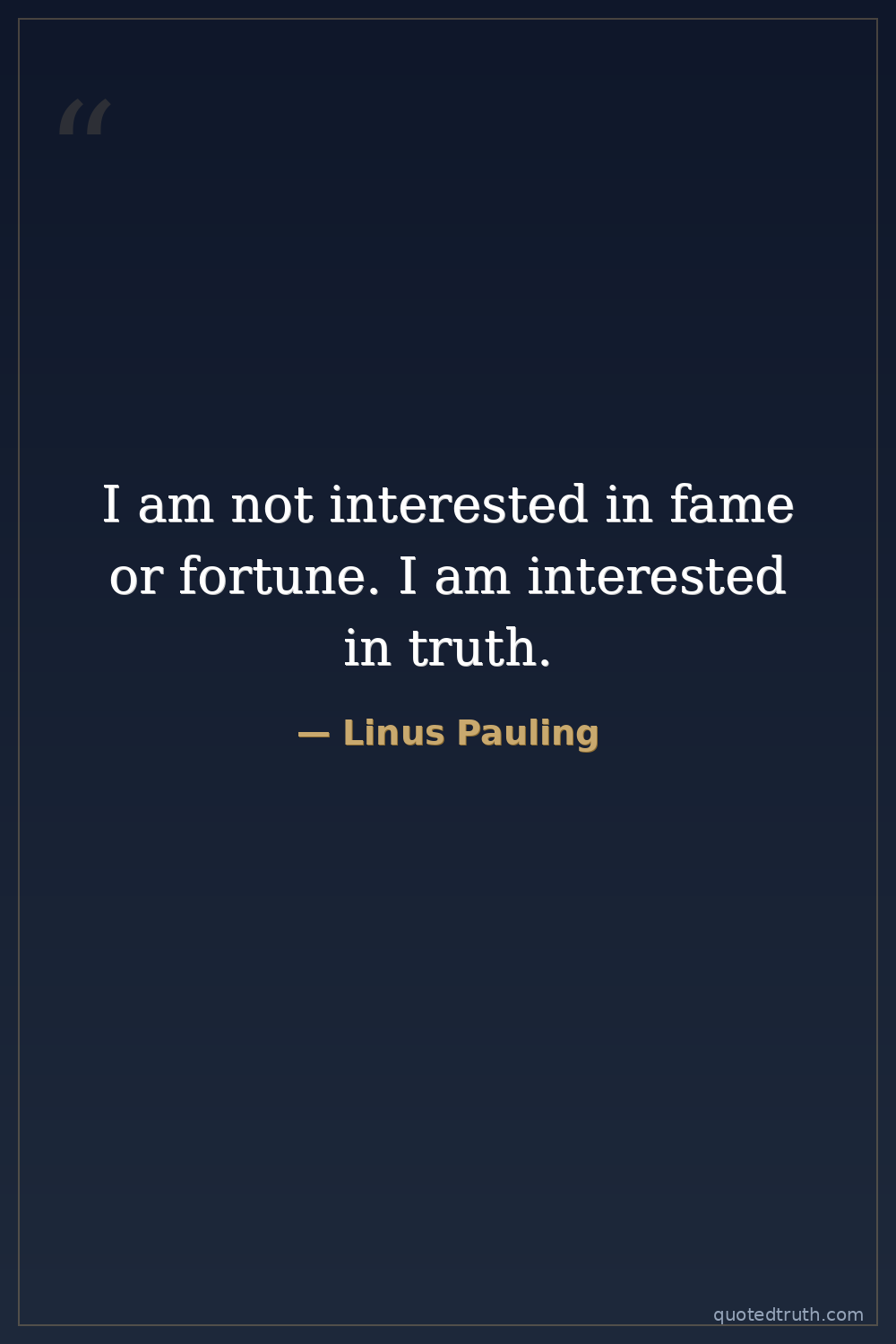
Linus Pauling — "I am not interested in fame or fortune. I am interested in truth."
I am not interested in fame or fortune. I am interested in truth.
I am not interested in fame or fortune. I am interested in truth.
Click any product to generate a realistic preview. Up to 3 at a time.
* Initial load can take up to 90 seconds — revising the preview in another color is nearly instant.
"I have had a good life, and I am grateful for it. I have done my best to make the world a better place."
"I refuse to be intimidated by the word impossible."
"I am convinced that we can abolish war, and that we must do so if we are to survive."
"Vitamin C is the best natural antihistamine."
"I have something that I call my Golden Rule. It goes something like this: 'Do unto others twenty-five percent better than you expect them to do unto you.' … The twenty-five percent is for error."
Found in 1 providers: grok
1 source checked
The speaker prioritizes discovering what is actually real and correct over personal gain or recognition. Fame brings attention, fortune brings comfort, but neither reveals how the world truly works. Truth demands rigorous, honest inquiry regardless of reward or consequence. This is a declaration that intellectual integrity and factual accuracy matter more than the social or financial benefits that sometimes accompany great achievement.
Pauling won two unshared Nobel Prizes—Chemistry in 1954 and Peace in 1962—yet remained deeply controversial for his late-career advocacy of vitamin C megadosing and his anti-nuclear activism during McCarthyism. He risked his reputation and passport fighting for what he believed was true. His pursuit of chemical bond theory and protein structure wasn't driven by acclaim but by obsessive curiosity about molecular reality.
Pauling worked through mid-20th century America, when Cold War pressures pushed scientists toward weapons research and ideological conformity. McCarthyism threatened careers for dissent. The race to unlock DNA, develop nuclear weapons, and advance pharmaceutical science created enormous commercial and political incentives that could corrupt scientific objectivity. Pauling's insistence on truth over fortune was a pointed rebuke of that era's corrupting pressures on science.
AI-generated insights based on extensive research and information for context. Factual errors? Email [email protected].
Your cart is empty