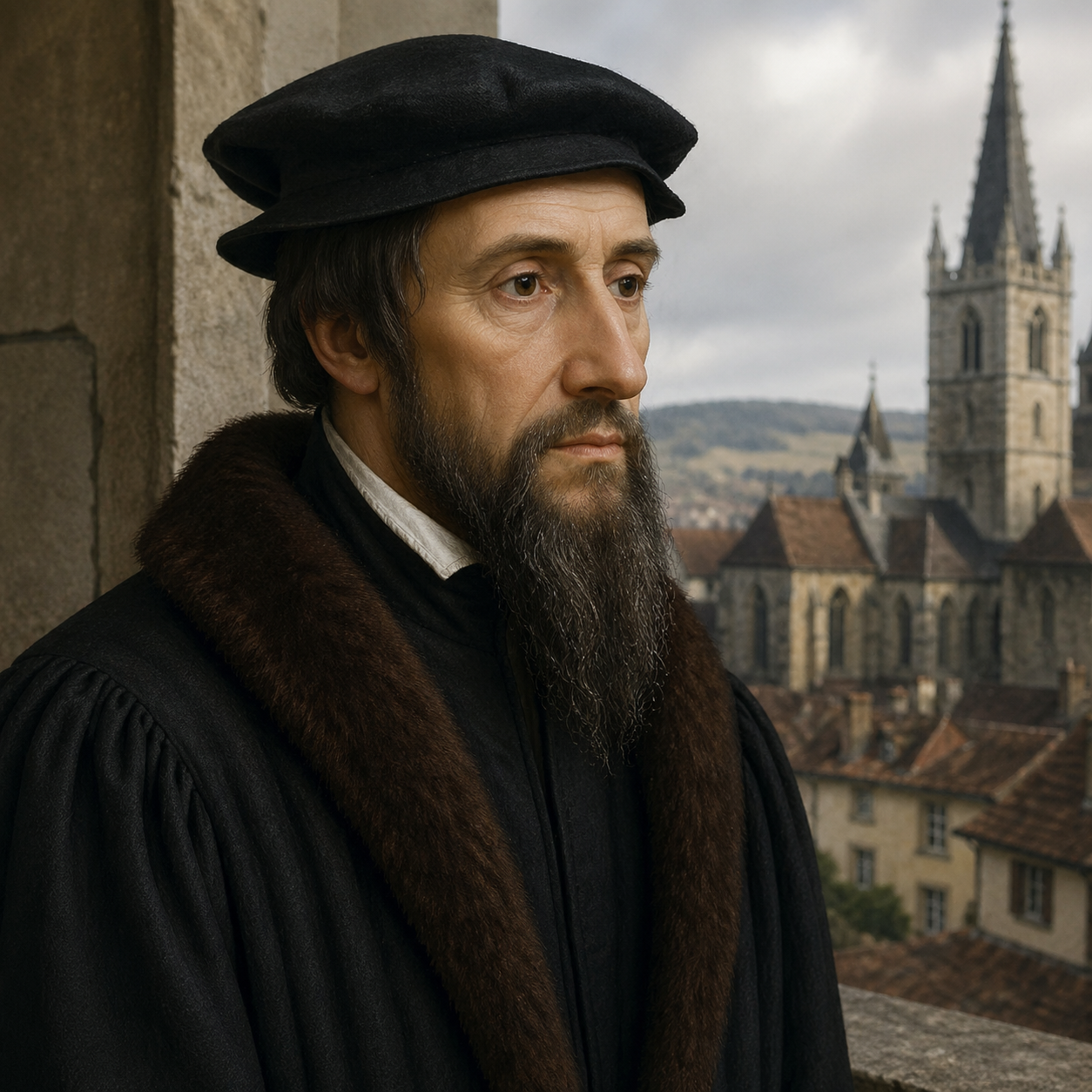
John Calvin — "All true knowledge of God is born of obedience."
All true knowledge of God is born of obedience.
All true knowledge of God is born of obedience.
Click any product to generate a realistic preview. Up to 3 at a time.
* Initial load can take up to 90 seconds — revising the preview in another color is nearly instant.
"The greater part of the world, because it despises the Word of God, despises also the whole of true religion."
"The whole life of a Christian should be a perpetual exercise of repentance."
"The will of God is the supreme rule of righteousness."
"Man's chief end is to glorify God and to enjoy him forever."
"Ignorance of predestination is a great evil, because it deprives us of the knowledge of God's glory."
French theologian whose Institutes of the Christian Religion (1536) systematized Protestant Reformed doctrine, including predestination. Closely associated with Martin Luther (Reformation founder, Calvin's predecessor). For an intellectual contrast, see Jacobus Arminius, Dutch Reformed theologian (1560-1609) — Arminius's rejection of strict double-predestination founded Arminianism — the theological tradition modern Methodism, most evangelicalism, and Pentecostalism descend from. The Calvinist-Arminian debate has divided Protestantism for 400 years.
Found in 1 providers: grok
1 source checked
Genuine understanding of God cannot come through intellectual study alone. True knowledge is experiential — it emerges from actively living in submission to God's commands. Abstract theology without corresponding obedient practice produces only hollow belief. To truly know God, one must yield to His will, and through that yielding, deeper spiritual understanding becomes possible. Knowledge and obedient action are inseparable; submission is not the result of knowing God but the very pathway to knowing Him.
Calvin devoted his life to reforming Christianity through rigorous biblical study and strict church discipline in Geneva. He believed God's sovereignty was absolute and humans must conform entirely to Scripture. His Institutes of the Christian Religion systematized Reformed theology around submission to divine authority. As pastor and theologian, Calvin modeled obedience by subordinating his own considerable intellect to scriptural commands, and demanded the same disciplined conformity from every member of Geneva's Reformed church community.
Calvin wrote during the 16th-century Protestant Reformation, when European Christianity fractured over papal authority and salvation theology. The Catholic Church emphasized clerical hierarchy and tradition as God's pathways; Reformers insisted on Scripture and direct divine relationship. Renaissance humanism was resurging, elevating reason and classical learning. Calvin's claim that obedience — not scholastic argument or ritual — produces genuine knowledge was a sharp rebuke of both Catholic ceremonialism and the detached intellectualism spreading through European universities.
AI-generated insights based on extensive research and information for context. Factual errors? Email [email protected].
Your cart is empty