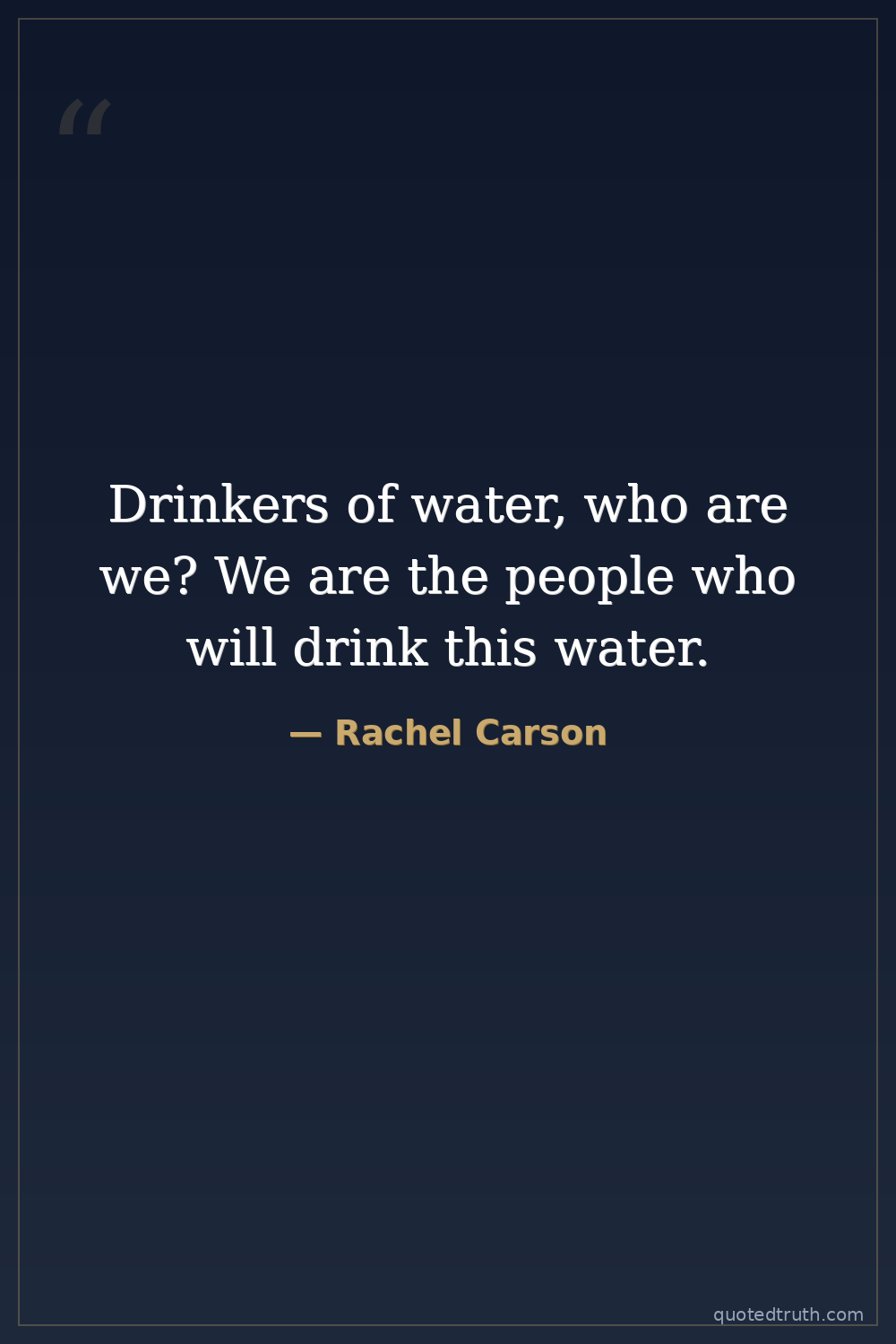
Rachel Carson — "Drinkers of water, who are we? We are the people who will drink this water."
Drinkers of water, who are we? We are the people who will drink this water.
Drinkers of water, who are we? We are the people who will drink this water.
Click any product to generate a realistic preview. Up to 3 at a time.
* Initial load can take up to 90 seconds — revising the preview in another color is nearly instant.
"The more I learn about the natural world, the more I am filled with awe."
"In nature, nothing exists alone."
"The long fight to save wild beauty represents humanity's spiritual resistance to the omnipresent ugliness and vulgarity of a materialistic civilization."
"The 'control of nature' is a phrase conceived in arrogance, born of the Neanderthal age of biology and the convenience of man."
"The more we tamper with the delicate balance of nature, the more we risk unintended consequences."
Found in 1 providers: grok
1 source checked
This quote uses a rhetorical question to establish collective responsibility. By asking 'who are we?' and answering 'the people who will drink this water,' it forces readers to recognize themselves as both agents and victims of water quality. It collapses the distance between polluters and the polluted—we cannot contaminate water and escape consequences. Everyone downstream drinks what everyone upstream puts in.
Carson spent her career documenting how human activity poisons the natural systems humans depend on. In Silent Spring, she traced how DDT and other pesticides entered waterways, bioaccumulated up food chains, and ended up in human bodies. As a marine biologist, water was central to her worldview. This quote captures her core argument: we are not separate from nature but embedded in it, vulnerable to whatever we release into it.
In the early 1960s, American industry discharged chemicals freely into rivers and groundwater with minimal regulation. DDT, industrial solvents, and agricultural runoff were contaminating drinking water sources nationwide, yet the public largely trusted tap water was safe. Carson's era predated the Clean Water Act (1972) and the EPA (1970). Rivers like the Cuyahoga literally caught fire. This quote challenged the assumption that water contamination was someone else's problem.
AI-generated insights based on extensive research and information for context. Factual errors? Email [email protected].
Your cart is empty