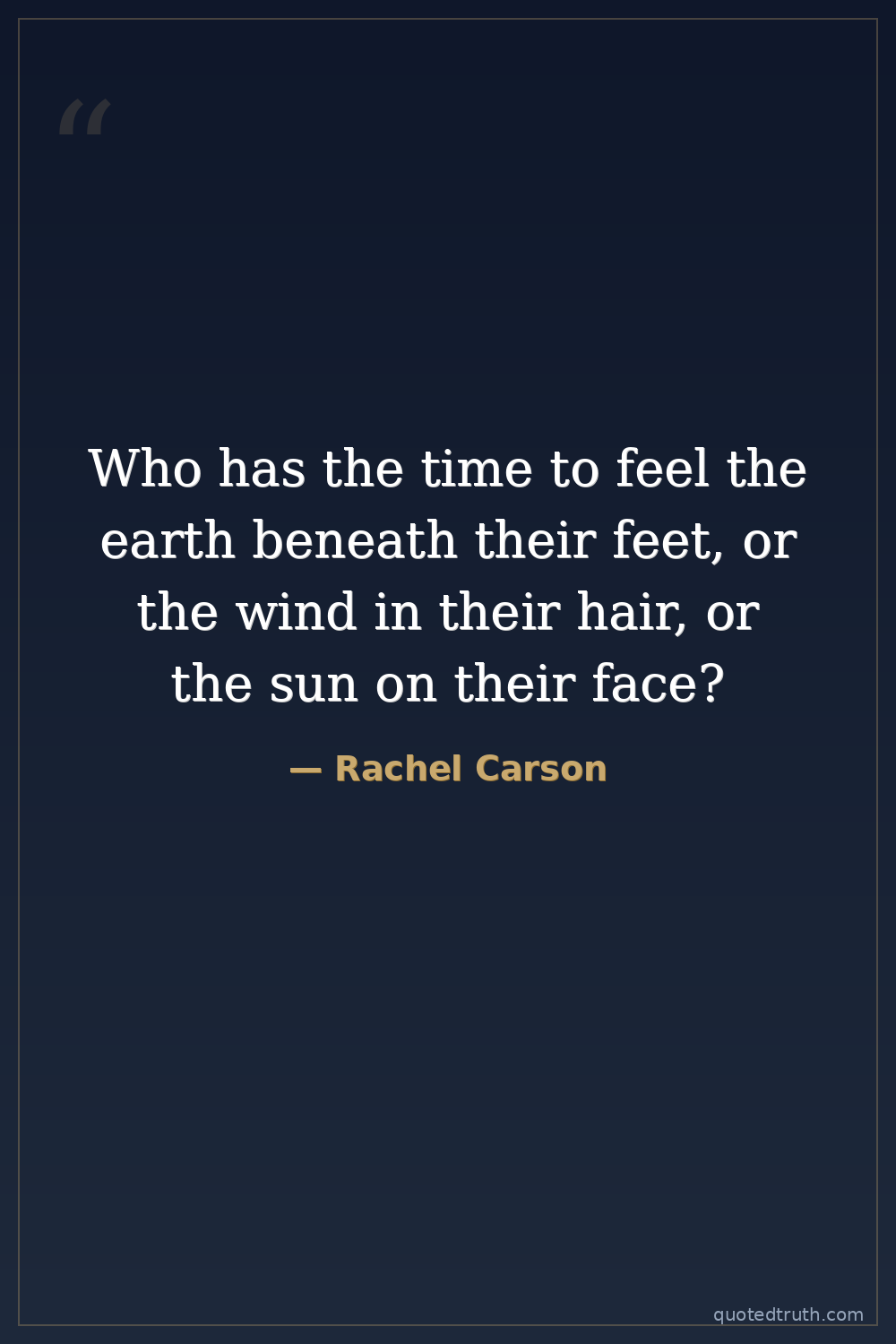
Rachel Carson — "Who has the time to feel the earth beneath their feet, or the wind in their hair…"
Who has the time to feel the earth beneath their feet, or the wind in their hair, or the sun on their face?
Who has the time to feel the earth beneath their feet, or the wind in their hair, or the sun on their face?
Click any product to generate a realistic preview. Up to 3 at a time.
* Initial load can take up to 90 seconds — revising the preview in another color is nearly instant.
"The more we learn about these chemicals, the more terrifying the prospect becomes."
"Are we to stand by while the people of the world are fed into a biological meat grinder? When we poison the air, the water, and the soil, we are poisoning ourselves."
"The fact that we are so ignorant of the long-term effects of these chemicals is terrifying."
"We are surrounded by an infinite number of wonders, and yet we see so few of them."
"Perhaps the most serious of all the omissions of the mass extermination programs is the failure to take into account the fact that environmental pollution is a two-way street."
Found in 1 providers: grok
1 source checked
The quote laments how the relentless pace of modern life has severed people from direct, sensory contact with the natural world. Feeling earth, wind, and sun represents a primal human relationship with nature that erodes under schedules, deadlines, and indoor living. It poses a rhetorical challenge: who among us actually slows down enough to register the physical textures and rhythms of the environment through our own bodies, rather than passing through it unseeing?
Carson spent her life insisting that direct sensory engagement with nature was the foundation of all conservation. Her book 'The Sense of Wonder' argued children's instinctive tactile delight in the natural world must be preserved into adulthood. As a marine biologist who waded tidal pools and observed shore life intimately, she believed intellectual knowledge of ecology meant nothing without physical presence in it — that people cannot protect a world they no longer stop to feel.
By the early 1960s, postwar America had accelerated into suburban sprawl, television culture, and chemical-dependent agriculture. DDT was aerially sprayed over neighborhoods. Factory farms displaced family land. Office work replaced outdoor labor. Americans were physically retreating indoors while industry reshaped the landscape around them. Carson's 'Silent Spring' (1962) exposed how this industrial disconnection enabled ecological poisoning to proceed unnoticed — making her question of who still pauses to feel the earth both urgent and indicting.
AI-generated insights based on extensive research and information for context. Factual errors? Email [email protected].
Your cart is empty