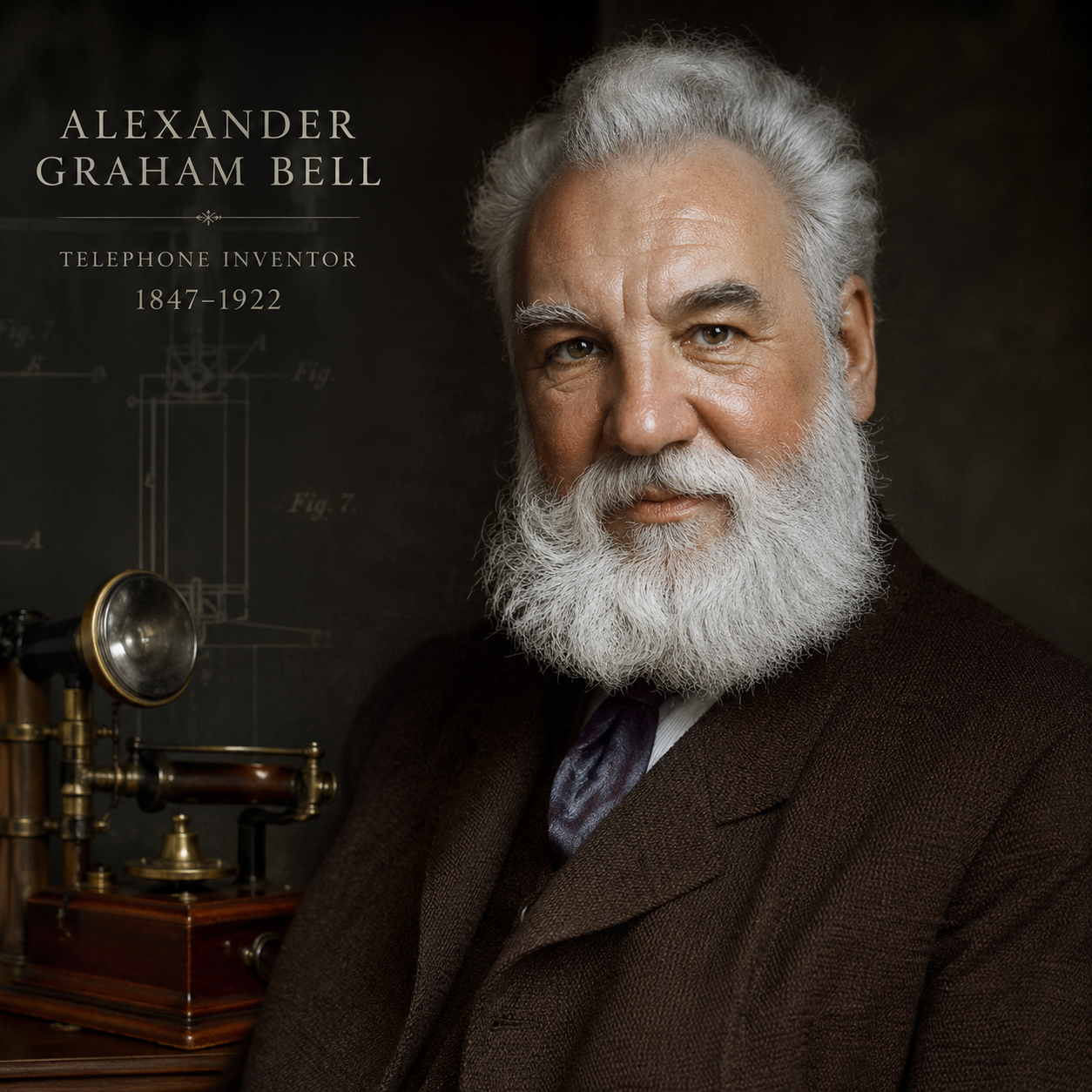
Alexander Graham Bell — "The only way to do great work is to love what you do. If you haven't found it ye…"
The only way to do great work is to love what you do. If you haven't found it yet, keep looking. Don't settle.
The only way to do great work is to love what you do. If you haven't found it yet, keep looking. Don't settle.
Click any product to generate a realistic preview. Up to 3 at a time.
* Initial load can take up to 90 seconds — revising the preview in another color is nearly instant.
"The greatest minds are capable of the greatest vices as well as of the greatest virtues."
"The only difference between a successful person and others is not a lack of strength, not a lack of knowledge, but rather a lack of will."
"Every man has a right to his own opinion, but no man has a right to be wrong in his facts."
"I am a believer in unconscious cerebration. The brain is working all the time, though we do not know it. At night it follows up what we think in the daytime. When I have worked a long time on one thin…"
"If it is not necessary, it is obviously not advisable, that deaf children should acquire, and use, as their ordinary and habitual means of communication — their vernacular in fact — a language that is…"
This is a direct quote from Steve Jobs' 2005 Stanford Commencement Address. It is frequently misattributed to Bell.
Date: 2005 (Jobs)
RelationshipsFound in 1 providers: grok
1 source checked
Exceptional achievement requires genuine passion for the work itself. You cannot fake deep commitment — it has to come from inside. The advice to keep searching rather than settling acknowledges that many people spend years in the wrong direction. Passion fuels the persistence, creativity, and sacrifice that separate ordinary output from truly great work. Comfort is the enemy of calling.
Bell's obsession with sound and communication was rooted in personal stakes — his mother and wife were both deaf, and he taught speech to the deaf before inventing the telephone. That love of human connection drove years of exhausting experiments. He never stopped inventing after the telephone — pursuing the photophone, hydrofoil, and aeronautics — embodying lifelong passion over comfortable legacy-resting.
The late 19th century was the heroic age of the solo inventor. Edison, Tesla, and Bell proved that individual passion could literally rewire civilization. Industrial expansion created new technical frontiers, and the self-made genius pursuing a calling — not a trade — became a cultural archetype. The era rewarded obsessive dedication; the inventors who changed history were uniformly those who could not stop themselves from building.
AI-generated insights based on extensive research and information for context. Factual errors? Email [email protected].
Your cart is empty