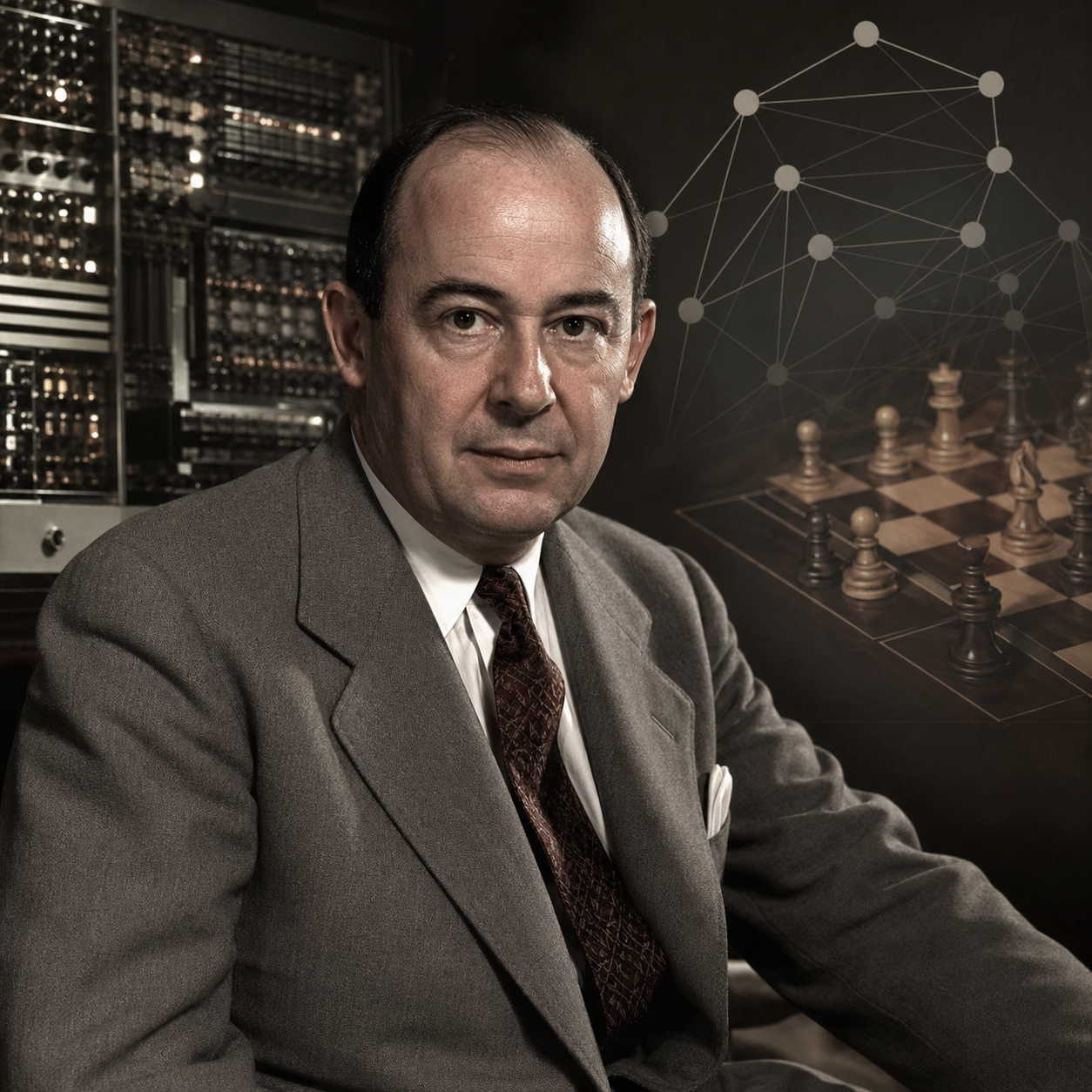
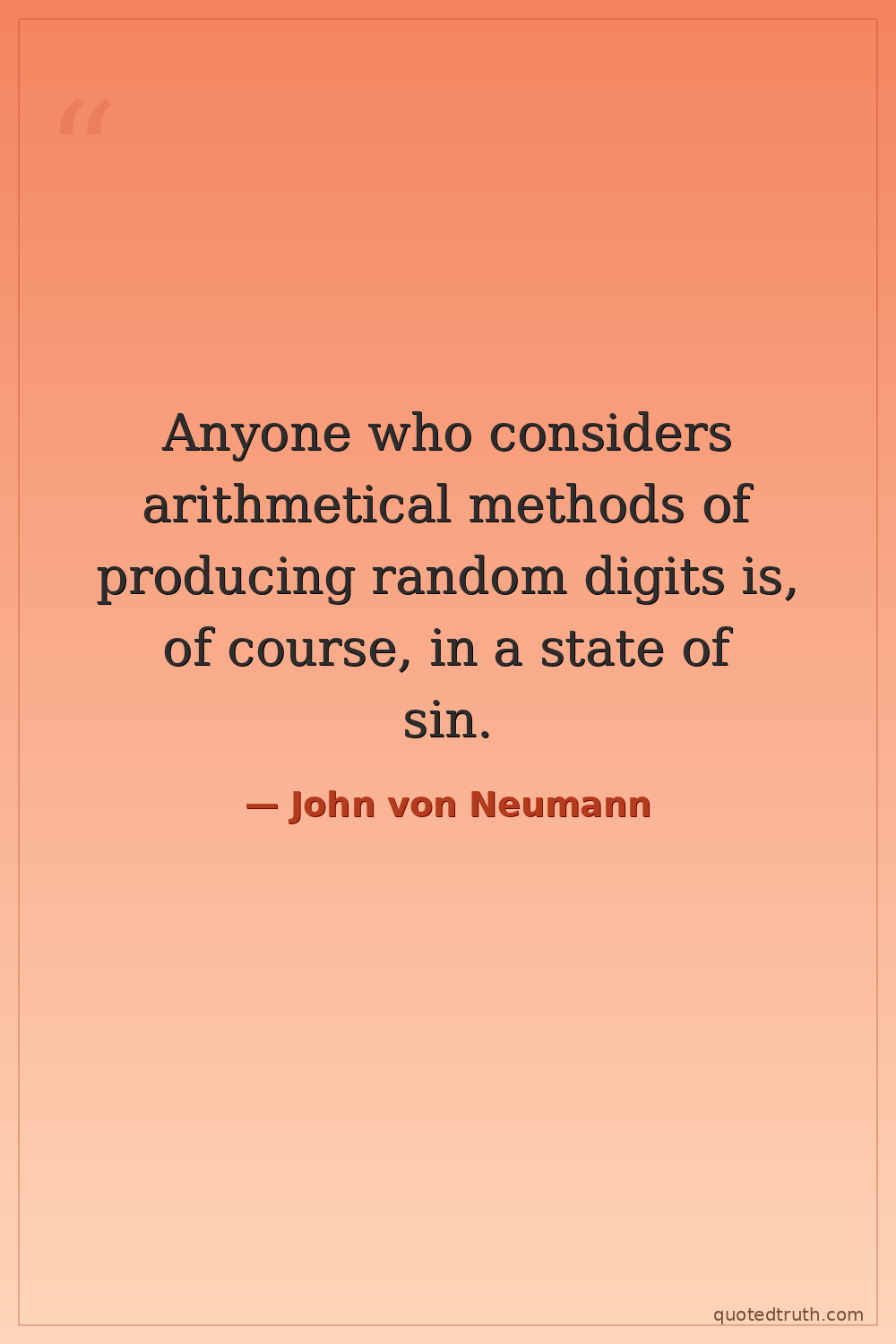
John von Neumann — "Anyone who considers arithmetical methods of producing random digits is, of cour…"
Anyone who considers arithmetical methods of producing random digits is, of course, in a state of sin.
Anyone who considers arithmetical methods of producing random digits is, of course, in a state of sin.
Click any product to generate a realistic preview. Up to 3 at a time.
* Initial load can take up to 90 seconds — revising the preview in another color is nearly instant.
"The world is governed by statistics, not by laws."
"The human brain is an amazing thing. It works from the day you're born until you fall in love."
"The computer is a universal machine. It can do anything that can be described algorithmically."
"Mathematics is not a science. It is a language."
"The world is so complicated that it cannot be described in any other way than by itself."
Lecture notes or informal remarks, highlighting the difficulty of true randomness from deterministic processes.
Date: 1951
GeneralFound in 1 providers: grok
1 source checked
Any arithmetic formula used to generate 'random' numbers is deterministic by definition — it follows fixed rules and will eventually repeat. True randomness cannot emerge from a calculation. Treating these predictable pseudo-random sequences as if they were genuinely random introduces hidden flaws into statistical simulations, cryptographic systems, and scientific models that fundamentally depend on real, unpredictable randomness to produce reliable results.
Von Neumann pioneered Monte Carlo methods at Los Alamos during the Manhattan Project, simulating nuclear reactions using random number sequences. He personally invented the middle-square method — a simple arithmetic pseudo-random generator — knowing it was theoretically impure. His foundational work on ENIAC and computer architecture required practical random inputs. This quote captures his signature wit: confessing the 'sin' he himself committed out of computational necessity while maintaining rigorous mathematical honesty.
In the late 1940s, the newly born field of computational science demanded random numbers for Monte Carlo simulations used in nuclear weapons design, code-breaking, and early scientific computing. Hardware random number generators were impractical for the era's primitive machines. Scientists at Los Alamos, IBM, and RAND were forced to use algorithmic pseudo-random sequences despite their theoretical inadequacy — a compromise that haunted statisticians and cryptographers for decades as computers grew more powerful.
AI-generated insights based on extensive research and information for context. Factual errors? Email [email protected].
Your cart is empty