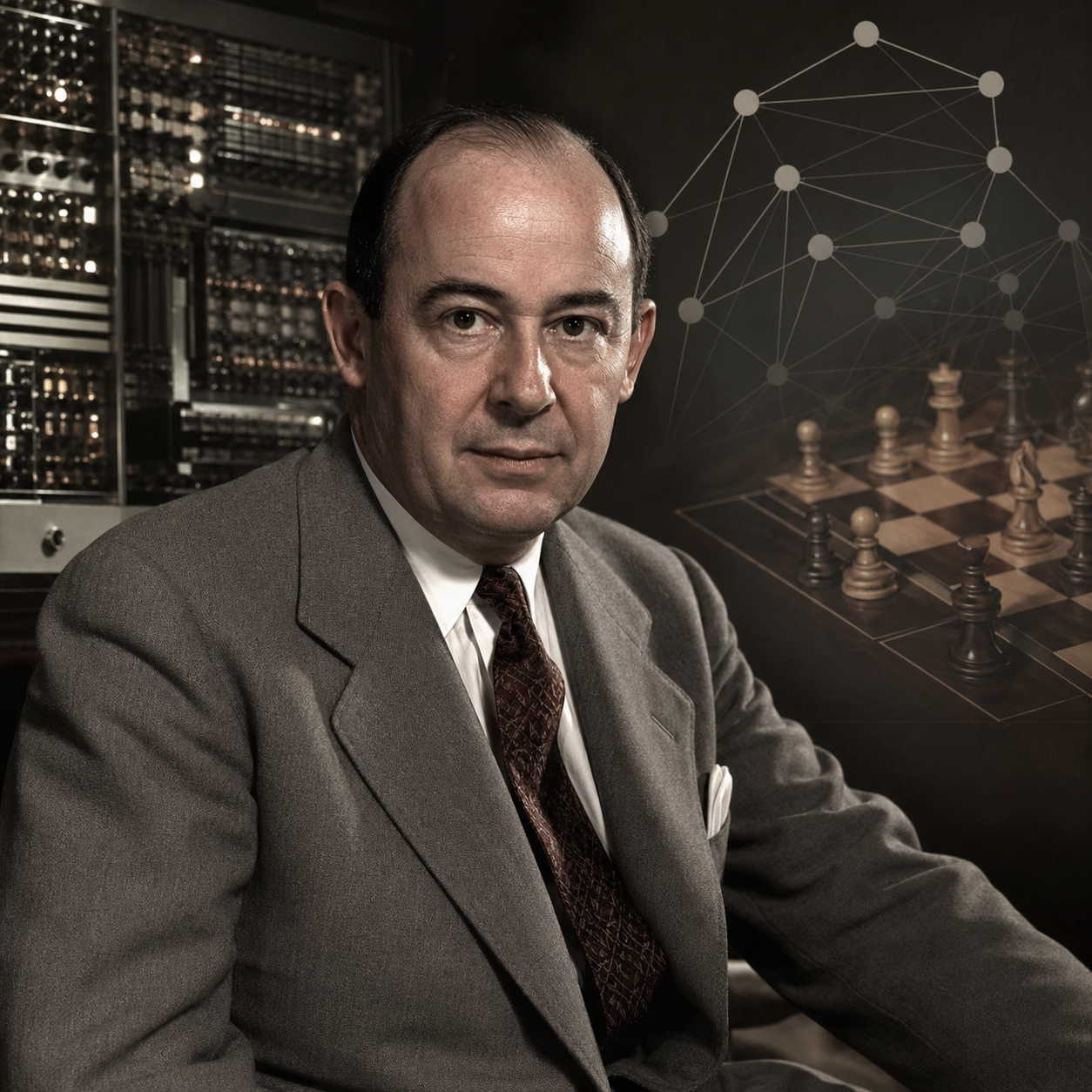
John von Neumann — "The world is not a game, but it has rules."
The world is not a game, but it has rules.
The world is not a game, but it has rules.
Click any product to generate a realistic preview. Up to 3 at a time.
* Initial load can take up to 90 seconds — revising the preview in another color is nearly instant.
"The only way to understand a system is to build it."
"The computer is the only machine that can be taught to do anything."
"I'm told that the only difference between a mathematician and a physicist is that a mathematician thinks about mathematics and a physicist thinks about physics. And a physicist is always trying to get…"
"Anyone who attempts to generate random numbers by deterministic means is, of course, living in a state of sin."
"As far as I'm concerned, the two most important things in life are mathematics and sex."
Found in 1 providers: grok
1 source checked
Reality is serious and consequential — not a pastime you can quit — but it's not random either. Beneath the chaos of human events, economics, and nature lie consistent, discoverable rules. Identify and master those rules and you gain real leverage over outcomes. It's a call to intellectual rigor: stop treating life as arbitrary or playful, and start mapping its actual structure so you can act within it effectively.
Von Neumann literally invented game theory with Morgenstern in 1944, formalizing how rational actors navigate strategic competition. Yet he understood games as simplified models — real life had higher stakes. His work on the Manhattan Project, MAD nuclear doctrine, and EDVAC computer architecture all reflected his belief that reality obeys mathematical law. He treated every domain — physics, economics, computation — as a rule-governed system awaiting formalization. This quote captures his defining intellectual premise.
Von Neumann worked through the 1930s–1950s, when two World Wars and the atomic bomb shattered any idea that civilization was self-regulating. The Cold War demanded new frameworks: deterrence theory, international law, economic modeling. His era was desperate for structure — proof that geopolitics, warfare, and markets followed discoverable logic rather than brute chaos. Game theory emerged directly from this need, offering mathematical rules for the most dangerous human competitions imaginable.
AI-generated insights based on extensive research and information for context. Factual errors? Email [email protected].
Your cart is empty